

 From
From 1,400-year-old hoard of pure gold coins uncovered in the Galilee
 Add ToI as a Preferred Source on Google
Rossella Tercatin is The Times of Israel's archaeology and religions reporter.
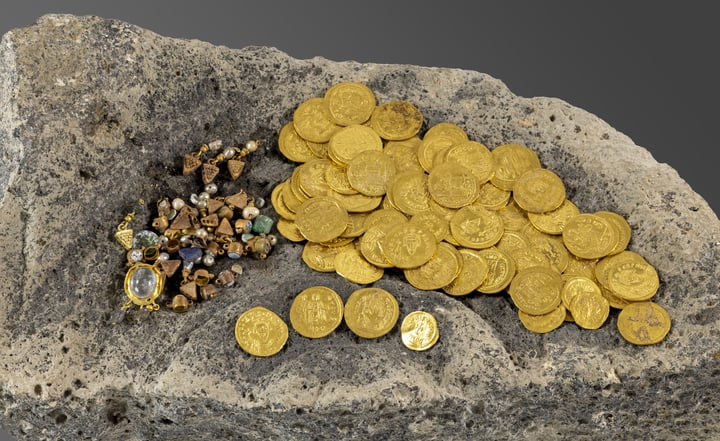
A magnificent hoard of 97 pure gold coins dating back to the 6th and 7th centuries CE has been discovered during archaeological excavations in the ancient city of Hippos (Sussita), near the Sea of Galilee, the University of Haifa says.
The hoard also includes dozens of fragments of gold jewelry inlaid with pearls, semi-precious stones, and glass.
“This is one of the largest hoards from the Byzantine period discovered on dry land in Israel, and its uniqueness lies in the combination of jewelry and gold coins from the reigns of different emperors,” expedition co-director Dr. Michael Eisenberg of the Zinman Institute of Archaeology and the Department of Archaeology at the University of Haifa says in a statement.
“Remnants of fabric were found on some of the coins — a trace of the cloth pouch in which the hoard had been hidden,” he adds.
The treasure was first uncovered during excavations in July.
The earliest coins date from the reign of Emperor Justin I (518–527 CE), the latest to the early reign of Emperor Heraclius (610–613 CE).
Founded by the Greek Seleucids on the eastern shore of the Sea of Galilee in the 2nd century BCE, during the Byzantine period (330 CE-636 CE), Hippos became an important Christian town with at least seven active churches. It endured even after the Arab conquest in the 7th century, until a devastating earthquake in 749 CE leveled the city, which was then permanently abandoned.
Archaeologists believe it may have been buried in the period leading up to the Sasanian-Persian conquest of 614 CE. Although the Byzantines briefly regained control about 15 years later, the hoard remained hidden underground.
“Gold is a noble metal, and when you find coins and jewelry nearly 1,400 years old that look new, it is a rare experience,” Eisenberg says.










The Times of Israel Community.