

 From the Liveblog of
Wednesday, August 6, 2014
From the Liveblog of
Wednesday, August 6, 2014
Anger at Hamas, shock among Rafah residents
 Add ToI as a Preferred Source on Google
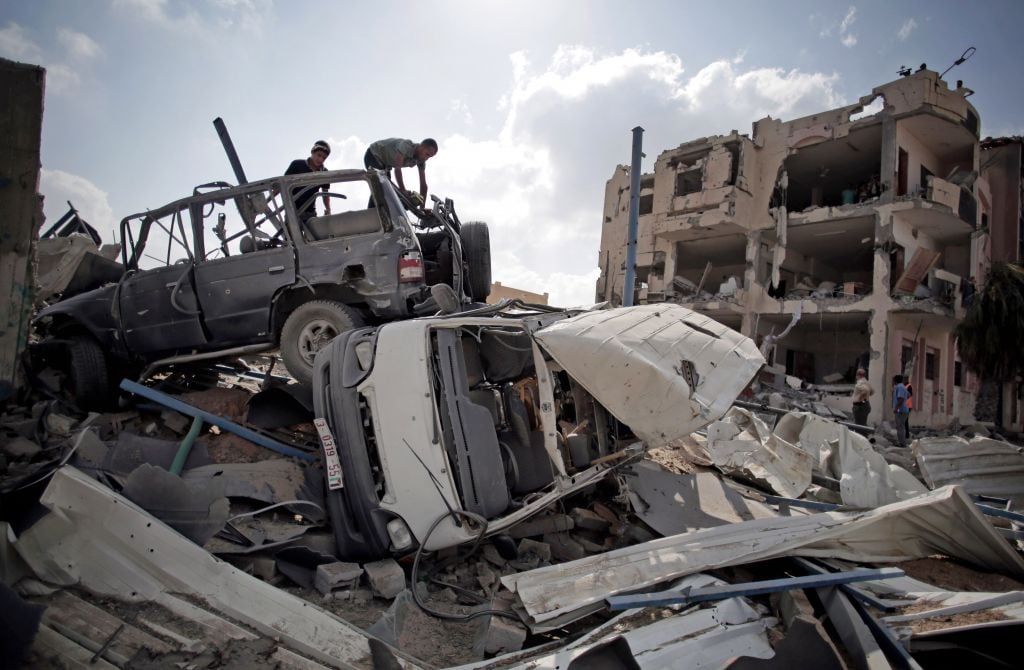
Residents of Rafah returning to their homes express shock at the damage, and some not-so-concealed frustration at Hamas, according to an AP report.
Asmahan Ismail Abu al-Rous started wondering a year ago about the cause of the cracks on the walls of her Gaza home. When she asked some of her more savvy neighbors, they told her: Militants were digging an attack tunnel not far away.
“I did not think much about it then. I thought that was the resistance’s business, not mine,” the widowed mother of four says, standing amid the ruins of her two-story home in the Shawkah district, an eastern section of Rafah near Gaza’s border with Egypt.
Abu al-Rous sits outside, saying little to one of her sons, Fady, who also came to check on the house, which she estimated was worth about $200,000.
But her anger and frustration are just below the surface. One of several teenagers casually asks her whether she knew where the attack had taken place.
“I don’t know,” she snaps. “Those who carried out the attack should tell you.”
Barely 50 meters (yards) away, according to villagers, is an entrance of the tunnel where Hamas fighters emerged Friday to attack Israeli soldiers. Two Israelis were killed and a third was initially believed to be captured by the militants.
“I never saw anything like that in my life,” says Tawfiq Barbakh, a 67-year-old father of 12, as he surveyed his badly damaged home. “I don’t know how many shells landed every minute, but it felt like 20 or 30. It was like the gates of hell opened on us.”
“I saw death with my own eyes,” says resident Khalil Barbakh. “There were dead bodies on the streets, the wounded screaming and people running away from the shelling.”
The destruction and suffering in Rafah have lent themselves to heated discussions about the war and its consequences. A group of men sat in the Shawkah district not far from Abu Louli’s house to smoke and drink sweet black tea.
“The Israelis have hit us really hard this time. They destroyed us,” says one man.
“I am convinced that no one dies before his time,” replies another.
“Arab nations never came to our rescue,” says the first man. “They are all preoccupied with their problems — Egypt, Libya, Syria and Iraq.”
The second man retorts: “They should take fighting lessons from us.”
A group of younger men then joins the mostly older group.
One of the new arrivals interjects sarcastically: “We have defeated the occupation, thanks be to God.”
— AP contributed to this report









The Times of Israel Community.