

 From the Liveblog of
Friday, April 5, 2024
From the Liveblog of
Friday, April 5, 2024
US envoy says Oct. 7 upended normalization plans, but insists deal is still possible
 Add ToI as a Preferred Source on Google
Jacob Magid is The Times of Israel's US bureau chief
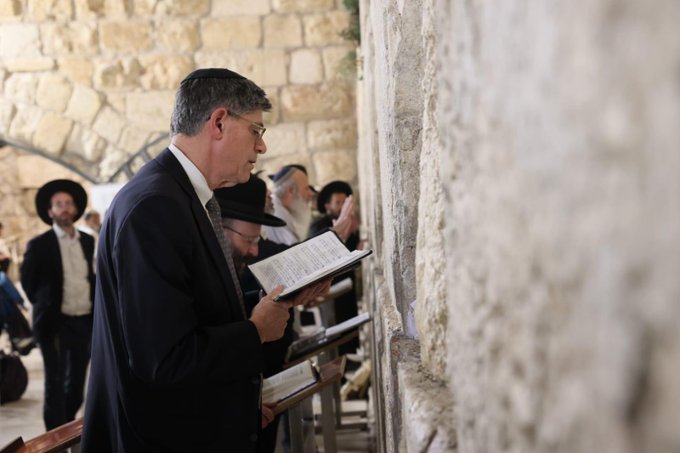
US Ambassador to Israel Jack Lew says he thought when US President Joe Biden nominated him for the post in September that he would be coming to Jerusalem to help pull an Israel-Saudi normalization deal across the finish line.
Lew was still in the US when Hamas’s October 7 terror onslaught unfolded, having not yet been confirmed.
Being an observant Jew, he tells the Yedioth Ahronoth daily that he didn’t find out about the attack right away.
While attending morning services for the Simhat Torah holiday, a fellow congregant approached Lew and told him that war had broken out in Israel.
He didn’t immediately understand what the man met, but Lew says he later heard the news from his daughter who lives in Israel — a detail that wasn’t widely known.
“As soon as I heard the news, without knowing all the details, I had a flashback to 1973, the Yom Kippur War. That was the last time I heard about a war in Israel that broke out on a holy day when I myself was in a synagogue,” Lew recalls.
“There was a sense of existential risk that felt very real,” Lew says of his emotions on October 7.
Acknowledging that his plans were upended by the Hamas attack, the ambassador says his goal is to overcome the crisis and return to the original path. “That is why I decided to take on this position in the first place,” he says of a potential Saudi-Israel normalization deal.
“To come out of this period of terrible darkness, there must be a vision of something better, sustainable, stable and safer for Israel and the region,” Lew says.
He insists that the “window is still open” for a deal, though, “It will become more challenging as time goes by,” as Riyadh intensifies its criticism of Israel’s prosecution of the war and comes under more pressure domestically and regionally not to ink a normalization agreement with Jerusalem following such a bloody conflict.
“It will become more challenging as time goes by, but I am of the opinion that if this was the strategic interest of the US, Saudi Arabia and Israel on October 6, it is the strategic interest of all three parties now as well,” Lew tells Yedioth, recognizing that a deal is far more challenging post-October 7.
He confirms that any deal will require Israel to agree to create a pathway to a future Palestinian state while reiterating that one would not be established immediately.
“We must enter a process where, beyond the horizon, this ambition must be realized,” Lew says.
The ambassador argues that a deal with Saudi Arabia would provide Israel with more regional stability and would also amount to a defeat for Hamas. “I’m not saying this was the reason for the attack in October, but it contributed to their sense of urgency that there is progress on this issue.”
Clarifying that the US only supports the creation of a demilitarized Palestinian state, Lew says he recognizes that opposition to the idea in Israel is still widespread.
“But I think there is a thirst for normalization with Saudi Arabia, and there is a strong desire for a better future than what led to October 7,” the US envoy continues. “The question is whether there is a process that will deal with the issues themselves so that Israel will receive the security it deserves and needs and so the Palestinian people will have a future that gives them something to live for, instead of something to die for.”
The ambassador implores Israel to begin having serious discussions regarding its plans for the post-war management of Gaza.
He says there has been considerable discourse regarding what the two-state framework can look like after October 7, but insists that it must “have some legitimacy among the Palestinian people and the Arab world.”









The Times of Israel Community.