

Police arrest 5 over Jaffa protests against construction plan on Muslim site
Two boys arrested for torching trash cans during unrest, 2 others apprehended for throwing rocks at arresting cops; another accused of pointing laser at police chopper
 Add ToI as a Preferred Source on Google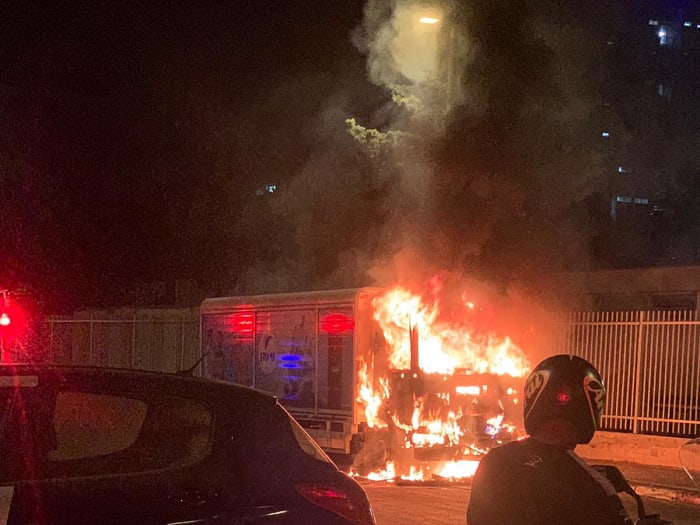
Five residents of Jaffa were arrested over the weekend following protests there over plans to build a homeless shelter on land discovered to be an old Muslim burial ground.
Police late Saturday arrested two boys, aged 13 and 15, suspected of setting a dumpster on fire. Equipment to start a fire was found in their possession, police said.
Two other men, men aged 19 and 21, were arrested on suspicion of throwing rocks at the officers who arrested the two boys. No police were injured in the incident.
In a separate incident in Jaffa, police said they had arrested a 23-year-old man over the weekend for aiming a laser beam at the pilot of a police chopper, thus “endangering the helicopter’s operation and disturbing police activity.”
Police said that incident occurred on Tuesday, and the suspect had been supposed to be in house arrest at the time of the incident. His remand was extended until Sunday, when he was scheduled to attend another remand hearing.
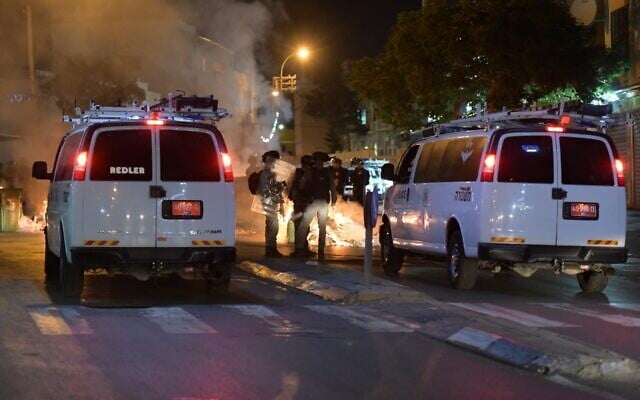
A number of vehicles were torched over the weekend and a firebomb was thrown at a Tel Aviv-Jaffa municipality building as unrest continued.
The municipality issued a statement condemning the attack, saying that “the perpetrators of these acts were part of a small group that does not represent most of the residents of Jaffa, who have a great deal of trust in the municipality.” The city said these acts would not affect plans to build the homeless shelter, which would go ahead “as the court has approved.”
The US Embassy on Saturday issued a security alert for Jaffa, a predominantly Arab city that is part of the Tel Aviv municipality.
“Protests continue this evening near the Clock Tower and throughout the city of Jaffa. Protests may turn violent to include vandalism, rock-throwing, burning of tires, vehicles, and fire bombs. Embassy personnel have been advised to maintain situational awareness and avoid the area tonight,” a statement on the embassy’s website said.
It added: “The Embassy strongly encourages US citizens to remain vigilant and take appropriate steps to increase their security awareness, as security incidents often take place without warning.”
MK Mansour Abbas of the majority-Arab Joint List visited the site on Saturday evening, saying “holy sites are of utmost religious value, necessitating a course correction by Mayor Ron Huldai.”
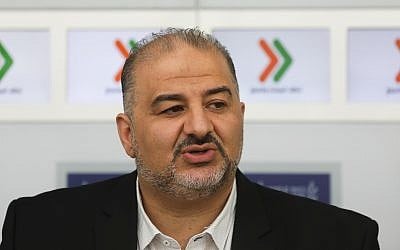
He added that a solution was possible “that will end tensions over the cemetery.”
The weekend protest was the third last week. On Wednesday, dozens of protesters took to the streets in Jaffa, clashing with police, setting trash cans on fire and throwing stones at officers. Four people were arrested in that protest.
The demonstrations were smaller than those that erupted Tuesday when some 300 protesters clashed with police. A video released by police showed a Tel Aviv city bus with shattered windows stopped by the side of the road and riot police using stun grenades to disperse the rioters near Jaffa’s iconic clock tower. Police said the demonstrators also burned trash cans and some cars. Some reports said the violence started when police blocked the marchers and tried to disperse them with force.
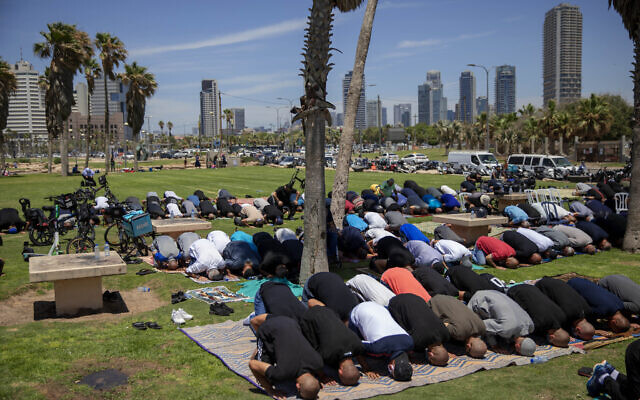
The dispute is over a site, known in Arabic as Maqbarat al-Is’aaf, Tel Aviv’s only known Muslim graveyard. According to court filings, the cemetery had gone unnoticed for many years before the Tel Aviv Development Fund decided to demolish an Ottoman-era one-story home that the nonprofit Gagon was using as an improvised homeless shelter.
Litigants fought in court for over a year over whether the planned demolition would go forward; the city hoped to build a new and improved three-story shelter in place of the old one.
Once bulldozers demolished the house, though, the bones of at least 30 people were discovered to have been buried in the structure. The Israel Antiquities Authority determined that the cemetery contained bones from the Ottoman period all the way back to the Hellenistic period. The Islamic Council built tombstones over each of the graves.
Negotiations between the Council and the city over the site proved unsuccessful. The High Court of Justice subsequently ordered the construction halted so the matter could be adjudicated in court.
The battle ended in January 2020, when a Tel Aviv court rejected the Islamic Council’s attempts to preserve the space. Judge Avigayil Cohen stated in her decision that the cemetery had not been used by the community for at least 100 years, and had been a public space since at least the 1940s without any legal objections. Moreover, none of the plaintiffs could claim a personal or familial connection to the remains.
“The project’s construction is a response to public need, and uses land that has not be used as a cemetery for over 100 years, and the Muslim community never before treated it as possessing holiness or having a religious affinity,” Cohen wrote.
“The Muslim community in Jaffa in general and all of the city’s residents have no problem with the homeless project, and it’s appropriate to find a physical location for it, but not over a Muslim cemetery,” Tel Aviv city council member Amir Badran told the Haaretz daily.




The Times of Israel Community.