

The muddle east
From Mizrahi heritage to Assad’s rule to African migrants under threat to North Korea tensions, Israeli papers take a break from their normal Western focus
 Add ToI as a Preferred Source on Google
Joshua Davidovich is The Times of Israel's Deputy Editor
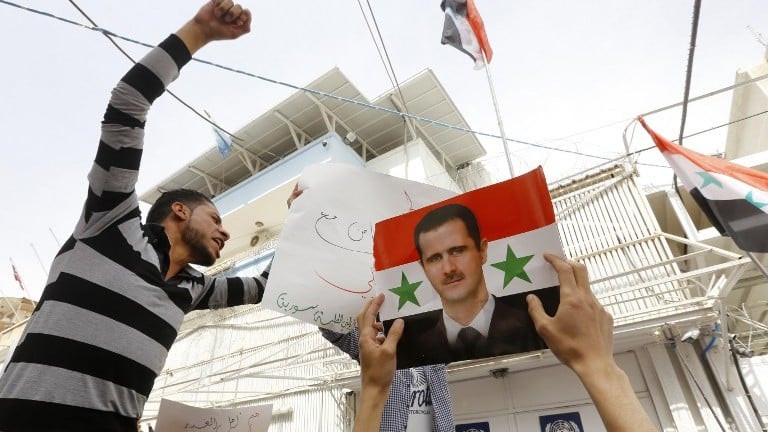
While Israel normally takes its cues from the West, there’s a focus on looking south and east on the front pages of the Hebrew dailies Wednesday morning, though papers are far from in agreement on what the top story is. The result in a slurry of news such as followup on an Israeli court decision that allows deporting but limits jailing of undocumented African migrants, a school program that will see kids learning more about Jewish heritage from the Middle East and North Africa, and an Israeli assessment that Syrian President Bashar Assad will be back in the driver’s seat over most of his country within a year.
That last story comes from Israel Hayom, which emblazons much of its front page with the news. The story cites an assessment from the defense establishment, which recognizes that gains made thanks to friends of the Syrian regime and a lack of American support for their enemies mean Assad no longer needs to worry about being out on his rump state.
“In the past, the general outlook of the defense establishment was that Syria will not return to how it was before civil war broke out in 2011 and the defense brass has assumed Syria would break apart into a series of autonomous zones based on geography and ethnic makeup,” the paper reports, adding in a dig at former defense minister Ehud Barak, who predicted in 2012 that Assad would be gone within six months.
Assad may not be history, but the Jews of Syria certainly are and thanks to a new program in Israeli schools, children will now learn more about them and other Jews who hail from Arab or Muslim lands, according to Yedioth Ahronoth’s front page.
The list of subjects includes the Damascus affair pogrom, the Jewish revolt in Iraq, oriental rabbinical culture, the Bukharim and Mughrabi quarters, Rabbi Ovadiah Yosef, Ethiopian Jewry, the story of Yemen’s Rabbi Shalom Shabazi, development towns, the expulsion of Jews from Egypt, the Holocaust for North African Jews and more.
“The time has come to reveal Mizrahi Jewish culture and show its beauty, richness and heritage after so many years of silence and ignorance,” the paper quotes Dr. Yehuda Amar, original from Yemen, who will go around to schools lecturing as a real-life Yemenite Jew.
While Jews from Africa are seeing their stature raised, non-Jews from the same continent have less to be happy about, with Haaretz’s lead story reporting that the government is looking at ways to keep migrants who refuse to be deported in prison despite a court ruling that they have to be freed after 60 days.
“Since the court’s ruling was announced on Monday, Interior Minister Arye Deri has been consulting with the Population Authority’s legal department to move ahead with the amendment to permit such detention. He reportedly has the backing of Prime Minister Benjamin Netanyahu and Justice Minister Ayelet Shaked,” the paper reports.
The broadsheet’s lead editorial also goes after Shaked for her attack on the court in the wake of the ruling.
“The very person who is supposed to defend the court was the one who spoke out in a way that should trouble any citizen who wants to live in a democratic country,” the editorial reads. “With a combination of ignorance and manipulativeness, Shaked has had the gall to harness ‘Zionism’ for her own purposes by claiming that a contradiction exists between Zionism and universal human rights. In other words, Israel should violate human rights in the name of Zionism. In Shaked’s view, Zionism is nothing but a euphemism for racism or nationalism.”
Papers also look even farther east, playing up reports of tensions ramping up again after North Korea test fired a missile over Japan, with journalists perhaps gunning for another trip to Guam.
In the meantime, Israel Hayom makes do with talking to an Israeli in Japan, who says the rocket alarm made him feel like he was back in the Middle East instead of the Far East.
“For many of the Japanese, it was there first time hearing a rocket alarm of this kind. Everyone turned on the TV and then saw what was going on. It was clear for them it was a dramatic event,” Yonatan Oz, vacationing in Japan, tells the paper. “After all, the atom bombs dropped on Hiroshima and Nagasaki are an inseparable part of the history of Japan, and people are really feeling threatened by this.”
In Yedioth, Nahum Barnea uses the benefit of distance to take a more analytical view of the rising tensions and predicts war between Washington and Pyongyang is not in the offing.
“Experts say it’s not the personalities of the leaders but the geopolitical conditions on the ground that will determine what happens — and could keep war from actually happening. Even yesterday the South Korean president Moon Jai-in threw cold water on the bonfire of ‘all options are on the table’ set by Donald Trump,” he writes. “So why isn’t war expected? Because neither side has a realistic chance of winning, and both sides see mostly large risks and massive damage. Trump is correct when he says that North Korea ‘made its intentions clear’ when it shot the rocket over Japan. Kim [Jong-Un] indeed doesn’t intend to cave to American pressure. On the other hand, Trump can possibly threaten, but he has very few options to carry out those threats and the military options he holds are close to zero.”




The Times of Israel Community.