

IDF’s West Bank chief claims illegal settler farming outposts ‘greatly strengthen security’
Avi Bluth tells residents of wildcat communes — which critics say have become ground zero for violent extremists and a tool for dispossession of Palestinian lands — that he loves them
 Add ToI as a Preferred Source on Google
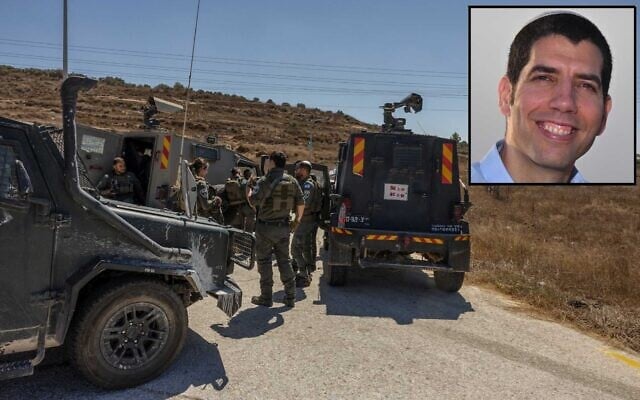
The Israeli army general responsible for the West Bank said Wednesday that illegal farming outposts in the West Bank — which have been linked to widespread violence against Palestinians — “greatly strengthen security” in the territory.
Speaking at a conference organized by the so-called Farm Union, Central Command chief Maj. Gen. Avi Bluth said that the settlement farms “align well with the security concept. It does not contradict it.”
The remarks demonstrate the extent to which the IDF — particularly since Bluth took over the Central Command in 2024 — is aligned with the settlement movement, despite mounting concerns by critics of the ties that the farming outposts in particular have had to violence against neighboring Palestinian communities.
Bluth, however, insisted that the farming outposts are “integrated” into the IDF’s security framework, so long as they maintain “ethical conduct, and operate in accordance with the law.”
Given that all farming outposts are built without the necessary permits and approvals, it’s unclear how Bluth determines which of them are nevertheless deemed to be operating “in accordance with the law.”
But his stance does appear to be an extension of the policies of Prime Minister Benjamin Netanyahu’s hardline government, which has either turned a blind eye to the establishment of over 150 illegal outposts or actively funded them, while also working to retroactively legalize them.
אבי בלוט בפורם הביטחון של איגוד החוות
"אנחנו משנים תפיסה: החוות החקלאיות הן חלק מתפיסת הביטחון של פיקוד המרכז. הן מחזקות את הביטחון במרחב. אני מאמין באנשי החוות, מעריך את עשייתם ורואה בהם שותפים משמעותיים לביטחון." pic.twitter.com/YC89zqVtc3— ינון מגל Yinon Magal (@YinonMagal) July 15, 2026
“All of this greatly strengthens security,” Bluth said. “I have great faith in the people here. I look each and every one of you straight in the eye. I love you, I appreciate you, and I appreciate what you do.”
Bluth — a settler himself — is the latest in a long line of Central Command heads who have sought to build strong ties to the settler leadership, including some of its most extreme elements, as the IDF believes that they are necessary to maintain order and security in the West Bank.
But ties eventually frayed between hardline settler leaders and many of Bluth’s predecessors when they tried to crack down on settler violence.
Bluth has also spoken out against what he had dubbed “Jewish terrorism,” but critics say his policies have allowed it to reach unprecedented levels, given that many of the attacks on Palestinians are perpetrated by residents of farming outposts.
Read how an entire system is designed to impose a messianic vision on Israelis, at the expense of the vast majority who never chose it.
Read the full report: https://t.co/NJOzKFLGU5 See less pic.twitter.com/tcOEJD97xE— Peace Now (@peacenowisrael) July 15, 2026
The farming outposts have become a preferred tool for settler leaders in recent years, as they allow for the takeover of large swaths of land throughout the West Bank. They only require a small number of young settlers who use livestock grazing to clear areas of Palestinians.
According to the Peace Now settlement watchdog, 118 Palestinian communities have been displaced after coming under repeated attacks and harassment by residents of the 120 farming outposts that have been established in the nearly three years since Hamas’s October 7 terror onslaught.
While some of the outposts are established on what is defined as state land, others are found to be located on private Palestinian land. Those behind them have also moved to establish outposts in Areas A and B of the West Bank, which are supposed to be under the control of the Palestinian Authority.
Despite their illegal establishment, Netanyahu’s government has provided the outposts with security equipment and subsidies for raising livestock. Government-supplied ATVs have been spotted in repeated attacks by settlers on Palestinians and solidarity activists trying to protect them.
Haaretz revealed earlier this month that the Israeli government is providing an NIS 4 million ($1.3 million) grant to a nonprofit organization operating in illegal West Bank settlement outposts that was sanctioned by six Western countries last month.









The Times of Israel Community.