

The Trumperfly effect
The US president’s moves (or lack thereof) ripple into Israel, allowing for the reheating of the controversial outpost bill and catching Jews born in Muslim countries in the US visa ban net
Joshua Davidovich is The Times of Israel's Deputy Editor
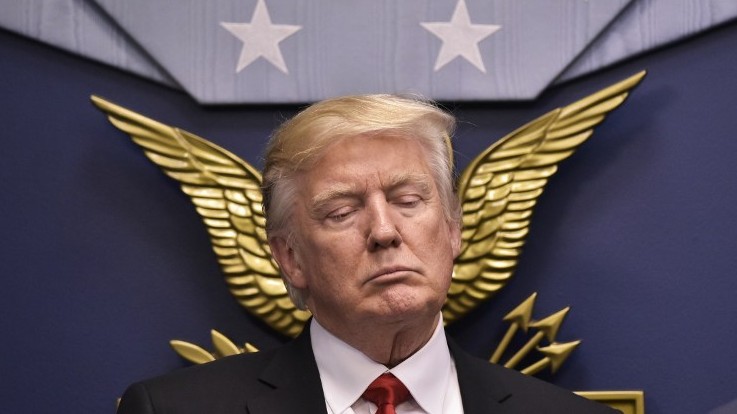
The “again” in US President Donald Trump’s Make America Great Again slogan overtly implies a return to an earlier time, a time — it’s increasingly becoming clear – when groups were marginalized in the interest of “putting America first.”
But it’s not just among the purple mountain majesties and amber waves of grain that a rewind is happening. In Israel, as well, a controversial law that will essentially legalize wildcat outposts in the West Bank is making a comeback, thanks to that selfsame Donald Trump, whose tacit support (or at least lack of condemnation) makes possible such a move, after it was frozen during the waning days of the Barack Obama administration.
The return of the so-called outpost bill is high on the Israeli news agenda Monday morning, as the Knesset is expected to vote it into law after Prime Minister Benjamin Netanyahu ordered it back on the legislative slate.
Haaretz leads with the news and reports that the opposition, with 220 objections filed, plans to filibuster the measure, which could lead to its further delay. As for the original delay when the measure was frozen last month, Haaretz quotes an unnamed Likud minister saying that was Netanyahu plan’s all along when he put the brakes on in December.
“That’s what was agreed from the start. The plan was that the law would be advanced after the Obama era if no other arrangement for this issue could be found,” the minister is quoted saying.
Another Likud source is quoted by the paper saying that Netanyahu’s support only extends as far as it can win him some credibility on the settler street.
“It was clear all along that despite Netanyahu’s objections to the law, he couldn’t allow himself to obstruct its progress and be perceived by right-wing voters as the one who blocked the measure. Netanyahu simply didn’t want to give this gift to [Education Minister Naftali] Bennett and upgrade the status of Habayit Hayehudi as the primary fighter for the settlements, as opposed to Likud and Yisrael Beiteinu. The prime minister would prefer to be portrayed among his voters as supporting the law, while turning the final decision on its validity over to the High Court of Justice.”
The court shooting it down seems a foregone conclusion given the objections of Attorney General Avichai Mandelblit, but as for the doomed outpost of Amona — the original raison detre for the bill, though it’s not one of the 16 outposts that may be saved by the measure — Israel Hayom reports that the government lawyer is prepared to defend any deal with the settlers there. That comes after they reiterated in a letter they are prepared to move off the land peacefully, though the paper notes that “it’s not clear if most Amona residents stand behind the letter.”
With any deal seemingly off the table, though, the paper previews a “day of rage” planned by the settler leadership against the evacuation (taking a page out of the Hamas playbook), which will include a strike and a protest in Jerusalem next week.
Despite the many misgivings about the law, Yedioth commentator Shlomo Pyoterkovsky calls it “a borderline miracle” even without saving Amona.
“The law’s first and foremost a law that does justice. It does justice to the Jewish residents, who will for the first time receive legal standing as any people in the land they were born in. The law will also seemingly do justice with Palestinian landowners,” he claims. “They will for the first time have a pathway to get [the compensation] coming to them without worrying about a death sentence, official or de facto, from the Palestinian Authority and other factions.”
The issue of rights and the land people were born in also plays heavily into Yedioth Ahronoth’s attempt to localize Trump’s immigration ban by noting that Israelis born in certain countries could be denied entry into the US, no matter the fact that they no longer live there.
The paper notes that up to hundreds of thousands of Israelis born in Iraq, Iran, Yemen, Libya and Syria could be swept up by the order.
“I recommend Israelis like this not to travel to the US anytime soon, until it becomes clear who is against who here and it’s all cleared up,” a lawyer specializing in US visa law is quoted saying.
The story misses the point of the ban’s targeting of Muslims as much as a statement on Holocaust remembrance that omits Jews might miss the point, though it pretty much places the foibles and failings of the move in a nutshell. And while Jews might not be the main ones being banned, they are among those protesting the order, writes Yedioth analyst Ben-Dror Yemini.
“Jews are a nation of migrants. Jews suffered from the closing of the gates. No, this isn’t the same thing. But even symbolic steps have importance. Immigration policies can change. The desire to carry out checks is justified. But Trump’s order won’t fix the problem, and there is a problem, both from the needless discrimination and also when racism against Muslims spreads,” he writes.
Trump toady Israel Hayom tries to put a positive spin on the immigration order with a front page headline crowing that 48% of Americans support the visa ban. What the paper fails to mention – as did Fox News, which Israel Hayom falsely cites for commissioning the Quinnipiac University poll when all it did was report on it – is that the poll was released on January 12, before Trump was even president, and presented a hypothetical “suspension of immigration from terror prone regions.”
In Haaretz, Zvi Bar’el questions whether the order will do anything to protect Americans and instead sees it through the lens of Trump attempting to shift American policy vis-à-vis Syria by keeping Syrian refugees in Syria, both by setting up safe zones and stemming immigration.
“Trump wants to present a solution that will drop Syria from the world’s agenda,” he writes. “In other words, if there won’t be a refugee problem there also won’t be a need for a military or diplomatic strategy regarding Syria. And this is the type of solution that Trump prefers, stroke-of-an-ax solutions, here’s a wall, there are the safe zones, closing the gates, just sign and continue on your way.”








The Times of Israel Community.