

Tiny 2,600-year-old clay sealing inscribed with biblical name found in Temple Mount soil
Minuscule artifact discovered at the Jerusalem-based Temple Mount Sifting Project may reference an official who worked for King Josiah and who appears in II Kings and II Chronicles
 Add ToI as a Preferred Source on Google
Rossella Tercatin is The Times of Israel's archaeology and religions reporter.
![Temple Mount Sifting Project archaeologist Mordechai Ehrlich holds a First Temple period clay sealing reading “Yed[a‛]yah (son of) Asayahu” found in July 2025. (Temple Mount Sifting Project)](https://static-cdn.toi-media.com/www/uploads/2025/07/MORDECHAI-EHRLICH.jpeg "Temple Mount Sifting Project archaeologist Mordechai Ehrlich holds a First Temple period clay sealing reading “Yed[a‛]yah (son of) Asayahu” found in July 2025. (Temple Mount Sifting Project)")
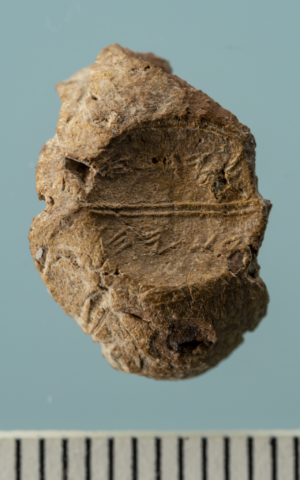
A clay seal from the First Temple period bearing a Hebrew name that appears in the Bible has been uncovered by archaeologists at the Temple Mount Sifting Project in Jerusalem, the organization announced on Tuesday.
The tiny artifact carries an inscription in Paleo-Hebrew reading “Belonging to Yed[a‛]yah (son of) Asayahu.”
“This is only the second time since the Temple Mount Sifting Project began over 20 years ago that we’ve uncovered a sealing with such a complete inscription — nearly every letter is clearly legible,” said archaeologist Zachi Dvira, who co-directs the project alongside Dr. Gabriel Barkay.
“We usually do not go public with new finds so quickly,” he told The Times of Israel over the phone of the sealing, which was spotted this month. “However, in this case, the artifact was very recognizable, and Dr. Anat Mendel-Geberovich, who works in our lab, is one of the leading experts in ancient Hebrew script. So we decided to move forward, also because we felt it was very significant that the sealing was found just before Tisha B’Av.”
Tisha B’Av, a Jewish day of mourning which this year falls on Sunday, marks the anniversary of the destruction of both the First Temple at the hands of the Babylonians in 586 BCE and the Second Temple at the hands of the Romans in 70 CE.
Based on the writing style, the researchers dated the sealing to the 7th or 6th century BCE.
The name Asaya appears in the Bible several times in the context of the kingdom of Josiah, the 16th king of Judah who reigned in the second half of the 7th century BCE.
“The king gave orders to Hilkiah, and Ahikam son of Shaphan, and Abdon son of Micah, and the scribe Shaphan, and Asaya, servant of the king,” reads II Chronicles 34:20.
The same story appears almost exactly in II Kings 22:12, “And the king gave orders to the priest Hilkiah, and to Ahikam son of Shaphan, Achbor son of Michaiah, the scribe Shaphan, and Asaya the king’s minister.”
The version of the name inscribed on the sealing, “Asayahu” contains an extra letter Vav, a type of suffix that was often added to ancient Hebrew names to testify to their connection with God (Y-H-V-H).
“The name Asayahu also appears on another clay sealing with the words ‘servant to the king,’ that was identified some 20 years ago,” he added. “However, since the artifact came from the antiquity market, and not from an archaeological context, it is more difficult to be sure of its authenticity.”
During the First Temple period, clay impressions, also known by their Latin name bullae, were used for the management of storehouses.
Dozens of such clay sealings have been unearthed in Jerusalem, at times carrying names that also appear in the Bible.
“Obviously, we are not sure that the Asayahu mentioned on the sealing is the same that appears in the Bible,” said Dvira. “However, several such artifacts found in the area of the Temple Mount carry biblical names, and it does make sense, because these were not objects used by common people.”
In ancient times, the lumps of clay were pressed over the knot of a cord securing a doorknob or a vessel. The manager of a treasury would then impress his, or his superior’s, seal upon the clay to prevent others from tampering.
Dvira explained that both the Temple and the royal treasuries stood in the area of the Temple Mount in biblical times.
“The owner of this seal was one of the administrators of the storages on the Temple Mount,” he said. “We cannot say if it’s the Temple treasury or the royal treasury.”
In light of its sensitive nature as a holy site for Jews and Muslims, who call it the Noble Sanctuary or Haram al-Sharif, no archaeological excavation can be conducted on the Temple Mount, which is managed by the Islamic Waqf (religious trust).
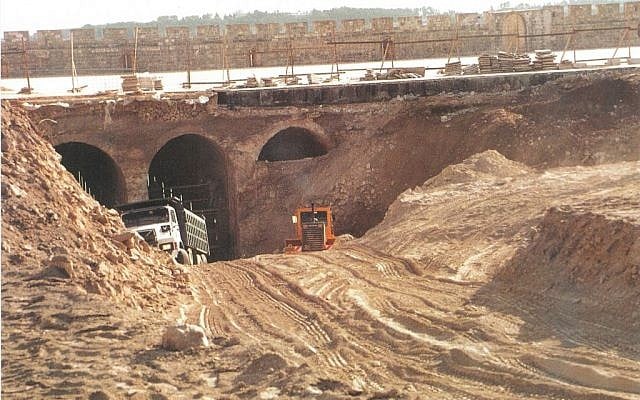
However, between 1996 and 1999, the Northern Branch of the Islamic Movement illegally conducted a large-scale construction project to build a subterranean mosque in an area colloquially called Solomon’s Stables.
The seeds of the Sifting Project took root then, after Barkay and Dvira salvaged some 9,000 tons of dirt from the construction site that had been dumped into the Kidron Valley.
From 2005 until 2017, the Sifting Project was housed at a facility administered by the City of David.
After a two-year hiatus, the sifting operations moved to the Mitspe Hamasuot (Hamasuot Lookout) site on Mount Scopus under the auspices of the Mount of Olives Ridge Jewish Communal Development Fund and supported by the New York-based American Friends of Beit Orot. The group describes its mission as “preserving the historic and spiritual heritage of Jewish Jerusalem by supporting activities in the Beit Orot area,” and creating “a vibrant and enduring Jewish presence in Jerusalem.”
The Project operates under the academic sponsorship of Bar-Ilan University’s Institute of Archaeology. Over the years, more than half a million finds, including coins, jewelry, clay artifacts, and charred animal bones, have been retrieved by some 260,000 volunteers from Israel and across the world who carefully sifted through buckets of dirt.
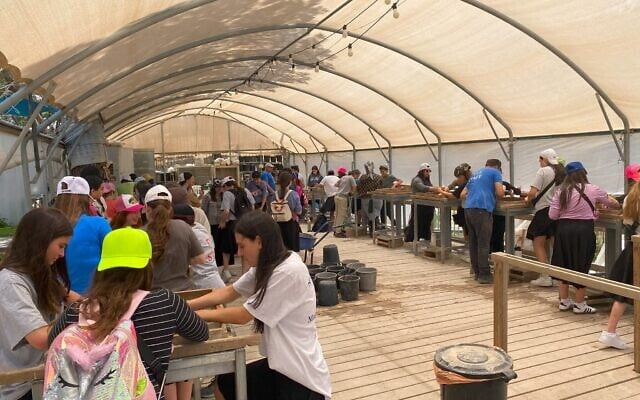
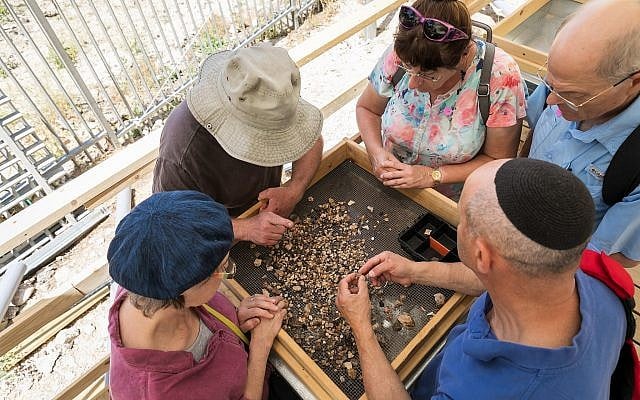
After the visitors sift through the soil, they sort relevant findings in different categories with the help of the Sifting Project staff, separating bones and pottery (the most common finds), glass, coins, and more, and placing them in different containers that a professional archaeologist later examines.
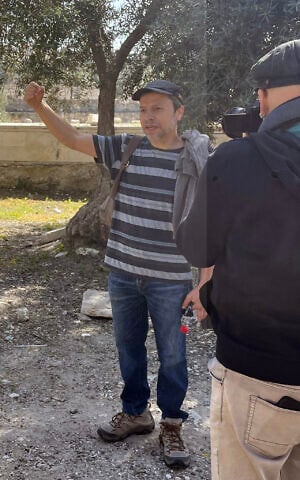
It was as he examined one such container, collecting bones sifted around two years ago, that archaeologist Mordechai Ehrlich identified the tiny Asayahu bulla.
“The artifact looked like a bone and had the color of a bone, but [Ehrlich] realized it was a clay object, and there was an inscription on it,” Dvira said.
To decipher the bulla, the researchers used special Reflectance Transformation Imaging (RTI) photography. This technique creates a composite image by photographing an object multiple times from the same spot, under changing light conditions as the source of light moves at the same distance around the object.
Dvira explained that in the past 20 years, as sifting techniques became more sophisticated and the practice more widespread in archaeological excavations across the region, the number of bullae from the field work has multiplied.
“Because of their small size, clay sealings are difficult to identify,” he said. “In the past, most of the bullae came from the antiquity market, but as we developed new techniques to sift through massive amounts of dirt, more excavations have started to either employ our sifting services or carry out their own sifting. Now, there are maybe 10 or 20 times more known bullae found during controlled archaeological work than in the past.”
Dvira said they are already working on publishing an academic article on the artifact.
Meanwhile, he said that the work at the Sifting Project is continuing, even though, as a result of the war started by Hamas’s October 7, 2023, atrocities, the number of visitors has significantly decreased.
“Now that it’s summer, we have many Israeli visitors, especially families, even though we are not able to open every day because many of our staff are called up for reserve duty in the army,” Dvira noted. “I hope that next year, tourists from abroad will come back.”
Amanda Borschel-Dan contributed to this report.






The Times of Israel Community.