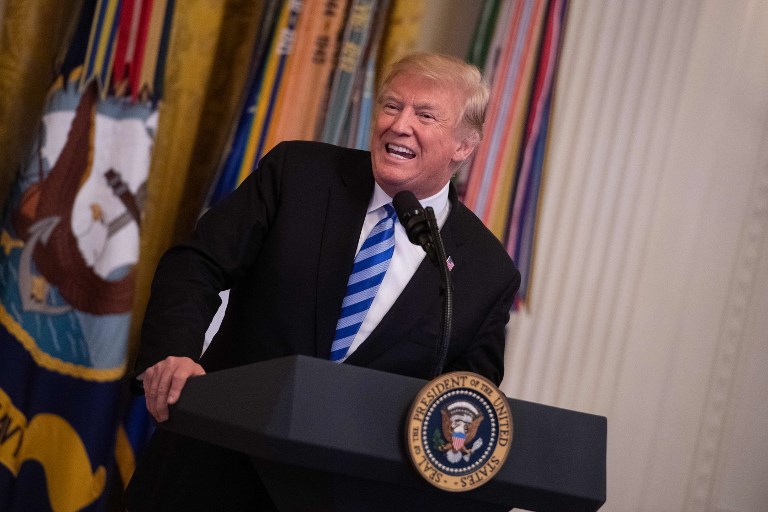
US President Donald Trump speaks at a reception commemorating the 35th anniversary of the attack on Beirut Barracks, on October 25, 2018 at the White House in Washington, DC. (NICHOLAS KAMM / AFP)
WASHINGTON — President Donald Trump signed legislation Thursday imposing new sanctions against Hezbollah, the Iran-backed terrorist group behind the 1983 Beirut barracks bombings.
Speaking at a White House event marking the 35th anniversary of the attack that killed 241 Marines, Trump said, “No terrorist group other than al-Qaeda has more American blood on its hands.”
The bill expands the list of those who can be sanctioned for doing business with Hezbollah.
Trump described the sanctions as “starving” Hezbollah.
“We will target, disrupt, and dismantle their operational and financing networks — of which they had plenty; they don’t have plenty now,” he said without elaborating.
Get The Times of Israel's Daily Editionby email and never miss our top stories
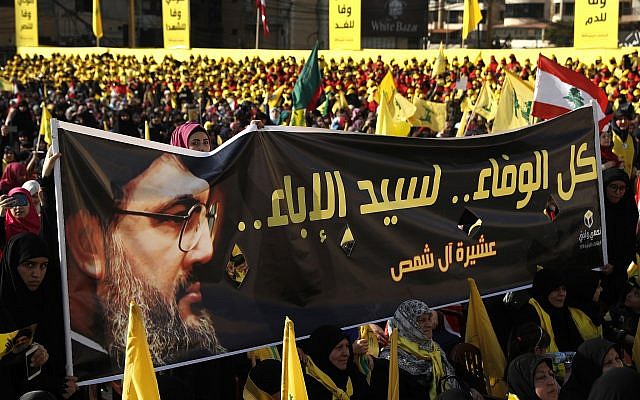
Supporters of Hezbollah leader Sayyed Hassan Nasrallah hold a banner with his portrait and Arabic words that reads: ‘All the loyalty to the man of nobility,’ during an election campaign speech, in a southern suburb of Beirut, Lebanon, April 13, 2018. (AP Photo/Hussein Malla)
Trump also said that Iran had retreated from efforts to gain access to the Mediterranean Sea. Israeli officials have warned repeatedly in recent years of an Iranian attempt to create a conduit to the sea through Iraq, Syria and Lebanon.
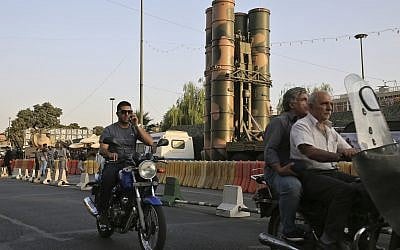
A Russian-made S-300 air defense system is on display for the annual Defense Week, marking the 37th anniversary of the 1980s Iran-Iraq war, at Baharestan Square in Tehran, Iran, September 24, 2017. (AP/Vahid Salemi)
“They’re not looking so much for the Mediterranean. When I took office, they were looking for the Mediterranean. They were going to take over everything. Now they want to survive,” he said.
He said sanctions against Iran set to kick in early next month as part of his pullout of the 2015 nuclear deal would be “just as good” as those that had been removed under predecessor Barack Obama, and promised more in the future.
Advertisement
“We will not allow the world’s leading sponsor of terror to develop the world’s deadliest weapons. Will not happen,” he said.
Help us report truthfully on social media
As a multimedia journalist, my job is to take the quality, fact-based journalism produced by The Times of Israel newsroom and make it accessible across every platform — from Instagram posts to podcasts to short-form videos.
This is how many, especially young people, consume news these days. But misinformation is rampant on social media. Our team at ToI produces accurate, responsible short-form reporting on Israel and the Jewish world.
If you believe in the importance of factual social media journalism, please consider joining our reader support group, The Times of Israel Community. Your financial support is essential to sustain responsible multimedia reporting.
We’re really pleased that you’ve read X Times of Israel articles in the past month.
That’s why we started the Times of Israel - to provide discerning readers like you with must-read coverage of Israel and the Jewish world.
So now we have a request. Unlike other news outlets, we haven’t put up a paywall. But as the journalism we do is costly, we invite readers for whom The Times of Israel has become important to help support our work by joining The Times of Israel Community.
For as little as $6 a month you can help support our quality journalism while enjoying The Times of Israel AD-FREE, as well as accessing exclusive content available only to Times of Israel Community members.
Thank you, David Horovitz, Founding Editor of The Times of Israel


 Add ToI as a Preferred Source on Google