

US cuts hundreds of millions in aid to Egypt
Move leaves Israeli officials frustrated by Washington’s major shift on a crucial part of the 1979 peace treaty
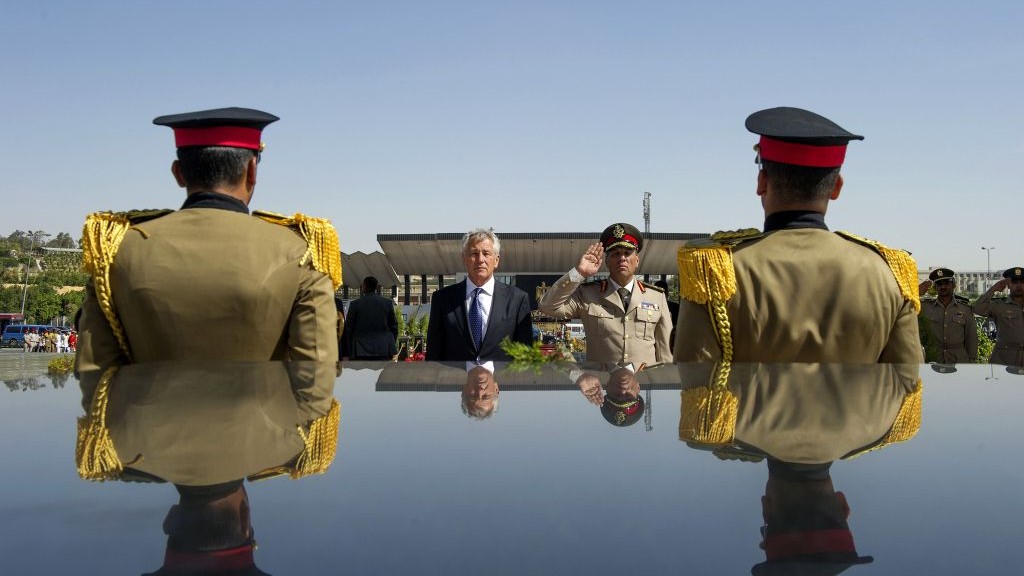
WASHINGTON — The United States on Wednesday cut hundreds of millions of dollars in aid to its Mideast ally Egypt, responding to the military ouster last summer of the nation’s first democratically elected president and the crackdown on protesters that has sunk the country into violent turmoil.
While the State Department did not provide a dollar amount of what was being withheld, most of it is linked to military aid. In all, the US provides $1.5 billion in aid each year to Egypt.
Officials said the aid being withheld included 10 Apache helicopters at a cost of more than $500 million, M1A1 tank kits and Harpoon anti-ship missiles. The US also is withholding $260 million in cash assistance to the government until “credible progress” is made toward an inclusive government set up through free and fair elections. The US had already suspended the delivery of four F-16 fighter jets and canceled biennial US-Egyptian military exercises.
In Cairo, military spokesman Col. Ahmed Mohammed Ali declined immediate comment. Before the announcement, Gen. Abdel-Fattah el-Sissi, the Egyptian military leader, described his country’s relations with the United States as “strategic” and founded on mutual interests. But he told the Cairo daily, Al-Masry al-Youm, in an interview published on Wednesday that Egypt would not tolerate pressure, “whether through actions or hints.”
Israeli officials expressed frustration at the US government’s decision and claimed that the aid to Egypt was essential in order to maintain regional stability, the New York Times reported. Israel considers aid to US aid to Egypt to be important support for the peace agreement between the two neighboring countries.
“You cannot disassemble the peace treaty and take out this part or that part,” one official, who spoke under condition of anonymity, told the New York Times. “But there are other elements in this conundrum. This is not just about Israel. This is about America’s standing in the Arab world.”
The State Department stressed that the long-standing US partnership with Egypt would continue and US officials made it clear that the decisions are not permanent, adding that there is no intent by the Obama administration to end any specific programs. Still, the decision puts ties between the US and Egypt at their rockiest point in more than three decades.
“The United States continues to support a democratic transition and oppose violence as a means of resolving differences within Egypt,” State Department spokeswoman Jen Psaki said. “We will continue to review the decisions regarding our assistance periodically and will continue to work with the interim government to help it move toward our shared goals in an atmosphere free of violence and intimidation.”
The US will continue to provide support for health and education and counterterrorism, spare military parts, military training and education, border security and security assistance in the Sinai Peninsula where near-daily attacks against security forces and soldiers have increasingly resembled a full-fledged insurgency.
The US officials providing the details did so only on condition of anonymity because they were not authorized to comment by name.
Other details about what military assistance is being cut were not immediately known, and the State Department declined to give an indication of how severe the impact of the cuts in assistance might be in Egypt.
Based on cost estimates, however, the M1A1 tank kits are about $10 million each, and Egypt was slated to get about four per month, officials said. The Harpoon contract was for 20 missiles, at a total cost of $145 million. It was not clear if any of those had already been delivered. F-16 fighter jets can cost more than $30 million each, but that amount could fluctuate depending on the equipment and weapons systems included.
Sen. Patrick Leahy, D-Vt., who chairs the Senate Appropriations panel that funds US assistance to Egypt, criticized the Obama administration’s action as too little.
“Our law is clear. When there is a military coup, US aid to the government is cut off,” Leahy said in a statement. “Rather than encourage reconciliation and restore democracy as it promised, the Egyptian military has reinstituted martial law and cracked down on the Islamic opposition, which has also used violence.”
Others, including some sharp political opponents of Obama on other subjects, supported the president’s decision.
Sen. Rand Paul, R-Ky., whose bill to halt aid to Egypt was roundly defeated in the Senate in July, said he was happy to see the administration “finally thinking about following the law.”
Administration officials, on a conference call to brief reporters on the decision, said Defense Secretary Chuck Hagel talked on the phone on Wednesday with el-Sissi, who led the military effort that ousted Morsi. They said the conversation was cordial, professional and ended on a positive tone.
But the decision certainly creates new friction in Washington’s already uneasy relations with the government that ousted Morsi. And the consequences won’t end there. The move will anger Gulf states, push Egypt to seek assistance from US rivals and upend decades of close ties with the Egyptians that that have been a bulwark of stability in the Middle East.
Egypt gives the United States permission to fly over its territory to supply American troops in the Gulf, allows the US to move troops and materiel through the Suez Canal without delay and cooperates with American intelligence agencies. It is unclear if cooperation on these fronts will be affected by the aid decision.
The US has been considering such a move since July, when the Egyptian military ousted Morsi. Ensuing violence between authorities and Morsi supporters has killed hundreds. The scheduled Nov. 4 trial of Morsi on charges that he incited the killings of opponents while in office and the US decision to cut its aid to Egypt threaten to add to the turmoil.
The cutoff of some, but not all, US aid also underscores the strategic shifts underway in the region as US allies in the Gulf forge ahead with policies at odds with Washington. Saudi Arabia and other Gulf states, including the United Arab Emirates and Qatar, are strong backers of Syrian rebel factions and were openly dismayed when the US set aside possible military strikes against Bashar Assad’s government. The Gulf states also feel increasingly sidelined as Washington reaches out to their rival, Iran.
Iran had moved quickly to heal long-strained ties with Egypt following Morsi’s election but now is redirecting its policies with Egyptian leaders who don’t share Tehran’s agenda.
US aid to the Egyptians has a long history. Since the late 1970s, the country has been the second-largest recipient — after Israel — of US bilateral foreign assistance, largely as a way to sustain the 1979 Egypt-Israeli peace treaty.
The United States gave Egypt $71.6 billion in assistance between 1948 and 2011, according to a Congressional Research Service report issued in June. That included $1.3 billion a year in military aid since 1987. The rest was economic assistance, some going to the government, some to other groups.
How much will the loss in US aid matter?
Egypt has other allies who may be able to fill the financial void. In fact, Saudi Arabia and some of its Gulf Arab partners have provided a critical financial lifeline for Egypt’s new government, pledging at least $12 billion so far and aiding in regional crackdowns on Morsi’s Muslim Brotherhood. On Monday, Egypt’s interim president, Adly Mansour, visited Saudi Arabia on his first foreign trip in a sign of the importance of the Gulf aid and political backing.



The Times of Israel Community.