

Why no Gaza ceasefire
The terror gangs want immunity from further Israeli strikes; they’re not going to get it

 Add ToI as a Preferred Source on Google
David Horovitz is the founding editor of The Times of Israel. He is the author of "Still Life with Bombers" (2004) and "A Little Too Close to God" (2000), and co-author of "Shalom Friend: The Life and Legacy of Yitzhak Rabin" (1996). He previously edited The Jerusalem Post (2004-2011) and The Jerusalem Report (1998-2004).
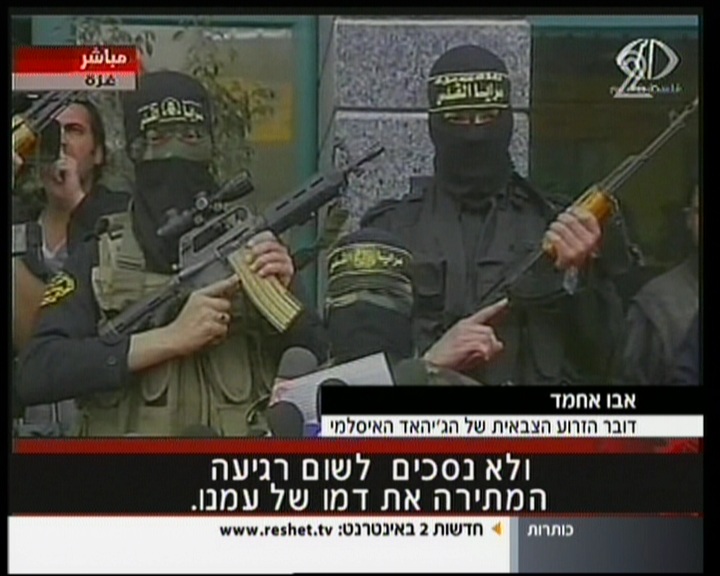
As a million Israelis spend their days braced for a dash to a protected area, and Gazans know their fate is potentially tied to their proximity to a rocket launcher or ammunition store, a very high-stakes game of chicken is now playing out between Israel and the Gaza terror gangs.
Both sides may well want this round of conflict to end. But if so, both want it to end with a perceived victory, in circumstances that create a better context for their future activities.
Shouting through his keffiya mask at a press conference in Gaza on Monday afternoon, automatic weapons all around him, an Islamic Jihad spokesman named Abu Ahmed declared that “we’re not interested in any ceasefire… that allows our blood to be spilled for nothing… We’ll continue to fire at the Zionist cities.”
Speaking rather more quietly at a press conference with his visiting Italian counterpart Giampaolo Di Paola, Israel’s Defense Minister Ehud Barak responded: “If the attacks will continue, we’ll continue to respond. It takes patience and staying power to overcome this kind of challenge. We are determined to protect our civilians.”
The disinclination of Islamic Jihad and the Popular Resistance Committees to stop firing rockets into Israel, even as the Israeli Air Force successfully hits more and more of their launchers and their operatives, stems from at least two interrelated factors. First, despite their very best efforts, as of Monday evening they had yet to achieve a significant operational “success” – they had failed, that is, to kill lots of Israelis. And second, that lack of “success” meant they had yet to achieve the deterrent capacity they sought to bolster in responding so concertedly to Israel’s assassination on Friday of PRC chief Zuhair al-Qaissi.
In general, the PRC and Islamic Jihad are dedicated to the demise of Israel, and committed to killing Israelis anytime, anywhere – soldiers and civilians alike. Al-Qaissi was targeted, Israeli officials say, precisely because he was about to orchestrate another attack on Israeli civilians via the Sinai – a repeat of the terrorist infiltration that left eight Israelis dead last August. But the specific goal of the rocket response to al-Qaissi’s death was to deter Israel from readily resorting to further such targeted strikes in the future.
No matter how urgently Israel might see an imperative to act – perhaps, as in this case, to try to avert a planned terrorist attack – the goal was to render such action almost unthinkable, exacting a high price for al-Qaissi’s death and ensuring that the memory of that high price would stymie Israel and henceforth allow the PRC, Islamic Jihad et al to prepare future terrorist acts with impunity.
On its side of the equation, Israel is not prepared to grant the terror gangs immunity from future attack. It is rebuffing ceasefire overtures that would include guaranteed immunity for the Gaza gangs. As Barak and other Israeli leaders are making plain, there is no plan here for an expanded operation into Gaza, and Israel will stop aiming for the terror cells if they stop firing into Israel. But so long as the rockets fly, the IAF will do its best to target those who are launching them.
In winter 2008, when Israel launched Operation Cast Lead against Hamas in Gaza, the resort to force was extremely carefully planned; the IDF had spent many months identifying targets in Gaza, and had a day-by-day plan of operation. Nonetheless, the various well-thought-out phases of Cast Lead quickly became the subject of much internal argument in the defense establishment.
Some influential figures wanted an early resort to a large-scale ground operation, designed to end Hamas’s rule in Gaza once and for all. Others wanted the operation halted altogether. Ultimately, under Barak’s stewardship, a middle path was followed – with a hope, which faded day by day, that the IDF could achieve some kind of ostensible moment of victory even if Hamas would not surrender. In the event, when the guns fell silent, Hamas was battered but not broken, and reasserted control relatively quickly.
The concern on day four of this cross-border escalation is that if Israel is again seeking a moment of victory, it will not be achieved via the IAF’s striking of rocket cells and ammunition dumps. And the longer those airstrikes continue, the greater the potential for an errant missile accidentally killing large numbers of civilians and bringing international pressure for a non-victorious halt.
And every day of continued rocket fire from Gaza, of course, brings an ever-greater danger that a salvo from the terror cells will defeat the Iron Dome defenses and exact the intended price in Israeli civilian lives – turning what on Day Four is still a limited flare-up into a full-scale war.
——-
Follow David Horovitz on Twitter.






The Times of Israel Community.