

With inspiring performance at AIPAC, Netanyahu seeks to show he’s indispensable
Showcasing Israel’s achievements, explaining how he’ll defeat its enemies, PM proves himself peerless. But the 18,000 roaring supporters in DC do not hold his fate in their hands

 Add ToI as a Preferred Source on Google
David Horovitz is the founding editor of The Times of Israel. He is the author of "Still Life with Bombers" (2004) and "A Little Too Close to God" (2000), and co-author of "Shalom Friend: The Life and Legacy of Yitzhak Rabin" (1996). He previously edited The Jerusalem Post (2004-2011) and The Jerusalem Report (1998-2004).
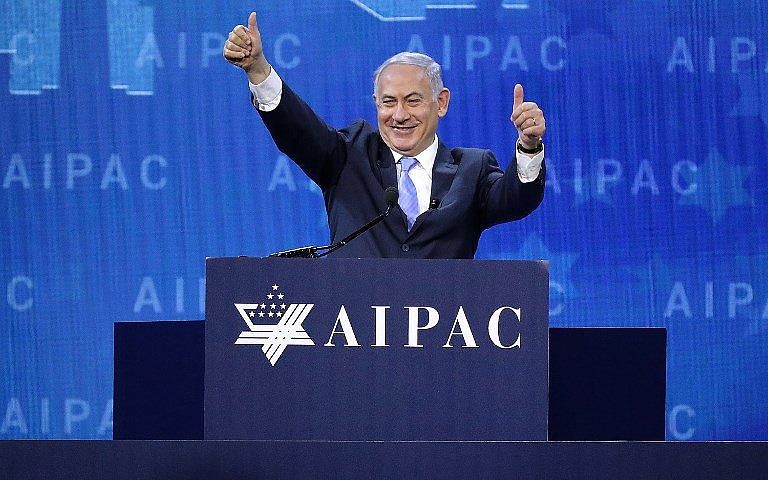
WASHINGTON — In a little more than half an hour at the AIPAC policy conference here on Tuesday morning, Prime Minister Benjamin Netanyahu demonstrated all his formidable public speaking skills in a bravura performance that underlined he has no remote competitor when extolling Israel’s virtues. Underlining his stellar display was his desire, too, to assert his indispensability in steering Israel to ever-greater economic growth, global diplomatic acceptance, and long-term security.
Needless to say, there was no hint of a mention of the legal troubles awaiting him back home. Neither, in a crowd of 18,000 passionately pro-Israel activists, was there any expectation of such references.
The prime minister left nobody in any doubt that he intends to be helming Israel for a long time to come. “I will not let that happen,” Netanyahu promised when discussing Iran’s ongoing efforts to establish a permanent presence in Syria and Lebanon from which to target Israel — a personal commitment.
And the whoops, cheers, and applause that met his every confident, uplifting announcement of Israeli prowess confirmed that, for most of this crowd, the words “Benjamin Netanyahu” and “prime minister of Israel” are and should remain synonymous.
“We love you Bibi,” a female voice in the crowd assured him at one point, in case there was any question. “That’s very kind of you. I love you too,” Netanyahu responded — much like the US Ambassador to the UN Nikki Haley had replied to similar sentiments the previous evening. Except that Netanyahu had the disarming presence of mind to ask lightly: “Who planted her?!”
Ambassador Haley is also quite the speaker, and particularly beloved by an AIPAC overjoyed by the robust response she has been leading against years of anti-Israel bias at the United Nations. She was the undisputed star of this policy conference last year, and she garnered ecstatic reviews on Monday evening too. But Netanyahu’s presentation was of an entirely more spectacular order, and his reception was in another league.
Nobody would have been too surprised that he began by referencing his meeting Monday with US President Donald Trump. The pro-Israel American audience is always going to be happy to be reminded that Israel’s prime minister now has an open door at the White House. He also had a slightly predictable if cute early line thanking thousands of students for “cutting class to be here,” and telling them to see him afterwards if they needed a note for their teachers.
But few would have expected to find Netanyahu then referencing Clint Eastwood’s spaghetti Western “The Good, the Bad and the Ugly” and building his entire speech around an amended title: “The Good, The Bad and the Beautiful.” The Good, of course, being the wonders of Israel; The Bad, its enemies — specifically Iran; and The Beautiful, the “eternal” alliance between Israel and the United States of America.
Netanyahu has delivered similar speeches to this one at various forums of late — including to major public events and to small groups he invites into the Prime Minister’s Office. It features a slideshow presentation to illustrate his key themes, including Israeli innovation, the flourishing economy, the Jewish state’s widening circle of allies worldwide, and Iran’s rapacious territorial progress.
But delivered at the vast Washington Convention Center, on giant screens, the effect was particularly powerful. And Netanyahu smartly bolstered the impact, early on, by abandoning his center-stage podium and going walkabout, back and forth across the stage. Hinting that there might be security concerns about such a move, Netanyahu first told his rapt audience that he didn’t really want to stand behind the lectern, and then, as if it was a spur of the moment decision, declared “What the heck, I’m the prime minister,” and set off to make closer contact with the crowd. Cue gleeful applause.
Utterly comfortable in his surroundings, Netanyahu was polished, clear, and cogent — in the starkest of contrasts to the latest would-be prime minister to speak here, Labor’s Avi Gabbay, who gave a perfectly reasonable speech on Sunday… for a non-native English-speaker finding himself at an unusually vast event.
For the Israelis in the hall, it was doubtless a pleasure listening to Netanyahu explain how the era of innovation has “unleashed the spark of genius embedded in our people.” For Israel’s supporters here in America, it was surely inspiring
If the presentation was skilled, the content of Netanyahu’s address was still more impressive. Even when he veered briefly into jargon, he made a virtue of it. Challenging his audience to understand how modern technology is revolutionizing old industries and creating new ones, with Israel at the emphatic forefront, he prepared them for what he said would be a complex explanation: It was, he said, all about “the confluence of big data, connectivity, and artificial intelligence.” Duly warned, the room stayed with him, and applauded when he illustrated that concept with an example from Israeli agriculture of sophisticated drones, coordinating with sensors, in turn activating irrigation, so that water is delivered “to the individual plant” according to its needs. Israeli agriculture, he concluded, is now “precision agriculture.” Seldom could a description of crop-growing have been met with such awed delight by an audience of non-farmers.
For the Israelis in the hall, it was doubtless a pleasure listening to Netanyahu hail Israel’s soldiers in all their black, white, gay, straight diversity; hearing him explain how the era of innovation has “unleashed the spark of genius embedded in our people”; watching him illustrate that the world is “turning blue” in forging diplomatic ties with our tiny state, and declaring that while Israel used to be isolated, “pretty soon, the countries that don’t have relations with us — they’re going to be isolated,” and that “those who talk about boycotting Israel — we’ll boycott them.” For the Americans, it was surely inspiring.
https://content.jwplatform.com/previews/xB1SXrk6-U4CTA3JQ
By the time Netanyahu moved from “The Good” to “The Bad,” a room that was always going to be receptive was adulatory. He now reminded them of his bona fides in having opposed the Iran nuclear deal from the get-go. He claimed grim vindication in Iran’s increasingly aggressive behavior region-wide, its escalated threat across the northern border, and its unceasing quest for the bomb. He asserted recognition in that Trump, by contrast to the unmentioned predecessor who signed the accord, shares his own determination to fix it or nix it. And when he gave that personal pledge to stop Iran, there would have been few in the audience inclined to argue that perhaps a different Israeli prime minister might handle things better.
Even on Iran, Netanyahu tempered his firm anti-regime posture with empathy for the people. Israel, in the Netanyahu narrative, must and will defend itself, but it knows how to distinguish between its enemies and their victims. “We stand with those in Iran who stand for freedom,” he declared, predicting the eventual fall of the ayatollahs, and an era of friendship and peace.
Similarly, Netanyahu asserted that Israel seeks peace with all its neighbors, certainly including the Palestinians. If only Palestinian Authority President Mahmoud Abbas would stop spending what the prime minister claimed is about 10% of the PA budget on salaries for terrorists and their families, there would be money for schools, hospitals, factories. “Stop paying terrorists,” he urged Abbas, because the message those payments send to Palestinian children is “murder Jews and get rich.” Netanyahu skillfully involved the audience here, urging them to “raise your hands high if you think President Abbas should stop paying terrorists to murder Jews.”
Netanyahu’s “The Beautiful” ending was brief but calmly effective, noting the shared values that animate the US-Israel partnership and are today “writing a new chapter in our common story.”
And then, with a call to God to bless Israel, America and their alliance, he was waving his farewell.
Few would have noticed, in the euphoria of their response to so rousing an address, that, as with his legal troubles, there was no mention either of some of this audience’s hot-button issues — the frozen Western Wall prayer agreement, concerns over conversion, dismay in some quarters at Israel’s stance on tens of thousands of African asylum-seekers.
And if they did notice, few would have complained. They had gathered because they care about Israel, because they want Israel to be safe, and because they want to feel good about Israel.
In meeting those needs, Netanyahu proved himself peerless. If the 18,000 people who cheered him here voted in Israeli elections, he wouldn’t have a political care in the world. Indeed, as things stand, our polls suggest that enough Israeli voters feel much the same way about him.
A national leader at the very top of his game, the prime minister did everything to show himself not merely inspiring and commanding, but irreplaceable. But it’s not AIPAC that will determine his fate. As things stand, it’s not Israeli voters either. It’s Israel’s law enforcement authorities.
His supporters would say they should have been watching.





The Times of Israel Community.