

Israeli author puts the ‘book’ back in Facebook
Award-winning writer experiments with new publishing platform by releasing work via Facebook photo album
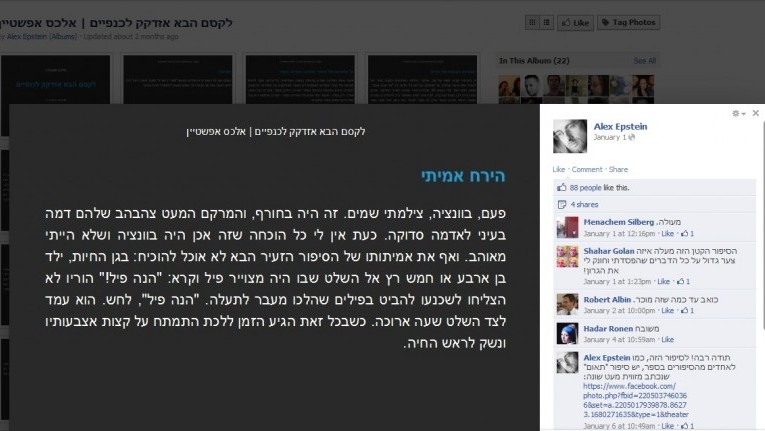
Israeli author Alex Epstein has stumbled upon a novel way to expose new readers to his work — by “publishing” it on Facebook. It’s an experiment that could foretell a new paradigm in book publishing, according to Epstein: a way of leveraging social networks to interest new readers in an author’s work, and perhaps even change the concept of “book” as it applies online.
Epstein is actually an accomplished writer who has authored 10 books, including four collections of short stories and three novels; his work has been translated into English, French, Spanish, Russian, Greek, Dutch, Croatian, and Italian, and in 2003 he was awarded the Prime Minister’s Prize for Literature.
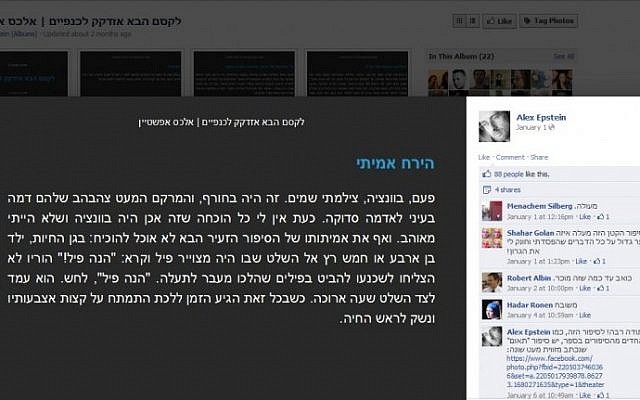
And Epstein is also the author of “For My Next Illusion I Will Use Wings,” a Hebrew-language collection of 88 short stories that were “published” on Facebook earlier this year. Samples of the book are now being translated into English, together with Electric Literature, which experiments with new and novel ways to distribute fiction. The book will also be published in print later this year.
“Illusion” is the first book in Hebrew, English, or any other language that is using Facebook as a distribution mechanism. “This is different than an e-book, which is a closed ‘object’ or file that imitates a print book,” Epstein said. “They are sold through a bookstore, you remember the page you are on with a bookmark, etc. It’s a finished product that you react to. I wanted to see if I could turn literature into a social phenomenon — for example, how do people react when their friends are reading and commenting on stories together with them at the same time.”
Unlike other social literature experiences — like a book club, for example — using Facebook promises a much more dynamic interaction with readers. “In a book club, online or offline, you are taking a work that has been written and reacting to it, while on Facebook, you can comment or analyze almost in real time,” Epstein said. Indeed, he added, one of the biggest surprises in the experiment has been how people were reading the book almost as he was posting the pages, and commenting.

Epstein chose the Facebook photo album format for several reasons. “It was easy for me to do technically, and it is available to anyone with a computer, smartphone, tablet, etc. You don’t have to be my friend on Facebook to read it. All you need is the link.”
Perhaps more important is the fact that the photo album format preserves the text for posterity, “unlike a status update or a tweet, which is here today and gone tomorrow,” Epstein added.
In 2010, American author Lou Beach created a book using Facebook status updates, but the stories Beach wrote are now posted on a web site, as well as published as a brick and mortar book, not Facebook.
Can a Facebook-published or -distributed book somehow help struggling young authors to get their names out to the public? “I didn’t engage in this experiment to see its commercial implications, but there is no question that it’s getting harder for new readers to discover different kinds of literature, whether it’s short stories or poetry,” Epstein said. “But I think this experiment proves that there is a market for non-mainstream art. People just need to have the opportunity to discover it.”










The Times of Israel Community.