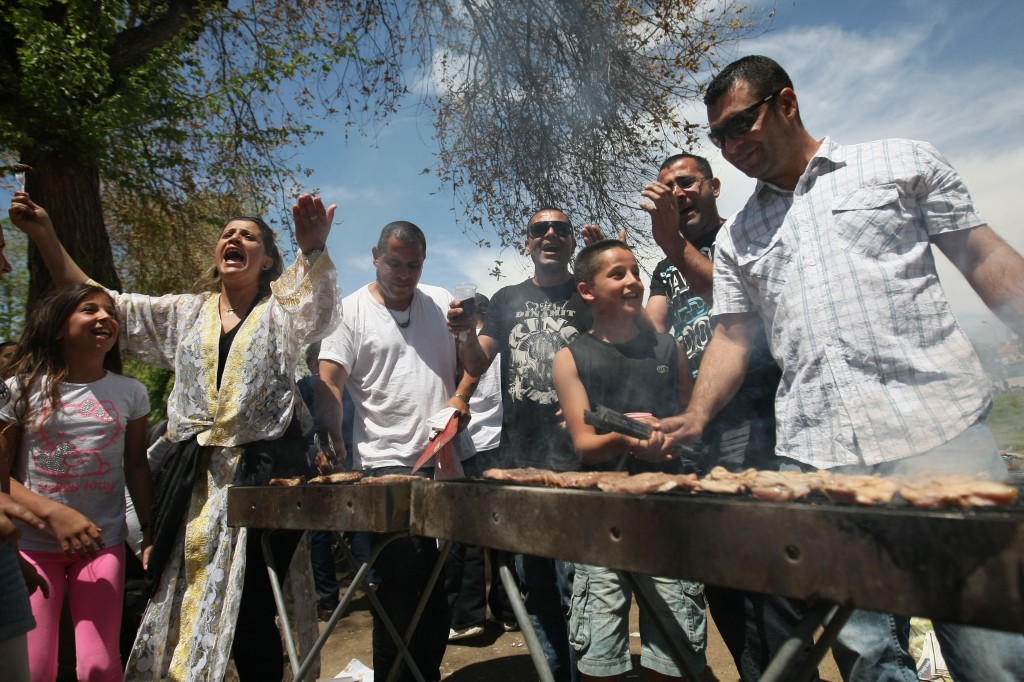
A family barbecue in Jerusalem's Sacher Park last April (photo credit: Kobi Gideon/Flash90)
Everyone knows that after soccer, the national Israeli sport is “al ha’aish,” literally “on the fire” but known to North Americans as barbecue, to Australians as barbie, and to South Africans as braai. At no time is that more apparent than during the period between Passover and Independence Day, when the parks seem constantly filled with families from all walks of life practicing their red-hot culinary skills.
During this month of the mangal (barbecue), meat consumption rises to around 2.3 kilograms (5 lbs.) per person, as opposed to 1.7 kg. (3.7 lbs.) per month normally, according to statistics recentlyreleased by the Agriculture Ministry.
During a normal month, Israelis consume 9,500 tonnes (10,500 tons) of meat — beef and lamb — but during the spring holidays that figure rises to around 15,000 tonnes (16,500 tons). About 18 kg. (almost 40 lbs.) are consumed by the average Israeli over the course of a year. In addition, the average Israeli will consume over 50 kg. (110 lbs.) of poultry.
Israel’s per capita meat consumption is among the highest in the world, but behind traditional meat-eating countries such as the United States, Spain, Australia and New Zealand.
Get The Times of Israel's Daily Editionby email and never miss our top stories
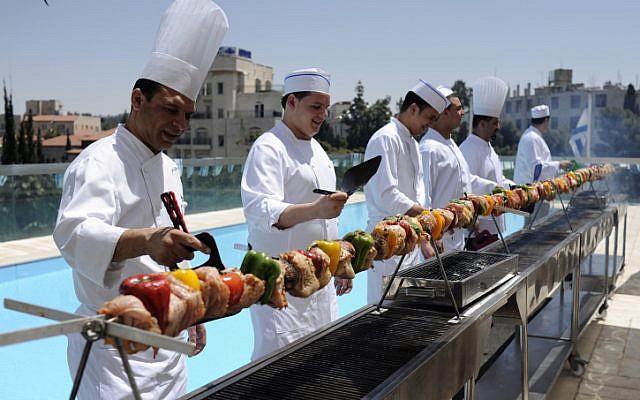
Israel's largest 'mangal' (barbecue grill), made up of 35 kilograms of meat and measuring eight meters long, was on display at Jerusalem's Grand Court hotel, on Monday (photo credit: Yoav Ari Dudkevitch/Flash90)
We can't do this work alone.
The war with Iran has been draining for all of us in Israel. But when I heard about a high casualty incident – ballistic missile impacts in Arad and Dimona that left nearly 200 people wounded – I drank a cup of coffee, packed a bag, and headed south.
There, I spoke with Shilgit, the head of an after-school program for underprivileged youth. Standing outside her destroyed center, Shilgit said it was a miracle that no children were hurt and spoke about the community coming together in the hours since.
As a Times of Israel reporter, I’m committed to telling stories of resilience like Shilgit’s. But my colleagues and I can't do this alone. If you value work like this,please consider joining our reader support group, The Times of Israel Community. Your financial support is essential to keep real human reporting like this going.
We’re really pleased that you’ve read X Times of Israel articles in the past month.
That’s why we started the Times of Israel - to provide discerning readers like you with must-read coverage of Israel and the Jewish world.
So now we have a request. Unlike other news outlets, we haven’t put up a paywall. But as the journalism we do is costly, we invite readers for whom The Times of Israel has become important to help support our work by joining The Times of Israel Community.
For as little as $6 a month you can help support our quality journalism while enjoying The Times of Israel AD-FREE, as well as accessing exclusive content available only to Times of Israel Community members.
Thank you, David Horovitz, Founding Editor of The Times of Israel