

Mourning a day early
Memorial Day is marked in the Hebrew papers as the country gears up to remember its fallen soldiers
 Add ToI as a Preferred Source on Google
Ilan Ben Zion is an AFP reporter and a former news editor at The Times of Israel.
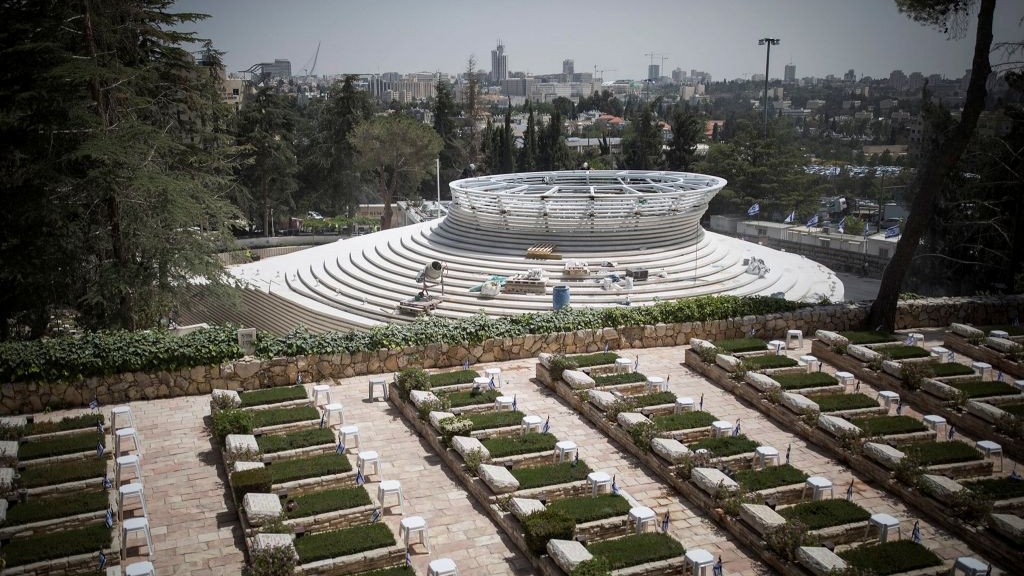
Memorial Day starts Sunday morning in the Hebrew newspapers, ahead of the ceremonies that commence in the evening. Stories of families without fathers, brothers, sons, daughters, mothers and sisters and pictures of Israelis crying over the graves of the fallen in uniform military cemeteries are the bread and butter of the media focus that will extend into Monday afternoon.
The slow news weekend allows Yedioth Ahronoth and Israel Hayom to dedicate a substantial portion of their main coverage to articles honoring soldiers killed in action and the families they left behind. Yedioth Ahronoth dubs its somber reporting “Our heroes,” soldiers who fell in combat from the 1967 Six Day War to this past year’s “Intifada of knives.” All of the op-eds in the back of Yedioth Ahronoth deal with Memorial Day as well. What Israel Hayom lacks in personal profiles for Memorial Day, it makes up for with op-eds: two written by IDF generals and another by the head of an organization for bereaved families. As if the paper were an internal IDF gazette, Israel Hayom runs the order issued by IDF Chief of Staff Lt. Gen. Gadi Eisenkot to the troops ahead of Memorial Day underscoring the importance of the holiday and the obligation “to stand by the families [of the fallen] and accompany them in the journey of life after their loss, the journey which began the day in which the light of their lives was extinguished.”
Brigadier General Itzik Cohen writes that Memorial Day is “a will” left by fallen soldiers “that explains clearly that their death wasn’t in vain.” On that day “even the heavens themselves are in pain from the sound of the sirens,” he says, and recounts the death of one of his soldiers in a 2003 mission in Gaza.
Having spent all their Memorial Day material on Sunday, it’s easy to assume that there will be wall-to-wall coverage of this evening’s state ceremony on Mount Herzl in Monday’s paper, along with more tales of heroism and sorrow to boot.
Beyond the mournful headlines, Israel Hayom’s next big story is Hapoel Beersheba’s victory in the national soccer league for the second consecutive year with its defeat of Maccabi Tel Aviv. Yedioth Ahronoth opts for somewhat harder news, reporting on the growing tension between North Korea and the United States after Pyongyang attempted to test another ballistic missile this weekend.
Haaretz shies away from the emotionally charged reportage favored by Yedioth Ahronoth or content drafted by military officials, choosing instead to set its agenda ahead of Memorial Day as decidedly international. Memorial Day gets the big photo at the top of the page, but the top headlines address Israel’s diplomatic crisis with Germany, the North Korea crisis, and Turkey’s latest crackdown on free speech. Even though Haaretz relies heavily on the international news agencies for its coverage, these three issues notably find little to no mention on the front pages of the other two papers, and minor coverage behind the local news.
Concerning last week’s blowup in Israel-Germany ties, Haaretz says the crisis is only getting worse and quotes Foreign Ministry officials saying that Germany isn’t helping to spike an anti-Israel proposal in UNESCO. An anonymous Foreign Ministry official tells the paper that this past week a senior Foreign Ministry official had a really nasty conversation with the German ambassador to Israel and dressed him down for Berlin’s conduct vis-a-vis the UNESCO vote.
Haaretz wages war on the statisticians in its daily editorial. It says that the Central Bureau of Statistics’ annual report on the number of Jews living in the country is skewed and filled with “inaccuracies and manipulations that turned that dry statistical report into a ridiculous propaganda document.” Haaretz points out that the number of Jews mentioned includes all those in territories controlled by Israel, including the Golan Heights, East Jerusalem and West Bank while the millions of Palestinians are not counted — only Arab residents of Israel are. “The problem isn’t that the CBS doesn’t know how many Palestinians live in the territories,” it says. If it published the full statistics, “the Jewish majority would shrink wondrously, and the joy of Independence Day would be damaged.”







The Times of Israel Community.