

Mr. Bibi goes to Washington
It’s all eyes on Netanyahu in the Israeli press as the prime minister heads to Congress for his long-awaited address on Iran
 Add ToI as a Preferred Source on Google
Marissa Newman is The Times of Israel political correspondent.
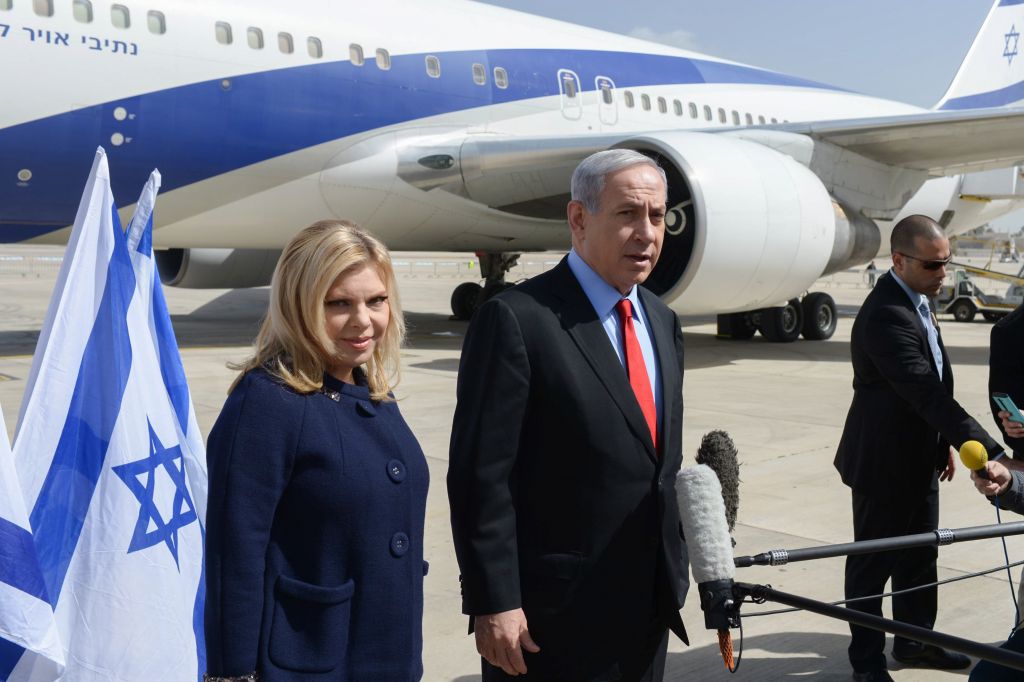
Prime Minister Benjamin Netanyahu’s high-profile departure for Washington ahead of his much-anticipated, controversial Congress address on the Iran nuclear talks leads the news coverage in all three Hebrew dailies on Sunday.
Israel Hayom waxes patriotic, its headline a quote from Netanyahu’s pre-flight speech on Saturday: “I am going to warn against a dangerous deal.” Yedioth Ahronoth emphasizes the strain on US-Israel ties, and Haaretz notes that Netanyahu’s Likud party is concerned it may receive far fewer seats than expected in the upcoming election, despite the speech.
Israel Hayom draws an “ironic” historical parallel with the 1975 invitation of Russian dissident novelist and Nobel laureate Aleksandr Solzhenitsyn by a senator to address Congress. US president Gerald Ford and secretary of state Henry Kissinger refused to invite him to the White House but couldn’t prevent the address from taking place, it reports.
“And here’s the irony: If you look at the photo of the address, you’ll see Solzhenitsyn on stage, his translator, and the four senators who advanced the initiative despite the fury of the president and secretary of state. One of them — the senator standing behind Solzhenitsyn in the picture — is a young senator from Delaware by the name of Joe Biden,” it reports. Biden will not attend Netanyahu’s speech to Congress.
On its third and fourth pages, Israel Hayom has a media review of its own, juxtaposing various US newspapers’ editorial comments on Netanyahu’s speech: The Wall Street Journal calls it “The Speech of the Year.” In an op-ed in The New York Times, Zionist Union leader Isaac Herzog writes that Netanyahu’s speech is “a major mistake” but says Israelis are united in preventing a nuclear Iran. In The Washington Post, Charles Krauthammer writes: “We are on the cusp of an epic capitulation. History will not be kind.” And in The New York Post, Michael Goodwin condemns “Obama’s chilling Iran nuke lie.”
Over in Yedioth Ahronoth, Netanyahu is reported to be departing “for what he views as his life mission: to stop the agreement with Iran, or at the very least, to affect its content.”
The daily writes that Netanyahu’s trip has been a blow to AIPAC, and casts the much smaller J Street as a full-fledged competitor to the pro-Israel lobbying group. “If in the past, the president and vice president made sure to attend the forum, this year it was decided to weaken the position of AIPAC with relations to its competing organization, J Street, and to send lower-ranking representatives: the [national security] adviser [Susan] Rice, and UN envoy Samantha Power,” it reports.
In an op-ed for the paper, Orly Azoulay argues that the effects of the diplomatic crisis will be felt only after Netanyahu leaves Washington.
“Israel, which according to [a report in] Bloomberg, requested from the US another $317 million to develop the anti-missile systems Arrow III and David’s Sling, is likely to discover that America is a lot less generous than before,” she writes. “Officials in the administration are already drafting a plan for the day after Netanyahu’s speech: which clauses will be removed in terms of aid to Israel, and which of its requests will be met with red tape.”
Obama has two more years in office, she writes, “and from his perspective, he’s done with Netanyahu. Now, it’s no longer a crisis of confidence, it’s the end of the road.”
The paper’s Alex Fishman outlines the terms of the nuclear deal and its remaining two hurdles: the timetable of when sanctions will be lifted and the stamp of approval by Supreme Leader Ali Khamenei.
Haaretz, meanwhile, reports that Iranian concessions on the number of centrifuges it is willing to get rid of is what is driving the talks to proceed. But still, it reports, citing Western diplomats, the chances of reaching a final accord by the end of the month are slim.
“The Iranians surprised the representatives of the six powers when they presented their own alternative proposal, the diplomats said. That proposal included, for the first time, concessions regarding their stockpile of enriched uranium, as well as a bid to cut the number of old-generation centrifuges by one-third,” it reports.
Like Fishman, Haaretz’s Barak Ravid maintains that the question of how quickly the sanctions on Tehran will be lifted is one of the key points of contention.
While critics have described Netanyahu’s address as a way to garner additional votes at home, Haaretz reports — quoting Likud sources — that the party fears that it may only receive 18 mandates, since the numbers of its constituents who will head to the polls on March 17 has dwindled significantly.
“A source in Likud told Haaretz, ‘If surveys are now talking about 22-23 seats for Netanyahu, that could easily end up being only 18,'” it reports. Still, the ruling party believes that even if the Zionist Union party receives more seats, Likud will still be tasked with forming the next coalition, the report said.







The Times of Israel Community.