

Painter’s hidden work on display for the first time
Holocaust survivor artist Boris Lurie’s conflation of consumerism with Shoah imagery spawned the No!art movement, now exhibited in NY
 Add ToI as a Preferred Source on Google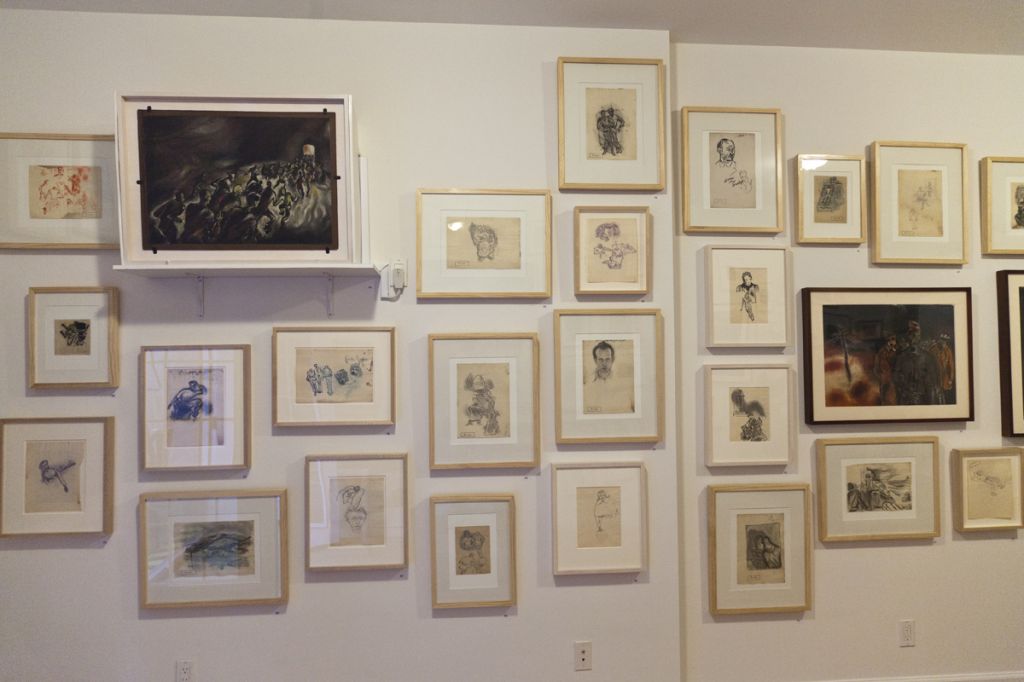
NEW YORK — Current exhibit, “Boris Lurie: The 1940s” jolts visitors from New York City’s manicured Upper East Side to a time and place no one wants to return: Europe’s concentration camps.
Ninety-five drawings and paintings dating from 1946 to 1947 are on display at the Studio House Space (239 East 77th Street) until November 15th.
Created mostly from his memory of the four years he was incarcerated in the camps, Lurie considered them his “private” collection, and hid them away very carefully, according to curator Gertrude Stein, who met Lurie in 1962 and opened her gallery, Gallery Gertrude Stein, with his work.
After his death in 2008, Stein felt it was finally time to bring this “private” collection to the public eye.
“He didn’t want to be seen as a Holocaust artist,” Stein says today, “but the Holocaust was all over his work.”
Born in Leningrad in 1924, and raised in Latvia, Lurie’s family was deported to the concentration camp Riga in 1941. His mother, sister and grandmother were murdered, while he and his father survived three more camps, Salaspils, Stutthoff and finally Buchenwald-Magdeburg.
‘He didn’t want to be seen as a Holocaust artist, but the Holocaust was all over his work’
Lurie hid during the day, and came out at night, according to Stein, and this nocturnal habit continued after the war.
“His walls were painted black. He slept during the day, and worked at night. He lived in this trauma of protection. Being seen and being hidden was a big theme for him.”
After the war, 21-year-old Lurie began sketching and painting scenes he’d witnessed in the camps. Lurie never wanted his artistic merit to be judged by this particular work, nor did he like what he called the “Holocaust industry,’ according to Stein, which was why he never allowed them to be shown.
The exhibit of these works, however, by no means exploits the Holocaust, and indeed artistically, they provide an important context for the themes that would emerge in his later paintings. There are dancing figures, nude women, degradation and humiliation, as well as glimpses of humanity and hope.
Covering three walls, the sheer number of pieces insist that the viewer see what the artist has seen, and bear witness, as well.
The black and white pen and ink on paper sketches of prisoners wearing striped prison garb, alongside the more detailed oil paintings of prisoners returning from work, their backs to the viewer, racing toward a door filled with light, reveal Lurie’s ability to powerfully capture the emotional world of his subjects, and to demand a response from anyone who sees it.
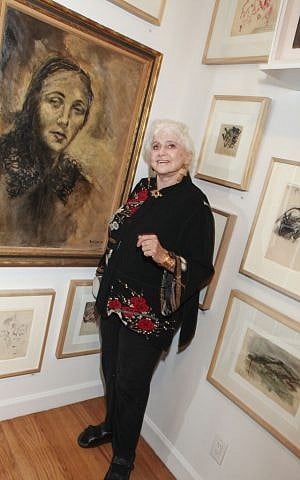
One of the most fully realized oil paintings in the show is of Lurie’s mother. Her face fills up most of the canvas. Her eyes are slightly downcast, her mouth is set, as if resigned; yet she is watchful and dignified and altogether beautiful. One feels the complicated emotional world evoked in just her face.
“He tried to remember his mother as well as he could,” recalls Stein. “The guilt of his mother dying – it was unbearable. He put her in this wonderful light. She almost looks like she’s from the Pieta.”
In 1959, Lurie helped to launch the “NO!art” movement. It was so named when Lurie showed his Holocaust-themed work – for example, his Railroad Collage, in which he re-appropriated a well-known liberation photograph of a Nazi freight car full of naked, emaciated corpses and superimposed on it a photo of a pin-up girl pulling down her panties – to a gallery owner and she ran out, shrieking, “No!”
His Holocaust-themed work was often shocking and violent, a repudiation of consumerist society, and the commercialization of the art world. It was also an attempt to force the viewer to recognize the exploitation of women.
“He had a very protective attitude toward women,” Stein explains. “The Jewish woman had been so vandalized by the Nazis. Women were so vulnerable, and he was overcome with wanting to protect them.”
Through his art Lurie sought to force viewers to drop their indifference, and to confront how their own passivity. Not being willing to say, “No!”, enables atrocities to occur. Given what Lurie had witnessed in the camps, his political engagement and his urge to address the real problems in the world and take action to right wrongs is more than understandable.
Psychologist Dr. Eva Fogelman’s text that accompanies the catalog provides a fuller portrait of the man and his work, placing it firmly against the backdrop of the Holocaust and the post-Holocaust world he inhabited. Fogelman characterizes Lurie’s later images, those that are “aggressively offensive” as “the language of the camps,” and views his work as “simultaneously memorial and protest.”
Certainly, protest was what the NO!art movement was all about. As chairman of the Boris Lurie Art Foundation, Stein plans to continue and perpetuate that protest, in this exhibit as well as in upcoming exhibits elsewhere of his No!art work.
Psychologist Fogelman characterizes Lurie’s later images, those that are ‘aggressively offensive’ as ‘the language of the camps’
Lurie’s work, however, wasn’t just about raising the public’s consciousness about the broken, fragmented, damaged, world we live in, and the need to fix it. According to Fogelman, Lurie’s art enabled him to traverse the almost impossible and difficult road from mourning to meaning, which entails transforming “the feelings associated with loss into constructive behavior that makes a difference to oneself and to society… and connects us to the life and the culture that was destroyed.”
Without knowing anything else about Lurie, and without having access to his other NO!art works, the current exhibit at Studio Spring House is well worth seeing. There’s something incredibly intimate and powerful about being privy to sketches, drawings and paintings, never intended to be shown, but which nevertheless re-create a world to which any sane person would like to shout, “NO!”









The Times of Israel Community.