

Past vs. future in Egypt’s second round
Muslim Brotherhood campaign turns negative as Mubarak-era PM emerges second
Elhanan Miller is the former Arab affairs reporter for The Times of Israel
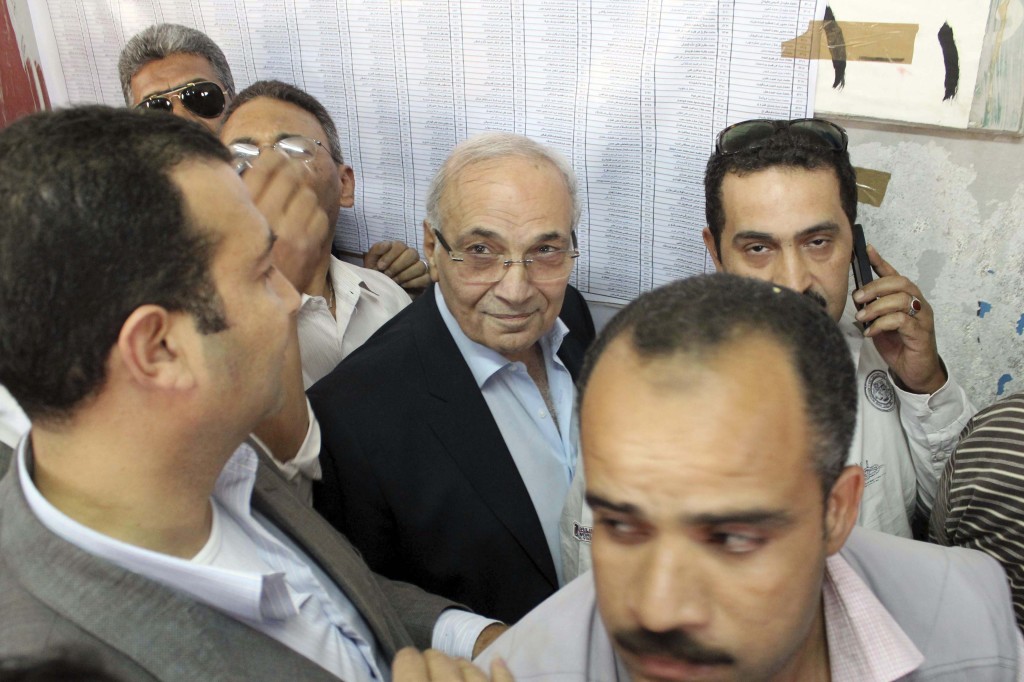
As evening fell on Cairo Friday, Egypt begins to summarize its first presidential democratic experiment. One candidate will certainly be headed for the second round of voting June 16: Muslim Brotherhood nominee Mohammed Morsi. The race is very close for second place, however, with two secular candidates in contention: left-wing pan-Arabist Hamdeen Sabahy and Mubarak-loyalist Ahmed Shafiq.
“Egypt has moved into freedom,” declared a spokesman for the Supreme Council of the Armed Forces (SCAF) on its official Facebook page Friday, as 90% of the votes were counted. The military spokesman described the elections as the most significant Egyptian achievement since the crossing of the Suez canal in the 1973 Yom Kippur War (known in Egypt as the October War).
It will be hard for Shafiq’s staunch opposition – be it Islamist or secular – to admit that a significant portion of Egyptian society still reminisces about the stability and certainty of the Mubarak era.
A self-confident Muslim Brotherhood Friday unleashed its heavy guns on Shafiq, a candidate it dubbed “feloul,” or remnant of the ancien régime of Hosni Muburak.
The Brotherhood accused Shafiq’s campaign of six “secrets,” explaining his unexpected success in the first round of voting. Its website accused the former prime minister of election fraud and of rallying Coptic voters (scornfully referred to as “sectarian mobilization”). The site also accused the government of tampering with votes in order to thwart the Muslim Brotherhood’s chances of winning.
A week before the elections, the Muslim Brotherhood had joined other opposition forces in creating “He will not rule,” a campaign against Shafiq portraying him as an authentic representative of the much-despised Mubarak era. On Friday, ratcheting up its tone, the Brotherhood declared that Shafiq’s strong performance in this week’s voting could only be the result of voter rigging, and promised a second revolution if he ultimately won the presidency.
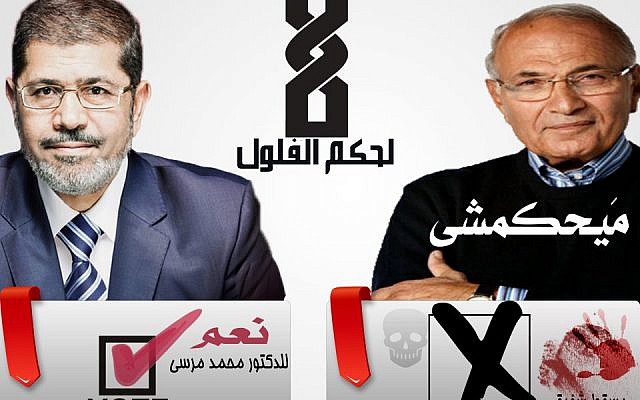
“If your dispute with Morsi is political, our dispute with Shafiq is criminal,” declared a poster published on a pro-revolution Facebook page called “honor to the martyrs.”
The page juxtaposed the images of Morsi and Shafiq, with a check-mark next to the first; and a bloody hand-print accompanied by a black X-mark next to the second. “If the run-off is between Shafiq and Morsi, yes to Morsi and no to the remnants,” read the caption.
It will be difficult for Shafiq’s staunch opposition — be it Islamist or secular — to admit that a significant portion of Egyptian society still reminisces about the stability and certainty of the Mubarak era. Now it will be up to the Muslim Brotherhood to convince skeptical Egyptians to support the promise of an unknown future.



The Times of Israel Community.