

Putin, Cameron thrown off by Damascus bombing
British and Russian leaders fail to find common ground on Syria; opposition congratulates Iranian president-elect
 Add ToI as a Preferred Source on Google
Michael Bassin is a founding member of the Gulf-Israel Business Council, a co-founder at ScaleUpSales Ltd, and the author of "I Am Not a Spy: An American Jew Goes Deep In The Arab World & Israeli Army."
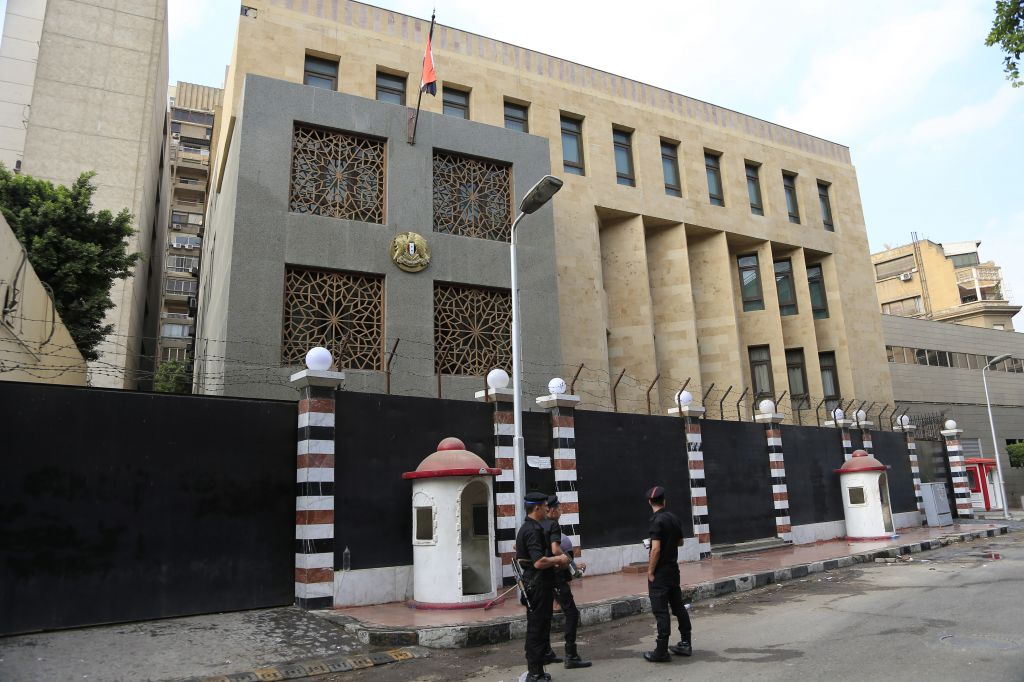
A car bomb at a checkpoint near a major military airport in the Damascus suburb of Mezzeh killed at least 20 Syrian soldiers on Sunday night. The Free Syrian Army, the umbrella organization that represents the military wing of the Syrian opposition, took responsibility for the attack, which struck painfully close to Syrian President Bashar Assad’s main headquarters, Arab media report.
“Large explosion hits Mezzeh airport in Damascus,” reads the leading headline on the website of the Dubai-based media channel Al-Arabiya. The outlet reports that the airport that was targeted is manned primarily by Syrian special forces troops as well as Iranian Republican Guards.
The airport was historically used as the personal airport of the Assad family. However, at the start of the civil war, it was converted into an artillery and rocket base to target rebel neighborhoods on the outskirts of Damascus.
The London-based pan-Arab daily Al-Hayat reports that the attack put a major damper on talks between British Prime Minister David Cameron and Russian President Vladimir Putin in London on ways to defuse the Syrian civil war ahead of the upcoming G8 summit. This past week both the United States and the United Kingdom agreed to actively provide weapons to the Syrian opposition. Both nations insist that Assad must give up power for the Syrian civil war to end.
While acknowledging that atrocities against civilians have been carried out by both the Syrian military and the opposition, Putin spoke out against supplying arms to the Syrian opposition during an awkward press conference with his British counterpart.
“I don’t think one should support people who not only kill their enemies, but also take apart their bodies and eat their organs in front of people and cameras,” Putin said. “Why does the West want to arm Syrian dissidents who eat human organs?”
‘I don’t think one should support people who not only kill their enemies, but also take apart their bodies and eat their organs in front of people and cameras’
The Saudi-owned A-Sharq Al-Awsat explains that Putin’s comments refer to reports that members of some of the Syrian opposition’s more extremist groups have eaten the organs of captured Syrian soldiers to show their power and “hunger for revenge.”
Cameron attempted to find common ground with the Russian leader. “What I got out of our discussion today is that we can overcome our differences,” he said. “We agree on the basic goal to end this conflict and prevent the disintegration of Syria. The Syrian people should decide who governs them and we must all fight against extremists.”
A major question both Putin and Cameron are apparently asking themselves is how Iranian president-elect Hasan Rowhani will approach Syria. It is unclear if Rowhani, who is favored by Iran’s reformist groups, will guide his country differently from his predecessor, Mahmoud Ahmadinejad.
Recent reports state that an additional 4,000 Iranian troops are about to deploy to Syria to assist the Assad government in suppressing the opposition. Still the Syrian opposition didn’t dally in congratulating Rowhani on his election victory, although the good wishes came with demands.
“The [Syrian] National Coalition calls on Iran’s new president to rectify errors that have occurred in the Iranian leadership over the past two years,” reads a statement drafted by the political body of the Syrian opposition, as reported in the London-based daily Al-Quds Al-Arabi.
“We underline the paramount importance of reforming the Iranian position. The [Iranian] leadership must internalize, before it is too late, that the will of the Syrian people is invincible and that no external aggression will break them.”
Despite the Syrian opposition’s efforts, and even Rowhani’s wishes, it is unlikely that Iranian policy on Syria will change much in the interim. It is widely assumed that despite the president’s position as “head of state,” the main power holder in Iran is the supreme religious leader, Ayatollah Ali Khamenei.



The Times of Israel Community.