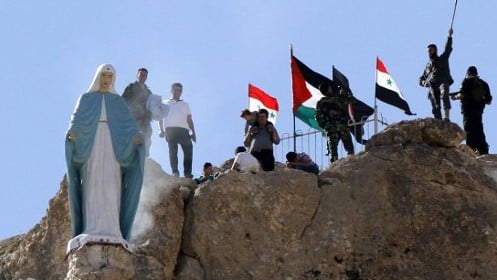
Members of the Syrian National Defense Forces (NDF) stand behind a statue of Virgin Mary perched on the cliffs overlooking the ancient Christian town of Maalula, 56 kilometers northeast of the Syrian capital Damascus, on June 13, 2015 after the statue was restored to its original place. (AFP PHOTO / LOUAI BESHARA)
The historic Christian Syrian town of Maaloula celebrated Saturday as a new statue of the Virgin Mary was erected in its center, replacing the figure destroyed in rebel attacks in 2013.
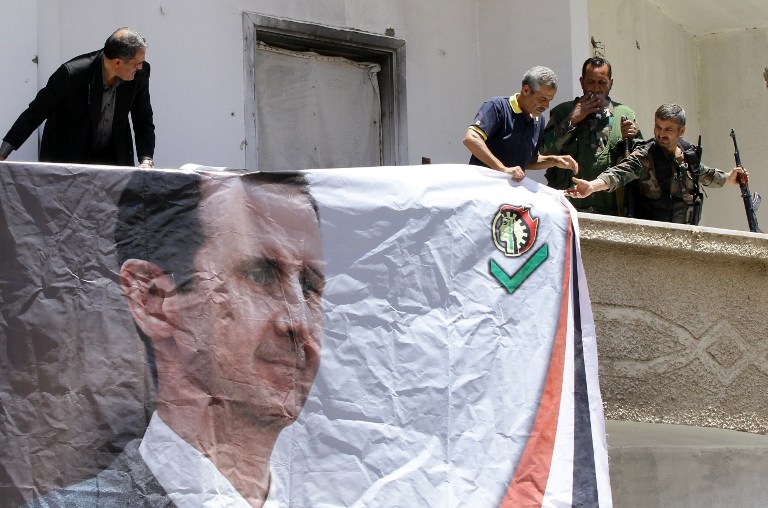
Dozens of families gathered alongside government officials and religious dignitaries in the main square, which was adorned with government flags and a giant portrait of Syrian President Bashar al-Assad.
Located north of Damascus, Maaloula is one of the world’s oldest Christian settlements, and its inhabitants still speak Aramaic, the language of Jesus.
In April 2014, government troops backed by pro-regime militia recaptured the town from rebel groups, including Al-Qaeda’s Syrian affiliate Al-Nusra Front.
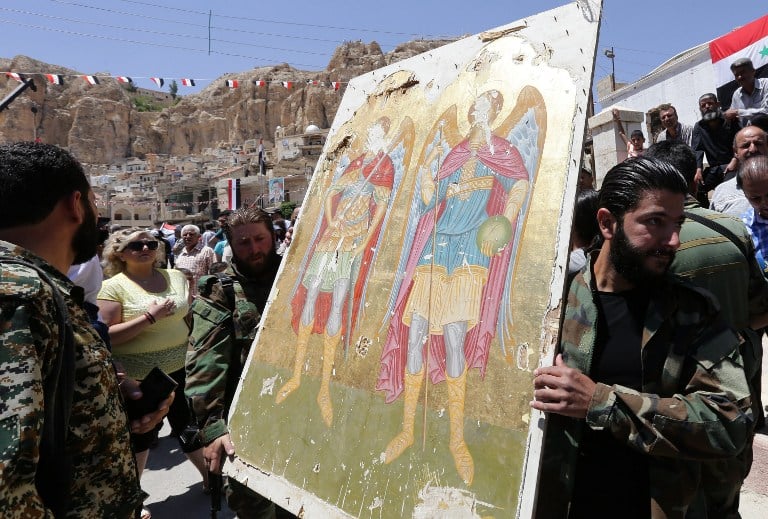
Members of the Syrian National Defense Forces (NDF) carry an icon in order to restore it to its original place on June 13, 2015 in the ancient Christian town of Maaloula, 56 kilometers northeast of the Syrian capital Damascus. (AFP PHOTO / LOUAI BESHARA)
The fighting damaged the ancient Mar Sarkis monastery and forced the town’s 5,000 people to flee their homes and abandon their modest storefronts.
Get The Times of Israel's Daily Editionby email and never miss our top stories
On Saturday, Syrian officials unveiled the new statue of the Virgin Mary, draped in a white robe topped with a blue shawl, her hands lifted in prayer.
“I made the statue as a message of peace for the ancient and unparalleled town of Maaloula,” said sculptor Buhaij al-Khoury.
Syrians, including members of the Syrian National Defense Forces (NDF), hang a portrait of President Bashar al-Assad on June 13, 2015 in the ancient Christian town of Maaloula, 56 kilometers northeast of the Syrian capital Damascus. (AFP PHOTO / LOUAI BESHARA)
The fiberglass figure stood at just over three meters (10 feet) tall and was placed on the base of the original statue.
Advertisement
“The statue was a symbol of protection for me, and when it was gone I felt a huge loss,” said Samya, a pharmacist and resident of Maaloula.
“Maaloula is now back to normal with the return of the statue,” the young woman said.
Help us report truthfully on social media
As a multimedia journalist, my job is to take the quality, fact-based journalism produced by The Times of Israel newsroom and make it accessible across every platform — from Instagram posts to podcasts to short-form videos.
This is how many, especially young people, consume news these days. But misinformation is rampant on social media. Our team at ToI produces accurate, responsible short-form reporting on Israel and the Jewish world.
If you believe in the importance of factual social media journalism, please consider joining our reader support group, The Times of Israel Community. Your financial support is essential to sustain responsible multimedia reporting.
We’re really pleased that you’ve read X Times of Israel articles in the past month.
That’s why we started the Times of Israel - to provide discerning readers like you with must-read coverage of Israel and the Jewish world.
So now we have a request. Unlike other news outlets, we haven’t put up a paywall. But as the journalism we do is costly, we invite readers for whom The Times of Israel has become important to help support our work by joining The Times of Israel Community.
For as little as $6 a month you can help support our quality journalism while enjoying The Times of Israel AD-FREE, as well as accessing exclusive content available only to Times of Israel Community members.
Thank you, David Horovitz, Founding Editor of The Times of Israel


 Add ToI as a Preferred Source on Google