Assad’s son takes part in math competition in Romania
Hafez, the Syrian president’s 16-year-old, asks to be treated as a normal student as his country is racked by a civil war that has left over 350,000 dead and millions displaced
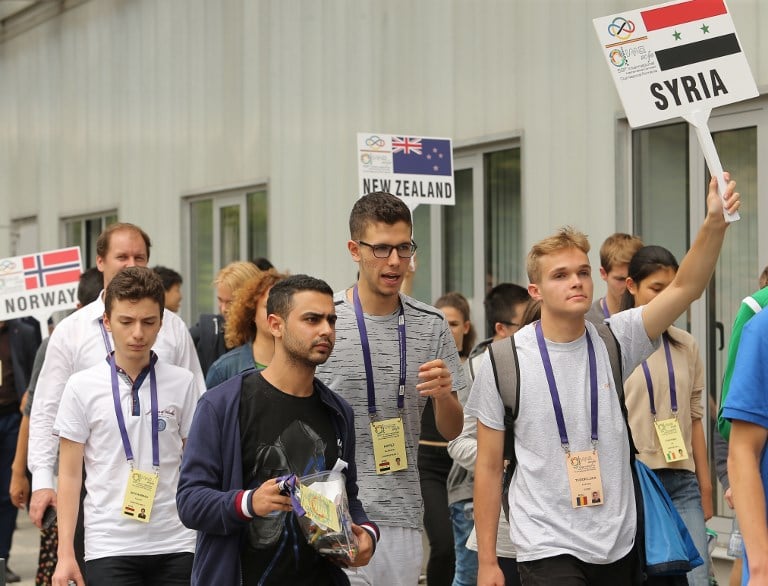
Hafez Assad (C), son of Syrian President Bashar Assad, attends the International Maths Olympics in Cluj Napoca city July 10, 2018 (AFP PHOTO / Mircea ROSCA)
BUCHAREST, Romania — The teenage son of Syrian President Bashar Assad is competing in the International Mathematical Olympiad in Romania, where he has asked to be treated like any normal student, a Romanian education official said Tuesday.
Hafez Assad, 16, is one of 615 students participating in the annual competition, which this year is being held in the central town of Cluj-Napoca until Saturday.
He already took part in last year’s competition in Rio de Janeiro in Brazil, where he finished in 528th place out of a total of 615.
“He wants to be treated like a normal student and he acts like one. He checked into a hotel alongside students from 18 countries,” Valentin Cuibus, head of the town’s schools inspectorate, told AFP.
Hafez Assad, son of Syrian President Bashar Assad, attends the International Maths Olympics in Cluj Napoca city, July 10, 2018. (AFP PHOTO / Mircea ROSCA)
Each country represented has a team of six students.
Get The Times of Israel's Daily Editionby email and never miss our top stories
According to Romanian media reports, security has been stepped up for the event.
Romania is one of the few European countries that still has an embassy in Syria, which has been battered by more than seven years of conflict that has left more than 350,000 people dead, millions more displaced and the country in ruins.
Romania is a popular destination for Syrian students, with thousands graduating from its universities in the last two years.
Advertisement
Help us report truthfully on social media
As a multimedia journalist, my job is to take the quality, fact-based journalism produced by The Times of Israel newsroom and make it accessible across every platform — from Instagram posts to podcasts to short-form videos.
This is how many, especially young people, consume news these days. But misinformation is rampant on social media. Our team at ToI produces accurate, responsible short-form reporting on Israel and the Jewish world.
If you believe in the importance of factual social media journalism, please consider joining our reader support group, The Times of Israel Community. Your financial support is essential to sustain responsible multimedia reporting.
We’re really pleased that you’ve read X Times of Israel articles in the past month.
That’s why we started the Times of Israel - to provide discerning readers like you with must-read coverage of Israel and the Jewish world.
So now we have a request. Unlike other news outlets, we haven’t put up a paywall. But as the journalism we do is costly, we invite readers for whom The Times of Israel has become important to help support our work by joining The Times of Israel Community.
For as little as $6 a month you can help support our quality journalism while enjoying The Times of Israel AD-FREE, as well as accessing exclusive content available only to Times of Israel Community members.
Thank you, David Horovitz, Founding Editor of The Times of Israel


 Add ToI as a Preferred Source on Google