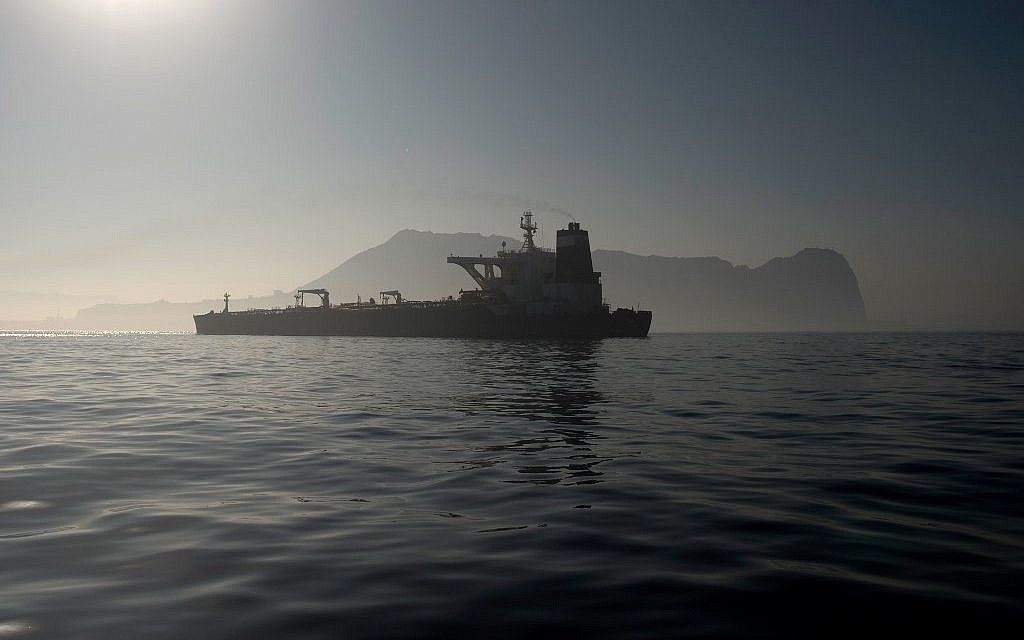
The Iranian supertanker Grace 1 is seen off the coast of Gibraltar on August 15, 2019. (Jorge Guerrero/AFP)
Greece’s deputy foreign minister announced Wednesday that his government will not help an Iranian oil-tanker approaching its shores deliver oil to Syria, Reuters reported.
“We have sent a clear message that we would not want to facilitate the trafficking of this oil to Syria in any instance,” the news agency quoted Miltiadis Varvitsiotis as telling Greece’s ANT1 television network.
The Adrian Darya 1, previously Grace 1, is an Iranian supertanker with $130 million worth of light crude oil that the United States suspects is tied to a sanctioned organization.
“This is a VLCC, a very large crude carrier … There is no Greek port that could accommodate a VLCC,” Varvitsiotis said, adding that if the ship entered his country’s waters “we will see what will happen.”
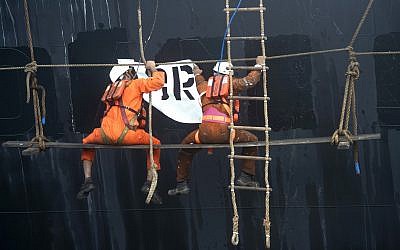
Crew members of the Grace 1 super tanker remove the name of ship in the British territory of Gibraltar, August 17, 2019. (AP Photo/Marcos Moreno)
The vessel left Gibraltar late Sunday after having been detained for a month in the British overseas territory for allegedly attempting to breach European Union sanctions on Syria. Gibraltar authorities rejected attempts by the US to seize the oil tanker again, arguing that EU regulations are less strict than US sanctions on Iran.
Get The Times of Israel's Daily Editionby email and never miss our top stories
Gibraltar said it had been assured by Iran that the tanker wouldn’t unload its cargo in Syria.
Iranian government officials have yet to publicly acknowledge the ship’s next destination, or where it will discharge its cargo of 2.1 million barrels of crude oil. Iran has denied it was ever headed for Syria.
US Secretary of State Mike Pompeo warned Tuesday that anyone who “touches,” supports or allows the tanker to dock risks US sanctions.
Advertisement
Help us report truthfully on social media
As a multimedia journalist, my job is to take the quality, fact-based journalism produced by The Times of Israel newsroom and make it accessible across every platform — from Instagram posts to podcasts to short-form videos.
This is how many, especially young people, consume news these days. But misinformation is rampant on social media. Our team at ToI produces accurate, responsible short-form reporting on Israel and the Jewish world.
If you believe in the importance of factual social media journalism, please consider joining our reader support group, The Times of Israel Community. Your financial support is essential to sustain responsible multimedia reporting.
We’re really pleased that you’ve read X Times of Israel articles in the past month.
That’s why we started the Times of Israel - to provide discerning readers like you with must-read coverage of Israel and the Jewish world.
So now we have a request. Unlike other news outlets, we haven’t put up a paywall. But as the journalism we do is costly, we invite readers for whom The Times of Israel has become important to help support our work by joining The Times of Israel Community.
For as little as $6 a month you can help support our quality journalism while enjoying The Times of Israel AD-FREE, as well as accessing exclusive content available only to Times of Israel Community members.
Thank you, David Horovitz, Founding Editor of The Times of Israel


 Add ToI as a Preferred Source on Google