Bolsonaro says he feels ‘very well’, praises hydroxycholoroquine
After WHO concludes controversial drug doesn’t help treat COVID-19, Brazilian president says ‘it worked’ for him, days after confirming he was infected
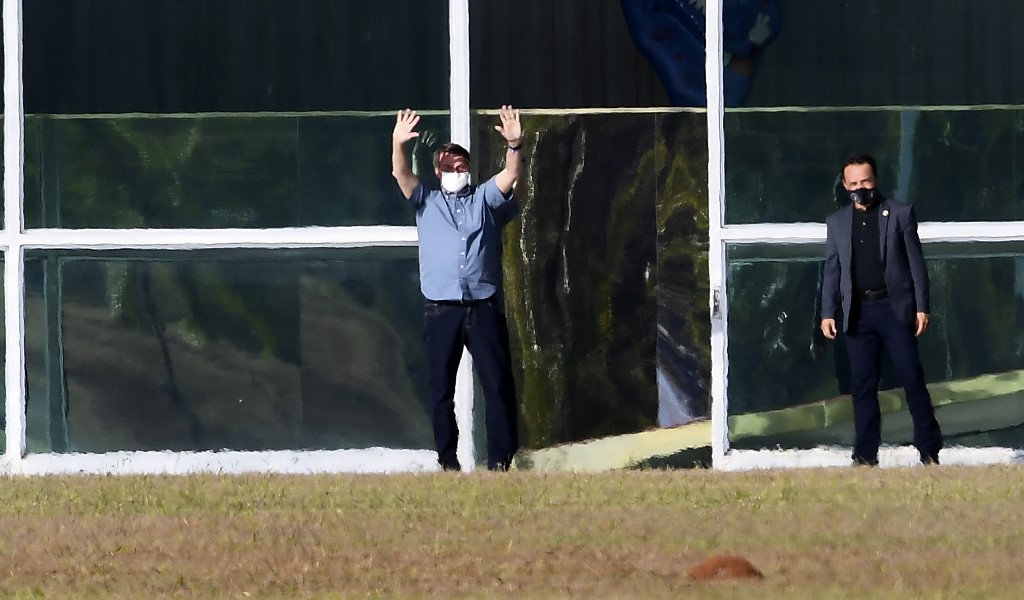
Brazilian President Jair Bolsonaro waves outside Alvorada Palace in Brasilia on July 9, 2020. (Photo by EVARISTO SA / AFP)
BRASILIA, Brazil — Brazilian President Jair Bolsonaro, who has tested positive for COVID-19, said on Facebook Thursday that he was “very well” and again advocated the use of the controversial drug hydroxychloroquine.
Bolsonaro, 65, appeared in his weekly Facebook Live post at his official residence. He appeared to be in good shape and was not accompanied, as is often the case, by ministers or senior officials, and the usual sign language interpreter was not present.
Since the beginning of the crisis, the far-right president has dismissed the seriousness of the epidemic and criticized containment measures ordered by governors in Brazilian states.
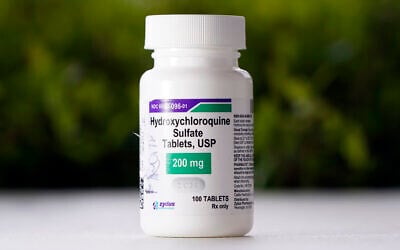
A bottle of hydroxychloroquine tablets in Texas City, Texas, April 7, 2020. (AP Photo/David J. Phillip, File)
The drug, originally tested to fight malaria, has been pushed as a treatment for COVID-19 in many countries — but its effectiveness has not been formally proven and the issue is deeply dividing the global scientific community.
Get The Times of Israel's Daily Editionby email and never miss our top stories
The World Health Organization this week halted trials on the drug, claiming it does not help against the disease.
“I’m saying this very clearly,” Bolsonaro said in his video. “I took (hydroxychloroquine) and it worked, and I’m fine, thank God. And let those who criticize it at least offer an alternative.”
He did, however, deny making “propaganda for hydroxychloroquine.”
Advertisement
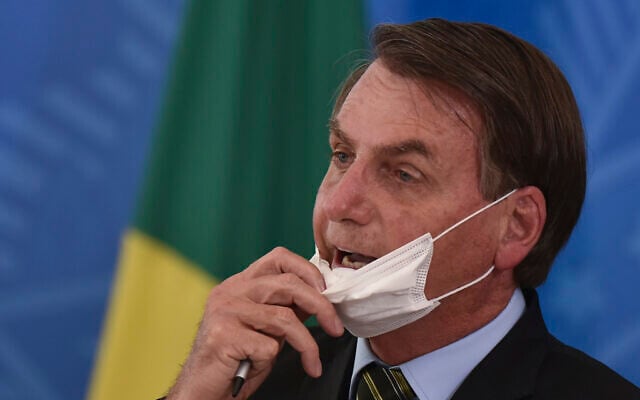
Brazil’s President Jair Bolsonaro removes his mask to speak to journalists after a press conference on the new coronavirus, at the Planalto Presidential Palace in Brasilia, Brazil on March 18, 2019. (AP/Andre Borges)
Brazil is currently the second country hardest-hit country in the world by the pandemic, behind the United States.
The death toll on Thursday was 69,184, with an increase of 1,224 in the previous 24 hours.
Help us report truthfully on social media
As a multimedia journalist, my job is to take the quality, fact-based journalism produced by The Times of Israel newsroom and make it accessible across every platform — from Instagram posts to podcasts to short-form videos.
This is how many, especially young people, consume news these days. But misinformation is rampant on social media. Our team at ToI produces accurate, responsible short-form reporting on Israel and the Jewish world.
If you believe in the importance of factual social media journalism, please consider joining our reader support group, The Times of Israel Community. Your financial support is essential to sustain responsible multimedia reporting.
We’re really pleased that you’ve read X Times of Israel articles in the past month.
That’s why we started the Times of Israel - to provide discerning readers like you with must-read coverage of Israel and the Jewish world.
So now we have a request. Unlike other news outlets, we haven’t put up a paywall. But as the journalism we do is costly, we invite readers for whom The Times of Israel has become important to help support our work by joining The Times of Israel Community.
For as little as $6 a month you can help support our quality journalism while enjoying The Times of Israel AD-FREE, as well as accessing exclusive content available only to Times of Israel Community members.
Thank you, David Horovitz, Founding Editor of The Times of Israel


 Add ToI as a Preferred Source on Google