






 Add ToI as a Preferred Source on Google
Welcome to The Times of Israel’s Daily Briefing, your 20-minute audio update on what’s happening in Israel, the Middle East and the Jewish world.
Editor David Horovitz joins host Amanda Borschel-Dan for today’s episode.
WATCH the full episode here:
During the course of the G7 summit of global leaders in France on Tuesday, US President Donald Trump said that Syria should replace Israel in the fight against Lebanon’s Hezbollah. He argued that the Jewish state’s war on the Iran-backed terror group has been too prolonged and indiscriminate, adding that Israel would have been “blown off the face of the earth” if not for him. Horovitz unpacks the multilayered concerns plaguing Israel in the wake of Trump’s statements.
More from The Daily Briefing
 September 29, 2026
Daily Briefing Sept. 29: Board of Peace envisions transformation in Gaza, and Israel
 September 28, 2026
Daily Briefing Sept. 28 - ToI's military correspondent reviews 'NAZA'
 September 27, 2026
Daily Briefing Sept. 27 - The curious timing of the Oct. 7 allegations against the PM
 September 25, 2026
Daily Briefing Sept. 25 - The PM's speech: Fiery rhetoric, inside and outside the UN
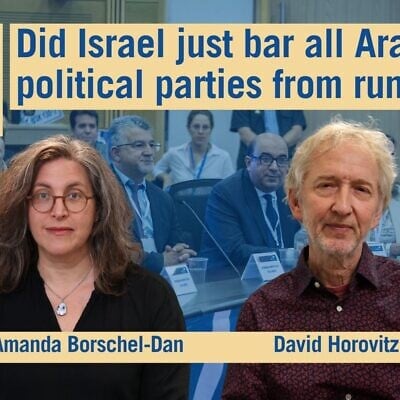 September 24, 2026
Daily Briefing Sept. 24 - Did Israel just bar all Arab political parties from running? Not so fast
The US-Iran memorandum of understanding, expected to be signed at an in-person gathering on Friday, reportedly provides for a full cessation of hostilities by Iran, the United States and their allies — including in Lebanon, where Israel has been battling Tehran’s proxy Hezbollah. This comes as Israel and Lebanon are nearing a US-mediated lasting ceasefire agreement, according to a Tuesday report. If the IDF were to withdraw from southern Lebanon, are Lebanese forces really strong enough to face Hezbollah?
Finance Minister Bezalel Smotrich claimed on Tuesday to have “abolished” components of the 1997 Hebron agreement that gave the Palestinian municipal council of Hebron authority over planning, zoning and construction in the H2 zone of the West Bank city, where the Jewish settlement of Hebron is located along with the Tomb of the Patriarchs. Can this effort be isolated from the looming elections? Horovitz weighs in on this and the current ultra-Orthodox move in the Knesset to pass Basic Law: Torah Study.
Check out The Times of Israel’s ongoing liveblog for more updates.
For further reading:
Trump: Israel’s war on Hezbollah is too long, too deadly; Syria should fight the group instead
US-Iran deal said set to halt regional hostilities, including in Lebanon, lift blockade
Israel-Lebanon talks said close to yielding lasting ceasefire deal
Smotrich says he’s ‘abolished Hebron agreement,’ given Israel more power in flashpoint city
Netanyahu denounces ‘police state’ trial as his cross-examination ends after over a year
Subscribe to The Times of Israel Daily Briefing on Apple Podcasts, Spotify, YouTube, or wherever you get your podcasts. This episode was produced by Yitzchak Ledee.
Check out yesterday’s episode here:
Today’s Transcript:
Amanda Borschel-Dan: Welcome to the Times of Israel’s Daily Briefing. Today is Wednesday, June 17. I’m Amanda Borschel-Dan here in our Jerusalem studio with founding editor David Horovitz. David, thank you so much for joining me today.
David Horovitz: Hi, Amanda, how are you doing?
Borschel-Dan: I’m okay. How are you doing?
Horovitz: I’m good, thanks.
Borschel-Dan: Good to hear it. Today, we are going to discuss the growing chorus of voices that are saying that Israel is perpetrating disproportionate force in Lebanon. And the leader of this chorus right now is US President Donald Trump. We’ll also hear more reported details of the memorandum of understanding between the United States and Iran. And we’ll talk about rumors or reports of an emerging ceasefire deal between Israel and Lebanon. All of this and more when we’re back.
And we’re back. I’m Amanda Borschel-Dan here in our Jerusalem studio with founding editor David Horovitz. David, the relationship between Israel and the United States has been a bit rocky for several weeks, but we haven’t heard such strong condemnation of Israel as what we heard yesterday from the G7 summit from US President Donald Trump. So, let’s review, a little bit, the statements that he made yesterday about Israel’s use of force in Lebanon.
US President Donald Trump’s on Israel’s force in Lebanon
Horovitz: Right, well, you’re, first of all, absolutely right to say things have taken a decidedly problematic turn, and not only yesterday. Lots of abusive language directed by the president at [Prime Minister Benjamin] Netanyahu, some of it reportedly private and some of it confirmed by him publicly, as the Iranians and the Americans have moved towards this memorandum of understanding, and Israel is the troublesome element there, saying, “This is a terrible deal, don’t do this.”
Not only Israel, but we should add the CIA director [John Ratcliffe], apparently, the American Defense Secretary [Pete Hegseth], and so on. “The Iranians are playing you, Mr. President.” I’m sure they didn’t say it like that. But it’s this very friction-filled moment in which an American president is trying to get out of the war that he and Netanyahu launched on terms that Israel doesn’t want. And you see that, you see that in what you hear directly from the president and what we are told he has said to Netanyahu in some of their calls. And then indeed yesterday at the G7, in a sort of a press conference, he didn’t give a speech as far as I know at the G7.
There were lots of things said on the sidelines, but at an event with the leader of Qatar [Sheikh Tamim bin Hamad Al Thani], of course, Israel is not at the G7, Netanyahu was not invited, and who knows, maybe he would’ve been arrested because of the arrest warrants against him. He was also giving testimony in his trial yesterday, his last day of cross-examination. He’s not there; the president is there. And among the things that the president said, basically, he called Israel, or Netanyahu, but I think kind of Israel, we’re a bunch of ingrates because we would not exist were it not for him.
And he formulated that as without the United States, we wouldn’t exist, because Iran would’ve blown us up, they would’ve got the bomb. And he also said, me personally, because not [former president Barack] Obama, Obama wouldn’t have stopped the Iranians. Thanks to me, you’re all here. And then he went on this verbal rampage against Israel as regards to Lebanon, as though he was one of our biggest critics, our veteran critics. Why, for no reason, are you doing such damage to Lebanon? Just because there’s one person who you’re trying to get, you don’t have to blow up the entire building. It’s all been going on for so long. And then it was the real clincher. “I think Syria should take care of Hezbollah. I think they’d do a better job of it than Israel, to be honest,” Right? Now remember, Syria used to be led by the Assad dynasty, which was mass murdering its own people. And then it was taken over by a new leader [Ahmed al-Sharaa] who, until December 2024, if my memory serves, had a $10 million American bounty on his head because he was a terrorist. He ousted [Bashar al-]Assad. You’ll recall that Trump met with him and was very impressed by him.
Tough guy, fought wars, you know? Like he was gushing over him. And now he’s decided that a veteran Islamic mass murderer, killer, who the Americans wanted as a terrorist, he’d do a better job of fighting those other Iranian-supported murderers and terrorists, Hezbollah, a US-designated terrorist organization, obviously, we need to remind President Trump. And it’s as though, really, without wanting to be cynical, but really being rather despairing, it’s as though he doesn’t appreciate who we’re dealing with here. An Iranian regime that mass murdered its own people, that is trying to wipe out Israel. So he knows that, but at the same time, he told us yesterday, very rationally, “I didn’t really care about regime change.” So now we’re rewriting the history of the war. And then Hezbollah, “Well, you know, let the Syrians take on Hezbollah. And why are you doing so much damage?” I don’t know how to sum it up effectively enough, but I think that what we’re hearing from the voices like the CIA director, the defense secretary, the secretary of state [Marco Rubio], not publicly, but privately in consultations with the president, are very wary about what is happening. Nobody wants to cross the president.
He’s mercurial, unpredictable. Again, there are many adjectives one could use, but this is a nightmare scenario. We’ve had difficult scenarios before. We now have a president about to sign a deal that we think is horrific, and we can elaborate on that in a moment, for the Iranians’ interests, for American interests, for the free world’s interests, certainly for Israel’s interests. And we’re openly being battered by the American president, who just a few weeks ago, at the end of February, went to war with us to create the climate for the regime to fall, to stop its nuclear program, to stop its ballistic missile program, to stop its support for proxies, to stop its worldwide terrorism. And they’re signing a deal that does none of those things.
Borschel-Dan: Let’s add one more wrinkle to this, and this is the reports of a ceasefire deal being reached between Israel and Lebanon. And currently, the conventional thinking, as far as I know, is stating that the Lebanese forces are not strong enough to take on Hezbollah. But what we’re hearing in terms of the reported details from this potential ceasefire is that the Lebanese Army is supposed to pick up the vacuum in southern Lebanon, and the IDF is supposed to pull out. So this obviously is also cause for alarm for Israel because, without this buffer zone, the residents of the North don’t feel secure in their homes. Even with it, they don’t feel secure in their homes right now. And the idea that a very weak force is going to be guarding their lives is extremely troubling, to say the least.
Realities of potential ceasefire deal between Israel and Lebanon
Horovitz: It’s like we’ve taken leave of the real world, basically. Israel and Lebanon, it’s great if there’s a peace agreement, which this isn’t going to be, or a truce agreement or whatever it is. But they are not the only two players who are relevant in Lebanon. The other two players are certainly Hezbollah and, by extension, Iran, which supports, arms, and inspires Hezbollah. So again, very nice if Israel and the Lebanese government are of one mind that we want peace for Lebanon and for Israel. That’s great. But signing a deal in which the terms do not guarantee peace for anybody, most especially because you’ve said the Lebanese Army isn’t strong enough to ensure peace where Hezbollah is concerned, and because Hezbollah is not part of the deal. I mean, that’s just absurd. And then you move over to the reported terms of the framework deal that Iran and the United States are supposed to formally sign on Friday, having already virtually signed it. That also has provisions that relate to Lebanon. They’re just not realistic. Iran commits, and so does the United States, that they themselves and their allies will stop fighting each other, but they won’t.
They won’t. Hezbollah will not stop fighting Israel. Now, Israel’s not required under the framework deal, as far as we know, to withdraw from southern Lebanon, but it is in theory, America is obligating that it will stop Israel from doing anything in Lebanon. I mean, again, we’re not in the real world here.
Borschel-Dan: Yeah. We also don’t have the fine-tuned details of this memorandum of understanding. There are many leaked reports, and we’ve linked to something on our site that details 14 different points. And we’re also hearing at the same time, US Ambassador to Israel, Mike Huckabee, stating, reiterating, saying again and again that Israel definitely has the ability to defend herself.
So we don’t know the final details, but the narratives that we’re hearing from the United States: that this is the holy grail of peace in the Middle East, that this memorandum of understanding is going to lead to a new era in the Middle East, and that Iran is going to have new partnerships with the Gulf states. And it’s this messianic fervor that I’m hearing from the United States that again worries me that they are not grounded in the realities of what actually happens here in the Middle East with the missiles firing, the tit-for-tat, and the escalations that could happen again. just like that.
Horovitz: If the terms that we have reported, which are not official, but which are of the same broad outline as everything we’ve heard so far, if those are more or less accurate, again, it’s a farce. And the United States and the Trump administration, put it gently, should be ashamed of themselves. And it’s not gonna work. You look at some of the wording, right? Iran’s gonna maintain the status quo on its nuclear program. Well, there is no status quo. The moment it can, it tries to advance its nuclear program.
Borschel-Dan: That’s the status quo.
Iran’s nuclear capabilities
Horovitz: So it has enriched uranium to 60%, enough for 10, 11 bombs. I remember a few months ago now, earlier this year, Steve Witkoff, one of the key American negotiators, just in an interview talking about how astounded he was that the Iranians with whom he was negotiating were openly bragging that they had evaded all oversight, in other words, broken all the rules and all the solemn commitments, and enriched enough uranium for 11 bombs. And now this deal leaves that enriched uranium there and gives Iran vast amounts of money without, at this stage, requiring, as was promised by the American president, the removal of the 60% enriched. Other experts have said, “Yeah, you need to get also the 10 tons of somewhat enriched.” This document, as far as we know, talks about Iran’s nuclear needs. It doesn’t even have the decency, or — I don’t even know what the word would be — to say Iran’s peaceful nuclear needs. They weren’t required to say that. Hey, we have nuclear needs too. Don’t ask us what those are, hahaha. That is set out in the black and white, and the only reason really why Trump has moved towards this deal is to get the Strait of Hormuz open, this terrible Achilles heel that, as far as we know, CENTCOM was supposed to prevent Iran from leveraging, from taking control of the strait.
That was one of the defining failures of this resort to force at the end of February. All that’s in there on the Strait of Hormuz is for 60 days; Iran will make sure that stays open and won’t charge tolls. That’s great. So, in other words, first of all, we wouldn’t believe any deal about the Strait of Hormuz anyway, but even the ostensible deal does nothing more than, yeah, we’ll give you 60 days where we’re not gonna cause more trouble. Meanwhile, give us vast amounts of money and let us have all the nuclear assets that we have right now, then you’re not gonna target them, you’re not gonna bring out the uranium and all the other things that have failed.
And you know, cap it all, as I said, you’ve got Trump yesterday saying, “Yeah, I was never too bothered by regime change. The regime has changed three times. These are new, lovely, wonderful, rational people.” They’re very rational, but their goals are not what we would consider rational goals. So they’re really smart. They’ve weighed their interests, they’ve weighed yours, they’ve outsmarted you because they know you’re desperate because you’ve told them that you’re desperate.
So rational, yes, with goals that we would not consider rational.
Borschel-Dan: Let’s go to a short break.
And we’re back. I’m Amanda Borschel-Dan here in our Jerusalem studio with founding editor David Horovitz. David, as part of the 14-point leaked memorandum of understanding, Iran has promised not to pursue nuclear weapons.
Horovitz: So that’s okay, we can stop the conversation right there. So that’s taken care of; everyone can sleep soundly in their beds. Great, yes.
Borschel-Dan: Yes, okay, so they promised this, and my real question is this. All of these statements are being made by Trump at the G7, right? And so first of all, just remind our listeners what is the G7? And my real question is, how do you think this influences how Trump is handling this negotiation right now?
Trump at the G7 Summit
Horovitz: You mean the fact that he’s there at this summit of the world’s leading industrial nations, the key players here? You’re wondering whether they’re pushing him in this direction or?
Borschel-Dan: So we’re talking about seven of the leading nations in terms of the economy. This isn’t meant to be an economic forum to begin with. But having all of the top-tier, shall we say, cronies for US President Donald Trump, I don’t know, in my mind, I’m just imagining that he saw this on the calendar and he said, “Okay, I’m gonna be here. When I get there, something has to be completely on track in terms of Iran. Otherwise, I can’t monopolize the whole summit and change the entire agenda for it.” It’s meant to talk about the economy. It’s meant to talk about cancer research, the environment, and things of that nature. But of course, right now it’s all, Iran, Iran, Iran. So I guess I propose to you that this G7 is extremely significant in terms of the timeline and the outcome of these negotiations.
Horovitz: I’m not sure. You might be right, you might not. It might have something to do with his birthday. He wants to get something done by a certain time. But the fact is, we’ve seen him being desperate to get it done for weeks. So I’m not sure that the G7 is particularly central. He didn’t have to go to the G7. He’s quite capable of saying and doing anything at any time. If there hadn’t been a deal, he would’ve found the right words as far as he was concerned for that moment. Remember, again, this is somebody who contradicts himself not only from one day to another, but from one hour to another, within the same short statements, he can say things that appear to be contradictory. I’m not sure it’s a hugely supportive audience, unanimously. I would imagine that some of the major powers are very troubled by this. They’re seeing the rise of Iran. They’re seeing a deal that, if they look at it in the cold light of day, they will realize continues to give Iran, for the time being at least, immense leverage over the Strait of Hormuz in an arrangement that also gives them loads of money upfront at the beginning here, access to colossal sums of money.
That means there’s lots of money for them to keep their restive population relatively less restive. Some of the protests have been over the economy. Again, these are “rational people” in terms of their own interests, so they will want to minimize opposition at the same time as showing the iron hand and killing and executing people guilty of “dissent.” So I’m not sure that he was on home turf to the extent that he might have been at certain other forums. He’s getting pushback from some parts of the Republican Party. There are still large numbers of sycophants who applaud everything he does, but sensible, smart people, looking with their eyes open at what is playing out here, if they’re honest with themselves, we’re so far from “hmm, maybe that’s a bit problematic.” We’re in “this is a catastrophe” territory. And I don’t know if anyone behind the scenes there, we saw he had a little appearance with [President of France Emmanuel] Macron a couple of days ago. I didn’t see Macron publicly dissenting. These people are wary of the United States; he can do tremendous harm to the economies of countries that would give him any grief. That’s one of the reasons why Israel is in a pretty difficult position, because, obviously Netanyahu did not say, “That sounds great, Mr. President.”
We’ve not heard Netanyahu say, “This is a wonderful deal, thank goodness the president has negotiated it.” We’ve heard Netanyahu really not directly commenting on the terms and saying things like, “President Trump believes he can—” Duh, duh, duh, duh, duh. But, you know, we’re at odds with the United States because we’re trying to survive here.
Borschel-Dan: Right. And of course, Netanyahu said, “I don’t know the details of the deal itself,” which was pretty stunning from his press conference the other night. But let’s turn our gaze to Netanyahu and more domestic matters. So we’re, of course, in an election year, as we’ve reminded our listeners umpteen times and will continue to do so. And as you mentioned, Netanyahu finished his cross-examination in one of his trials. So, many things are in play here in terms of the elections, but the coalition as it stands right now is basically pinned down by the Haredi vote and also the more extremist far-right vote, [MK] Itamar Ben-Gvir and the [Finance Minister Bezalel] Smotrich parties. And yesterday we saw some movement in terms of Bezalel/Smotrich pandering, or at least playing to his electorate in terms of Hebron and the Tomb of the Patriarchs. Do you want to tell us what happened here?
Bezalel Smotrich abolishes the Hebron Agreement ahead of elections
Horovitz: Yeah, I don’t think Smotrich is pandering to his electorate. Bezalel Smotrich wants Israel to annex the West Bank, the biblical Judea and Samaria. He was given not only the post of finance minister, but a defense ministerial position. He’s not the defense minister, but he has a ministerial position in the defense ministry. He has responsibility for settlements. He has influence as regards Israeli policy in the West Bank. It’s never been particularly clearly defined. And yesterday, he essentially, I think he said he was scrapping the Hebron Agreement, which is the arrangement by which this uniquely complicated West Bank city, because you have an Israeli settlement in the heart of a largely Palestinian city. He said he’s basically abolished that agreement, including as regards the control over the Tomb of the Patriarchs, the Cave of the Patriarchs, holy to both Islam and Judaism. Very complicated arrangements were worked out there. He’s basically said, “I’m abrogating them.” Now, I think official Israel, which he’s part of, so I don’t know where official Israel starts in non-Smotrich territory, is saying, “No, nothing has been canceled.” The PA, the Palestinian Authority, is asking the Americans to intervene. Throughout the lifetime of this coalition, we’ve had this tremendous friction between what the government ostensibly stands for and what central far-right ministers in the government say and do.
You’ve had Itamar Ben-Gvir repeatedly going to the Temple Mount and brandishing Israeli flags and praying and saying, “We allow prayer on the Temple Mount now,” and you’ve had the Prime Minister’s office saying, “Actually, no, we don’t.” But the fact is, there is prayer on the Temple Mount in a way that there wasn’t just a few years ago. And lots of things that Smotrich has said and done as regards Gaza, as regards the West Bank. And then, as you say, the other element of the coalition is the Haredi parties. We’re talking about four parties in all, right? The two Haredi parties, the two far-right parties, without them, Netanyahu has no coalition, and therefore, he has spent the entire term of this government trying somehow to keep everybody happy within this coalition. On things like the non-service of the Haredim in the army, which has caused friction between those two sets of parties. In other words, you’ve got the modern Orthodox Jews serving in very, normally, high numbers because there’s, whatever proportion they are, they go to the army, they put their lives on the line to protect this country, and the Haredi parties say to them and to the rest of us, “Well, you’re not real Jews, ’cause we’re studying Torah, and that’s the way to save and protect this country.”
Or they don’t even give you that bit, because some of them aren’t remotely Zionist or particularly Zionist. So Netanyahu is juggling all these pieces, and now in the final weeks of his government, because we have to have elections by October, what he’s really trying to do is keep them all happy and keep this bloc somewhat intact so that he runs for election in October, presumably.
Borschel-Dan: As he said he would at the press conference the other night.
Horovitz: Right, oh yeah, I’m talking about when. He’s certainly adamant that he will be running amid rumors, including from our friend President Trump, that maybe he’s a war prime minister. Did Trump say he’s been around for a long time? He’s not a young man anymore. He didn’t, probably because that would’ve reflected on him as well. But anyway, Netanyahu’s running, wants to run with a fairly solid block. But that’s as complicated as it has always been for him because the Haredim are demanding, as we know, this legislatively enshrined exclusion exemption from military service. And there’s no reconciling that with a reality in which, broadly speaking, other people are serving in Israel. And you can’t square that circle and keep everybody happy.
Borschel-Dan: Right, and so my theory is that in the next couple of months, we’re going to see rocket fuel being injected into all these different endeavors, such as the Smotrich-Hebron endeavor to say to his electorate, “Hey, vote for me again because I’m actually doing what you voted for me to do,” and the same with the Haredi parties. So let’s just conclude with an update on the Basic Law Torah study. First of all, what is this meant to be? It’s evolved somewhat, and where does it stand right now?
Update on Basic Law Torah study
Horovitz: Well, it was, I think, until a few days ago, it was a law that essentially called the study of Torah a foundational Israeli interest and enabled terms where basically it would be equated with military service. If one is studying Torah, one would be bringing the same value to the State of Israel and would be, therefore, eligible for the same benefits and conditions. In the latest draft, apparently as of yesterday, there is no longer any sort of overt equation with military service. But nonetheless, it’s legislation, it seems, that is designed when all kinds of things in terms of preferences, grants, subsidies, and so on are given to the ultra-Orthodox. And in previous iterations of this struggle, the justices have said, well, you can’t do that. They’re not doing equal service, they’re not fulfilling equal responsibilities, and therefore they shouldn’t be getting equal rights. They shouldn’t be getting subsidies on their mortgages, they shouldn’t be paid lots of money for their studies, etc. So this legislation is intended to make it harder for the justices to strike down benefits to the ultra-Orthodox, conditions for the ultra-Orthodox, and non-service for the ultra-Orthodox on the basis of inequality, because hey, here’s a basic law, ostensibly quasi-constitutional, that says it’s the same, or it’s more or less the same.
It’s all absurd because the court will strike down anything that enshrines in legislation that 13- 14% of the Israeli population do not have the obligation to do national service. And this government, if it is reelected, will continue its efforts to constrain the degree to which the court can strike down anything anyway. So it’s quite — I mean, the word is not charming — but it’s amusing that they’re trying to legislate to evade a potent, sensible, democratic Supreme Court when at the same time they’ve said publicly and they’ve moved legislation — they haven’t passed it yet — that is intended to make sure that the Supreme Court can’t be potent and independent and democratic.
Borschel-Dan: David, I think we need to finish on a totally different matter. And that’s, of course, the World Cup. And I don’t know about your household, but my household is up at all hours watching the games. And I just wonder, how are you doing so far? How are you emotionally?
FIFA World Cup
Horovitz: Yeah, I’m fairly non-obsessed. I’ve watched a little of it. All of our lives here are so relentlessly crazy. But actually, because it’s on at all hours of the day and night, there are sometimes most improbable hours when you can take 10 minutes and watch a, I will say, a football match. And it’s, I mean, from the relatively little that I’ve seen, it’s quite strikingly happy. I think that’s a very nice thing. You can see all these people in the sunshine in America, and all these supporters of this incredibly diverse range of countries, right? That’s really something. You know, Curaçao is in the World Cup, countries I bet, certainly can’t find on the map, but also the Iraqs and, let’s say it, the Irans. And in a kind of ideal world, this is lovely, right? All these people from lots of countries gathering together to enjoy people doing sports. There might be an underpinning of hostility, but even if there is, the fact that they’re taking out their hostilities in a game of football with clear rules and so on is really quite something.
And the other thing, for the genuine obsessives here, it’s really interesting to see the results because there are minnows, like nations that should not be very good at football, who are playing really well, including Iran, who tied their first game.
But others — Morocco, I think they drew 1-1 with Brazil. Brazil is one of the mightiest nations in world football, and Morocco really is not. Except this was not like a freak result. This was a nation that has become very, very good at playing football. I think Curaçao, by the way, if you had two soccer stadiums, that would be the entire population of Curaçao. I kid you not. How on earth did they get into the World Cup? So it’s very entertaining, and it’s a nice way to end a podcast because it’s actually quite a pleasure from lots of points of view.
Borschel-Dan: So continue enjoying. And David, thank you so much for joining me today.
Horovitz: Thanks, Amanda.
Borschel-Dan: Thanks for listening to the Times of Israel’s Daily Briefing. Please check out another installment tomorrow. This episode was produced and edited by Yitzchak Ledee. If you have any questions or comments about this or any other episode, please drop us an email to podcast@timesofisrael.com. Until tomorrow, shalom.

The Times of Israel Community.