






 Add ToI as a Preferred Source on Google
Welcome to The Times of Israel’s Daily Briefing, your 20-minute audio update on what’s happening in Israel, the Middle East and the Jewish world.
Legal and settlements reporter Jeremy Sharon joins host Amanda Borschel-Dan for today’s episode.
A new study conducted by a team of Israeli multidisciplinary researchers delves into accusations that Israel committed crimes against humanity, such as planned starvation and genocide, during the war against Hamas in Gaza. The authors’ objective was to conduct a rigorous factual analysis of the methodologies and evidence behind genocide claims. Sharon fills us in on how faulty source data used by reports accusing Israel of genocide may be partly to blame.
More from The Daily Briefing
 September 20, 2026
Daily Briefing Sept. 20 - IDF bolsters forces on all fronts ahead of Yom Kippur
 September 17, 2026
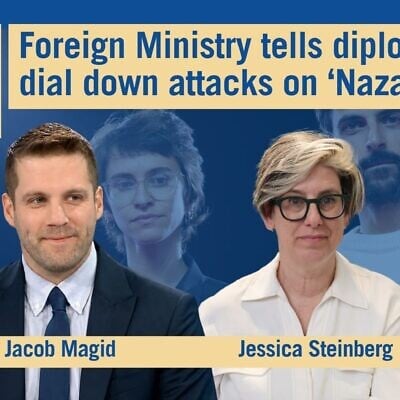
Daily Briefing Sept. 17: Foreign Ministry tells diplomats to dial down attacks on ‘NAZA’ film
 September 16, 2026
Daily Briefing Sept. 16 - From Mecca to Mokha: Houthis flex as Saudis flail
 September 15, 2026
Daily Briefing Sept. 15: How upstart parties could determine the Israeli election
 September 14, 2026
Daily Briefing Sept. 14 - IDF rejects film's claim Israel killed Gazans with AI-assisted targeting
Greta Thunberg has again set sail for Gaza on another so-called peace flotilla. We learn about the legalities of Israel’s eventual planned interception and deportation of the crew.
The High Court of Justice decided unanimously last Monday to recommend to the government that it reverse its decision to fire Attorney General Gali Baharav-Miara. The court told the government to inform it by September 14 whether it accepted the court’s recommendation to abolish the new method for firing the attorney general that the government established in June, and by extension, to undo the dismissal of Baharav-Miara. The clock is ticking. What are the next potential moves?
A kindergarten was opened in the illegal settlement outpost of Homesh on Monday, 20 years after it was evacuated under the 2005 disengagement plan, in a step that was praised by Education Minister Yoav Kisch and Finance Minister Bezalel Smotrich as boosting Israel’s control over the West Bank. Sharon delves into what the overt government support for this kindergarten represents.
Check out The Times of Israel’s ongoing liveblog for more updates.
For further reading:
US said to give Hamas, via mediator, principles for comprehensive hostage deal
High Court unanimously urges government to revoke attorney general’s dismissal
New kindergarten established at West Bank outpost evacuated under 2005 disengagement
Subscribe to The Times of Israel Daily Briefing on Apple Podcasts, Spotify, YouTube, or wherever you get your podcasts. This episode was produced by Podwaves.
Below is a full transcript of today’s Daily Briefing:
Amanda Borschel-Dan: Welcome to The Times of Israel’s Daily Briefing. Today is Sunday, September 7, day 702, or 23 months of the war. Amanda Borschel-Dan here with our legal and settlements reporter, Jeremy Sharon. Hi, Jeremy. Thanks for joining me today.
Jeremy Sharon: Good to be with you, Amanda.
Amanda Borschel-Dan: Always. Jeremy will give us a preview of a piece he’s working on about a new Israel-based report that attempts to refute allegations of genocide in Gaza. Greta Thunberg has again set sail for Gaza on another so-called peace flotilla. We’ll learn about the legalities of Israel turning them back. We’ll hear an update on the government’s efforts to oust the attorney general and finish off with a new star-studded opening of a kindergarten in the illegal West Bank settlement of Homesh. All of this and more when we’re back. I’m Amanda Borschel-Dan here with our legal and settlements reporter, Jeremy Sharon, for some updates. The United States has conveyed to the Hamas terror group a new set of principles for a comprehensive deal to end the war in Gaza, according to a Kan Public Broadcaster report this morning. In the meantime, the IDF [Israel Defense Forces] has begun striking high-rise buildings in Gaza City ahead of a major operation there, which the IDF assesses could take up to a year. The takeover plan has raised fears for the hostages still in Gaza, and the families of two captives [Alon Ohel and Guy Gilboa-Dalal] seen in a Hamas propaganda video released on Friday believe that their sons and potentially other hostages have been moved into Gaza City in recent days. In the Kan report, it said that the proposal was conveyed to the Hamas terror group via Gershon Baskin, who was a key Israeli negotiator in the deal that led to the release of IDF soldier Gilad Shalit from Hamas captivity in 2011. Jeremy, let’s turn to you. And a new study conducted by a team of multidisciplinary researchers delves into accusations that Israel committed crimes against humanity, such as planned starvation, deliberate massacres and even genocide during the war in Gaza. This study was led by Professor Danny Orbach, a military historian from the Hebrew University of Jerusalem, in collaboration with Dr. Jonathan Boxman, an expert in quantitative research. What’s interesting is the authors’ objective was to conduct a rigorous factual analysis of the methodologies and evidence behind the other genocide claims. So how did they go about checking into these claims of genocide?
Jeremy Sharon: OK, so the report is—it’s actually massive, it’s 300 pages long, and it deals with several aspects of the genocide allegations. One of the principal aspects it deals with is the claims of starvation made against Israel as a policy towards Gaza civilians. And actually that chapter, I think, takes up about 100 of the 300 pages. So that’s really one of the main focuses. And it also talks about other aspects, including allegations of deliberately targeting civilians and bombings and massacres, you know, frontal massacres of Gaza civilians. But as I said, the focus is on the issue of starvation.
And one of the major points which Orbach and his colleagues bring up is that they say that a lot of the allegations are based on false data, erroneous information—especially the basis for which the needs of Gaza civilians every day were determined. So according to Orbach and his colleagues, they said that the UN [United Nations] and other aid agencies made a false assumption that before the war, 500 trucks of aid went into Gaza every day, 150 of which had food. But if you work out the actual calculation, which needs to be based on the number of working days that the crossings operate in which trucks are delivered, it was only 292 trucks going to Gaza and only 73 of which had food items. That’s like, you know, half of what the UN was assuming. So these erroneous statistics were quoted by a lot of UN and humanitarian agencies during the course of the war, especially the beginning of the war, and also by the IPC organization, which has produced famine reports and repeatedly predicted that there will be famine—although there is famine in Gaza. So this is one of the key data points which the report pulls up.
Another issue is that the UN, including UNRWA [United Nations Relief and Works Agency], also underestimated or undercounted the actual amount of aid which Israel was putting into Gaza. And according to Orbach’s study, on average, you needed about 82 trucks of food to go into Gaza every day. And generally, Israel has either met that requirement or exceeded it, meaning that there is, in theory, enough foodstuffs going into Gaza.
Now, what Orbach said—I spoke to Orbach, I interviewed him after the final study was published last week—and what he wanted to focus on was that in order to make a genocide allegation, you really have to have a solid foundation of facts. And if you’re not building on a solid foundation of facts, then your allegations or your assumptions, your conclusions are inevitably going to be flawed. And in particular, he wanted to point out that if you want to declare a genocide—and crimes against humanity as well, as the ICC, the International Criminal Court, has alleged against Prime Minister Netanyahu and former Defense Minister Yoav Gallant—you need to show that the perpetrator tried specifically to maximize civilian casualties, or at the very least was utterly and completely indifferent. But if you see—this is what Orbach told me—that the perpetrator sacrificed his military advantage, meaning giving warnings to civilians, supplying large amounts of aid, what Orbach describes as unprecedented amounts of humanitarian aid to the enemy territory, then all talk of genocide and crimes against humanity must be discarded because that bar of showing that the perpetrator was trying to maximize civilian casualties really cannot be met.
Now, Orbach and the others in the study, they said that it’s likely that war crimes have been committed during this war and that war crimes happen in many wars. And they also were specifically critical of Israel’s decision to block all aid from March to May this year, 2025. There was the ceasefire. During the ceasefire from January to March, massive amounts of aid were let into Gaza. And I think it was something like 600 trucks a day. And this was designed to alleviate the humanitarian situation in Gaza, to improve the situation. But what happened was Israel saw that there was large-scale diversion by Hamas and it increased Hamas’s ability to continue ruling the Strip and continue governing the civilian population.
Now, the idea behind stopping the aid was to impact and negatively influence Hamas’s ability to govern. Now, Orbach is critical of that decision to cut off the aid because he said that actually Israel didn’t foresee, as it perhaps should have done, several factors in that. Firstly, consumption went up during that period. OK, that ceasefire was actually meant to eventually lead to negotiations to a full cessation of the war. And that never happened. So, you know, the assumption inside Gaza amongst the civilian population may well have been, you know, we don’t have to store food. We don’t have to save food. We can just, you know, increase massively our consumption. I think also the aspect of the level to which Hamas diverted aid was not taken into account. And also the spoilage of food—as food has often, especially fresh food, a shelf life. And those factors weren’t taken into account so that by the end of May and even actually before May, in April, the warehouses of the humanitarian organizations were running out and, you know, a real humanitarian crisis did begin to take place. And there was severe suffering, you know, even beyond what happened up till then. So, you know, they’re critical of Israel in that respect. But they also point out that so much aid went into Gaza between January and March that the Israeli assumption was that that amount of aid actually should suffice for about six months, until August.
Amanda Borschel-Dan: Right. Which, again, speaks to the idea of intention—no genocidal intent. Now, Jeremy, obviously this report was conducted by Israelis, Israeli researchers of all sorts of different disciplines. And do they actually expect that the international stage will take them at their word because they are biased? They are Israelis and the world is basically against Israelis at this point. So are they doing this as some kind of exercise or do they actually believe that people will latch on to these numbers and believe their own research?
Jeremy Sharon: Listen, these are, you know, serious academics. Orbach is from the Hebrew University. The others also have, you know, very good academic credentials. And as Orbach was saying to me, you look at their analysis, you look at the information that they’ve processed and analyzed, and they’re saying that these are hard figures which you can determine and see for yourself. Not only that, they also point out on several occasions where, for instance, UNRWA—which is, you know, the humanitarian agency, the highly problematic humanitarian agency for the Palestinians, specifically the Palestinian refugees—they actually corrected their own data, for instance on that problematic figure of 500 trucks a day going in before the war started. And not only UNRWA, but other agencies as well have corrected their data on the number of trucks which Israel has brought into the Gaza Strip. And they’re saying that, you know, if you look at the data, you can see a refutation of some of these genocide allegations. And absolutely, they want to be taken seriously, and this is why they published this study—because they want to put out into the dialogue on this what they are saying are the actual real data and what this conversation should be based on. In fact, Orbach said to me himself, he said, if you want to look at the real data and say, I still believe that Israel is committing genocide or war crimes or what have you, he said, that’s fine. But at least have—you know, I disagree with you, I disagree with you vehemently—but at least have the real data, at least have the actual facts. And you can then assess whether Israel had genocidal intention. And as Orbach and his colleagues, you know, argue, that’s not the case.
Amanda Borschel-Dan: Right. The numbers speak for themselves, but somehow I wish it were French or British academics who were doing the speaking about the numbers. Let’s go to a short break. And we’re back. I’m Amanda Borschel-Dan, here with our legal and settlements reporter, Jeremy Sharon. So the peace activist Greta Thunberg has again set sail for Gaza. And according to what we understand, she should reach close to Israel’s shores or Gaza’s shores in about a week. We understand she’s near Tunisia right now. And the question arises after all of these different attempts by all these different peace flotillas, or at least so-called peace flotillas—of course, live-streamed to Twitter, etc., the whole way through—what is Israel’s legal obligation? Meaning, when Israel does capture these flotillas inevitably and takes the people to Israel’s shores, is this a legal action on the part of the Jewish state?
Jeremy Sharon: Yeah. So as we know, this is not the first flotilla of activists to try and break Israel’s blockade on Gaza. It’s not going to be the last. And this has gone on for many years, ever since Israel imposed a blockade on Gaza. I spoke to Dr. Eran Shamir-Borer. He’s a senior official at the Israel Democracy Institute, and he also served in the International Law Department of the IDF’s Military Advocate General. And he pointed out that imposing a blockade is a very common practice by militaries around the world. It’s legal. It has to be done within certain parameters and certain restrictions. But it’s a very legal tool of war.
Now, to enforce a blockade, that means that you have to declare that you impose a blockade and you also have to declare to anyone that reaching the blockade will result in certain consequences, including interception, if that’s the case. Shamir-Borer pointed me to the San Remo Manual on International Law Applicable to Armed Conflicts at Sea from 1994. And that says clearly merchant vessels believed on reasonable grounds to be breaching a blockade may be captured, and they may even be attacked if they are warned and then resist capture. Under international law, such vessels may even be confiscated. And in fact, Israel has confiscated such vessels. So it’s the Haifa District Court which is empowered to deal with questions of confiscating vessels trying to breach a blockade, and those decisions have even been upheld by Israel’s High Court of Justice.
So, in short, Israel has the legal right to impose a blockade. And under international law, it is entitled to enforce that blockade. And that means even, by the way, in international waters. OK, Shamir-Borer told me that you don’t need to wait for a vessel to try to actually breach the blockade. If Thunberg says, I intend to breach this blockade—which has been lawfully imposed—then Israel is entitled to intercept that vessel, whether it’s in international waters or not. That’s legal, and you don’t have to wait until they’ve actually breached the blockade.
Amanda Borschel-Dan: OK, that’s so super fascinating. And obviously all steps on this blockade and the flotilla will be live-streamed, as I mentioned. So let’s turn to the attempted ouster of the attorney general, Gali Baharav-Miara. And last week, there was a bit of an update when the High Court of Justice decided unanimously to recommend to the government that it cancel its decision to fire her. And the court told the government to inform it by September 14 whether it accepted the court’s recommendation. So, Jeremy, the clock is ticking. What has happened so far, if anything?
Jeremy Sharon: Well, listen, the government decided not to respond to the petitions which had been filed against its decision to fire the attorney general. And it decided also not even to send a representative to court. Essentially, the government was basically boycotting the court, which is kind of unprecedented and a very concerning step in terms of what might happen down the road—whether the government will listen to the Supreme Court, whether or not we’ll see a constitutional crisis. So is the government going to respond to the court’s latest decision by September 14, which is, you know, next Sunday? I’m not sure. Often these things develop on the last day, so we might only know by then.
But it was a very important decision. And it was, you know, previous to this decision, there was one judge overseeing the case, the initial proceedings of the case. His name is Noam Sohlberg. He’s an ardent, strident conservative. And he already recommended to the government—the government basically changed the way it wanted to fire the attorney general after having already embarked on an initial process. And, you know, the court does not abide this type of tactic, where you kind of paint the target and then you fire the arrow, as the court has said. And so Sohlberg at the time said, I really recommend that you go back to the original process. That would be the best idea. And that was kind of like a recommendation, not with the force of a court order or a court decision.
And this time around, we had nine, fully nine, judges on the court, five of whom are conservative to one degree or another, including Sohlberg. And they all said unanimously, we recommend you go back to the original path of trying to fire the attorney general. This—what you’ve done—is essentially what they’re saying is just legal nonsense. This is not how a normal democratic state which abides by the rule of law functions. And that’s why it was, you know, nine to zero. It was such a categorical decision.
And, you know, we’ll see what happens. If the government decides not to respond by September 14, then basically the court will eventually just issue a ruling without the government’s input at all, whether or not it sends any kind of update or argumentation. But that will only come—the court put a date of, I think, the end of October for all final submissions to be made if the government does not accept its recommendation by September 14. And after that, you know, who knows? We’ll see what the court decides. Obviously, very likely, they will decide that the dismissal of Baharav-Miara was not legitimate based on its most recent ruling. And after that, we’ll see whether the government decides to go, you know, all in on a constitutional crisis with the court.
Amanda Borschel-Dan: Now, Jeremy, we have those two dates, September 14 and Ahareh Hagim [after the holidays]. But most Israeli parents, you and I included, were counting down to September 1 when schools opened throughout Israel. And in the illegal settlement outpost of Homesh, a new kindergarten was opened with the support and praise of Education Minister Yoav Kisch and Finance Minister Bezalel Smotrich. What’s interesting, of course, about Homesh is that 20 years ago, it was evacuated under the 2005 disengagement plan. And it is indeed an illegal settlement outpost. Tell us a little bit more about this new kindy in Homesh.
Jeremy Sharon: Yes, may I also just join you in celebrating that September 1 date? It’s really something of great importance for all parents around Israel. And also, as you said, for the new kindergarten in Homesh. As you said, this is actually a kindergarten which has been supported by the Ministry of Education and the Religious Education Network within the ministry. And we saw several—I don’t know, a handful of kids, 10–15 kids—celebrating in this new kindergarten, in this illegal outpost, with the head of the Samaria District Council, which is the settlement council in the region, and the Finance Minister Bezalel Smotrich sent a message, the Education Minister Yoav Kisch sent a message, and they were all celebrating how this was a step towards building Israel’s future in the entirety of the Land of Israel. And Smotrich also made comments about Israel’s right to all of the Land of Israel, including the whole of the West Bank, Judea and Samaria, as he refers to it.
And I think, you know, I was just looking at this and I was thinking that this is really reflective of, I think, the power right now of the settlement movement and the way it has really advanced its agenda in an unprecedented manner since it took office at the end of 2022. The government undid the law which prohibited Israelis from being in this area of the northern West Bank. Then the government brought about an IDF decision allowing Israelis to go back and live in Homesh and also one of the other settlements which was evacuated in 2005. And now we see that, as I said, the Education Ministry, a legal body, entity of the State of Israel, is building a kindergarten and operating a kindergarten in what essentially is still an illegal outpost, an illegal settlement.
And I think to a certain extent, you know, this government has brought about a normalization of even its efforts to expand the settlement movement in an illegal manner. We’ve seen the government giving all-terrain vehicles to people running illegal outposts, also people who are actually under indictment in court for violence against Palestinians. Those kind of people also received all-terrain vehicles from the Agriculture Ministry—I should say, from the Settlements Ministry. So we’re seeing a kind of normalization of illegal activity by the government itself. And I think this is very worrying.
And I should also say that I think on the other side of the map, you know, the left-wing, the centrists, the liberals, however you want to describe them, there’s no answer to this. There’s very rarely even any condemnation of this because I think it’s just so politically risky to talk about whether it’s Palestinian rights or Palestinian self-rule. One of the major objections to the settlements in Homesh and those other three settlements which were evacuated in 2005 is that they interrupt Palestinian territorial contiguity and make Palestinian self-rule very difficult. And Palestinian self-rule is difficult. It means it’s difficult for Israel to separate from the Palestinians. But yet, you know, this kind of issue, which used to be so important to the Israeli left and to the opposition, is now—it’s barely mentioned because it’s so politically risky, you know, since October 7 and obviously the very clear and present danger and reality of Palestinian terrorism. It means that the whole issue of separation from the Palestinians has just been— that issue has been abandoned to a large extent because of how problematic it is to talk about. And I think, again, we’re seeing that lack of response when the government and the Education Ministry builds a kindergarten in Homesh.
Amanda Borschel-Dan: Right. One of the things that caught my eye in the story is, of course, it’s a kindergarten, meaning there are real families that are living in this Homesh settlement. And it just kind of points to the rootedness of these settlements, meaning we’re not talking about just some single men that are going out to some kind of outpost and, you know, having some kind of Wild West adventure. No, we’re talking about families that are there. And for me personally, I heard about this new kindergarten in Homesh on the same day that I was told by a friend who lives in Modi’in—which is a very centrist city in central Israel—that all the kindergartens in her area have been closed for lack of pupils. So it is just fascinating to see this potential shift of population, the youth being fostered in these illegal settlements in the West Bank, or Judea and Samaria. Jeremy, thank you so much for speaking with me today. Such a pleasure.
Jeremy Sharon: Good to be with you as always, Amanda.
Amanda Borschel-Dan: Thanks for listening to The Times of Israel’s Daily Briefing. Please check out another installment tomorrow. This episode was produced by The Podwaves. If you have any questions or comments about this or any other episode, please drop us an email to podcast@timesofisrael.com. Until tomorrow. Shalom.
Please check out this recent episode:

The Times of Israel Community.