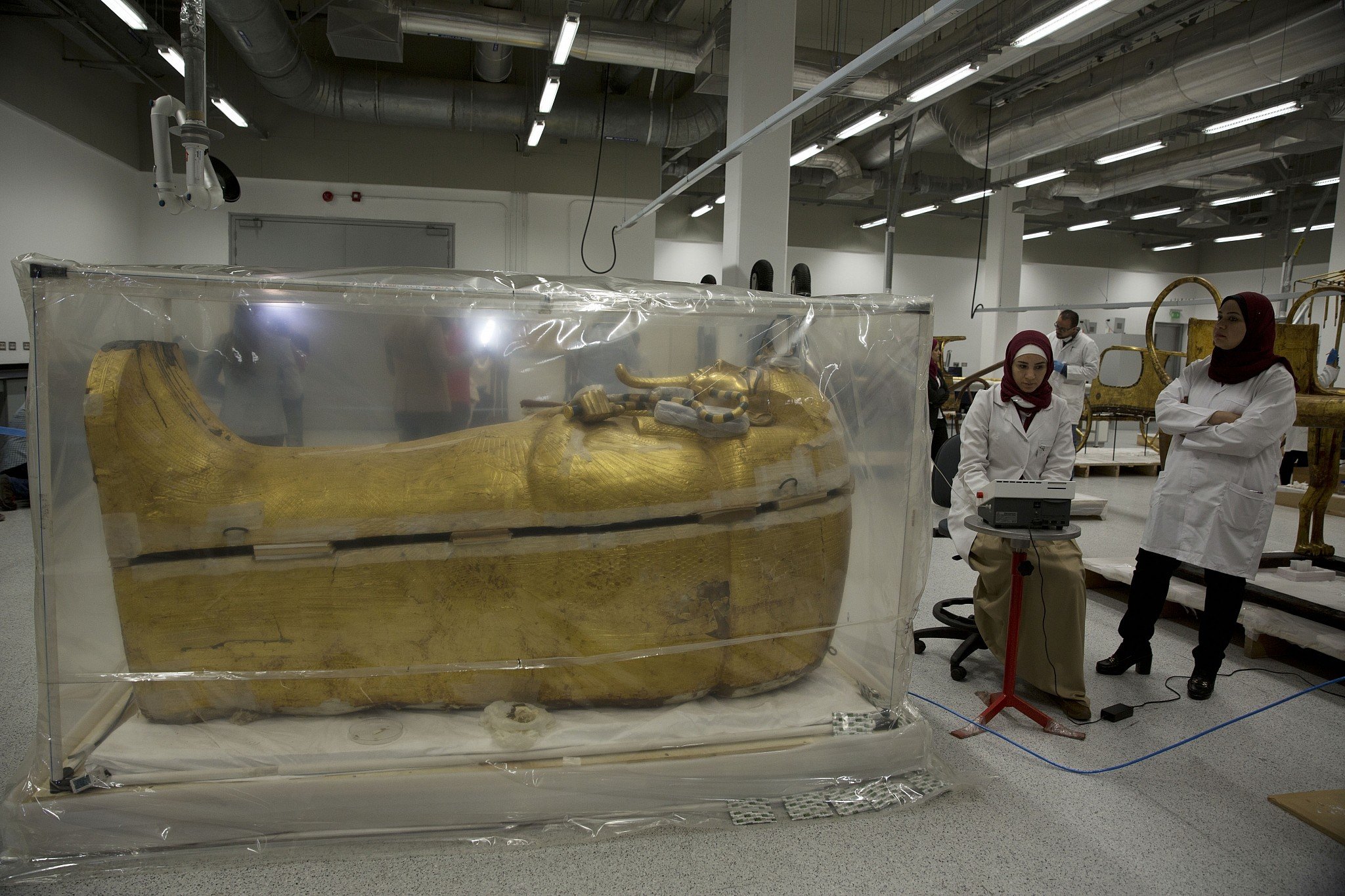
The gold-covered sarcophagus of King Tutankhamun is encased in a tent for restoration procedures at the conservation center of the the Grand Egyptian Museum in Giza, near Cairo, Egypt, August 4, 2019. (AP Photo/Maya Alleruzzo)
Egypt displayed on Sunday the gilded coffin of Tutankhamun, under restoration for the first time since the boy king’s tomb was discovered in 1922.
The restoration process began in mid-July after the three-tiered coffin was transferred to the new Grand Egyptian Museum in Cairo from the Valley of the Kings in Luxor, southern Egypt.
“We are showing you a unique historical artifact, not just for Egypt but for the world,” Antiquities Minister Khaled el-Enany told a press conference at the new museum, which overlooks the famed Giza Pyramids.
The golden coffin of the boy king will be displayed along with other Tutankhamun artifacts towards the end of next year when Egypt’s new mega-museum is opened to the public.
The restoration is expected to take around eight months.
Get The Times of Israel's Daily Editionby email and never miss our top stories
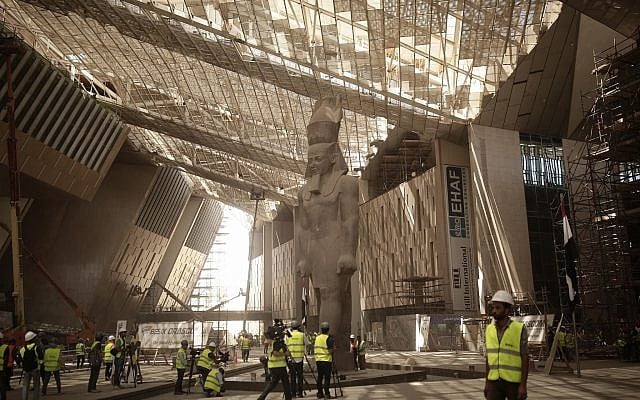
Construction workers and journalists gather at the Grand Egyptian Museum under construction in Giza, near Cairo, Egypt, August 4, 2019. (AP Photo/Maya Alleruzzo)
The outer gilded wood coffin stands at 2.23 meters (7.3 feet) and is decorated with a depiction of the boy king holding the pharaonic symbols the flail and crook, according to the ministry.
In the last century, the coffin has “developed cracks in its gilded layers of plaster, especially those of the lid and base.”
Famed British archaeologist Howard Carter discovered the tomb of the 18th dynasty king in Luxor in 1922.
Advertisement
Sunday’s announcement comes after the controversy the Pharoah courted in early July when a 3,000-year-old Tutankhamun artifact was sold in London for $6 million.
Furious Egyptian officials condemned the sale and asked the international police agency Interpol to trace the artifact which it deems looted.
Tutankhamun ascended the throne at age nine, ruling until his death at age 18 or 19.
Help us report truthfully on social media
As a multimedia journalist, my job is to take the quality, fact-based journalism produced by The Times of Israel newsroom and make it accessible across every platform — from Instagram posts to podcasts to short-form videos.
This is how many, especially young people, consume news these days. But misinformation is rampant on social media. Our team at ToI produces accurate, responsible short-form reporting on Israel and the Jewish world.
If you believe in the importance of factual social media journalism, please consider joining our reader support group, The Times of Israel Community. Your financial support is essential to sustain responsible multimedia reporting.
We’re really pleased that you’ve read X Times of Israel articles in the past month.
That’s why we started the Times of Israel - to provide discerning readers like you with must-read coverage of Israel and the Jewish world.
So now we have a request. Unlike other news outlets, we haven’t put up a paywall. But as the journalism we do is costly, we invite readers for whom The Times of Israel has become important to help support our work by joining The Times of Israel Community.
For as little as $6 a month you can help support our quality journalism while enjoying The Times of Israel AD-FREE, as well as accessing exclusive content available only to Times of Israel Community members.
Thank you, David Horovitz, Founding Editor of The Times of Israel


 Add ToI as a Preferred Source on Google