Egyptian President Abdel Fattah al-Sissi delivers a speech during a meeting with Pope Francis in the capital Cairo on April 28, 2017 (AFP/Andreas Solaro)
CAIRO — Egyptian President Abdel Fattah el-Sissi on Saturday urged the United States to help restart negotiations between Israel and the Palestinians, a statement from the presidency said.
The statement came after Sissi met Palestinian Authority President Mahmoud Abbas, who will meet US President Donald Trump in Washington on Wednesday for talks on reviving the stagnated peace process.
Sissi said it was “important that the United States returns to play an active role in efforts to resume negotiations between the Palestinians and Israel,” the statement said.
The two “agreed that the two-state solution is the only way to bring stability to the region,” it added.
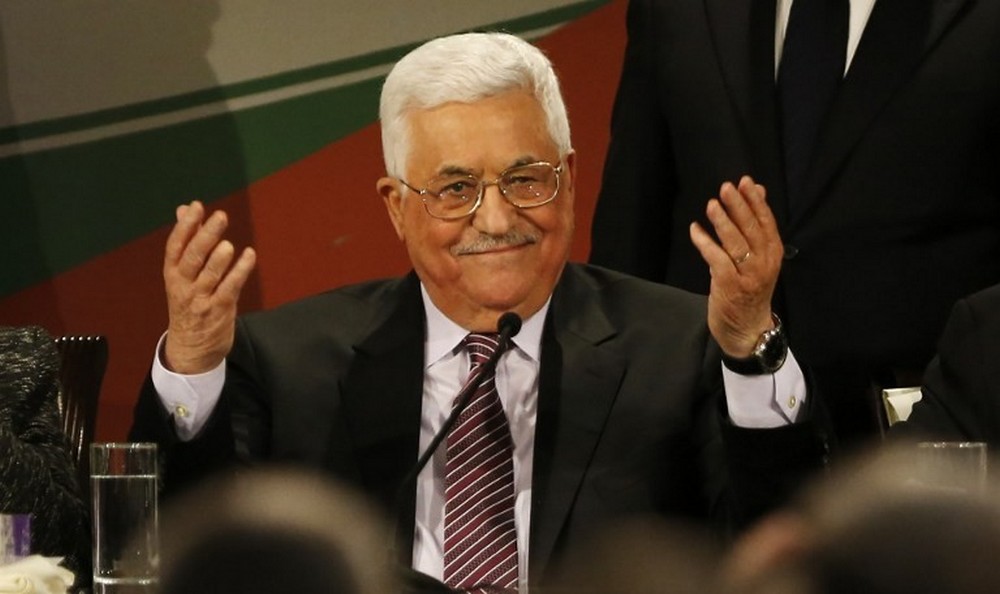
Palestinian Authority President Mahmoud Abbas gestures after delivering a speech on the second day of the 7th Fatah Congress in the West Bank city of Ramallah on November 30, 2016. (AFP/Abbas Momani)
Sissi said the 2002 Arab Peace Initiative should be the basis for a comprehensive solution.
Get The Times of Israel's Daily Editionby email and never miss our top stories
The Saudi-led initiative offered normalized relations with Israel in exchange for resolving the decades-old Israeli-Palestinian conflict.
When Abbas meets Trump on Wednesday it will be the first encounter between the two men, but will follow a series of US contacts with the Palestinian leader.
Israeli-Palestinian peace talks have repeatedly run aground despite periodic US efforts to revive them, most recently by former secretary of state John Kerry.
Advertisement
But Abbas, who met in Ramallah recently with CIA chief Mike Pompeo and Trump’s special representative Jason Greenblatt, has said Trump is “seriously considering a solution to the Palestinian issue.”
Shortly after taking office, Trump alarmed Palestinians by calling into question his administration’s support for a two-state solution, a bedrock of US policy.
But he has since warned Israel against “unrestrained” building of settler homes in the West Bank.
We can't do this work alone.
The war with Iran has been draining for all of us in Israel. But when I heard about a high casualty incident – ballistic missile impacts in Arad and Dimona that left nearly 200 people wounded – I drank a cup of coffee, packed a bag, and headed south.
There, I spoke with Shilgit, the head of an after-school program for underprivileged youth. Standing outside her destroyed center, Shilgit said it was a miracle that no children were hurt and spoke about the community coming together in the hours since.
As a Times of Israel reporter, I’m committed to telling stories of resilience like Shilgit’s. But my colleagues and I can't do this alone. If you value work like this,please consider joining our reader support group, The Times of Israel Community. Your financial support is essential to keep real human reporting like this going.
We’re really pleased that you’ve read X Times of Israel articles in the past month.
That’s why we started the Times of Israel - to provide discerning readers like you with must-read coverage of Israel and the Jewish world.
So now we have a request. Unlike other news outlets, we haven’t put up a paywall. But as the journalism we do is costly, we invite readers for whom The Times of Israel has become important to help support our work by joining The Times of Israel Community.
For as little as $6 a month you can help support our quality journalism while enjoying The Times of Israel AD-FREE, as well as accessing exclusive content available only to Times of Israel Community members.
Thank you, David Horovitz, Founding Editor of The Times of Israel