

Environmental tikkun olam hits the Big Apple
With solar panel installation on JCCs and in-house composting programs, New York Jewish institutions reduce their carbon footprints
 Add ToI as a Preferred Source on Google
Reporter at The Times of Israel

NEW YORK – Juicy tomatoes and crunchy carrots may seem like the stuff of dreams as winter grips New York City. But come June, about 70 employees of the UJA-Federation of New York will enjoy weekly deliveries of farm fresh vegetables.
The UJA-Federation belongs to a CSA, Community-Supported Agriculture, run by Row By Row Farm. That means once a week, for 20 weeks, the employees get produce grown in upstate New York by Mira and Dakota Miller, who met studying permaculture in central Israel.
“You have to make the environmental revolution personal. Everyone has to be a foot soldier,” said Deborah Joselow, managing director of the Commission on Jewish Identity and Renewal for UJA-Federation.
The UJA-Federation’s participation in a CSA is just one way Jewish institutions across New York City are reducing their carbon footprints.
Many of these organizations find it’s no longer enough to “Reduce. Reuse. Recycle.” They aim to take their environmental initiatives to the next level through joining CSAs, installing community-wide solar projects and composting.
‘You have to make the environmental revolution personal. Everyone has to be a foot soldier’
It helps that environmental conservation is an integral part of Jewish tradition. Judaism teaches that humans are stewards of the earth, that each individual has a responsibility to leave the world a better place for future generations.
“Unless you yourself are aligned with these values you can’t ask others to act on them,” Joselow said. “You can’t come at it politically, but rather make it clear that this is our core value. That’s a conversation people are willing to have no matter what side of the fence they sit on.”
That’s the central message of Hazon, a nonprofit that promotes environmental awareness in Jewish communities in the US and Israel.
“In terms of the Jewish community it’s a win-win-win. You’re saving money by reducing energy output, you’re reducing your carbon foot print and you’re renewing Jewish life because you are bringing in more members and even more donors,” said Becca Linden, associate director of Thought Leadership and Capacity Building for Hazon.
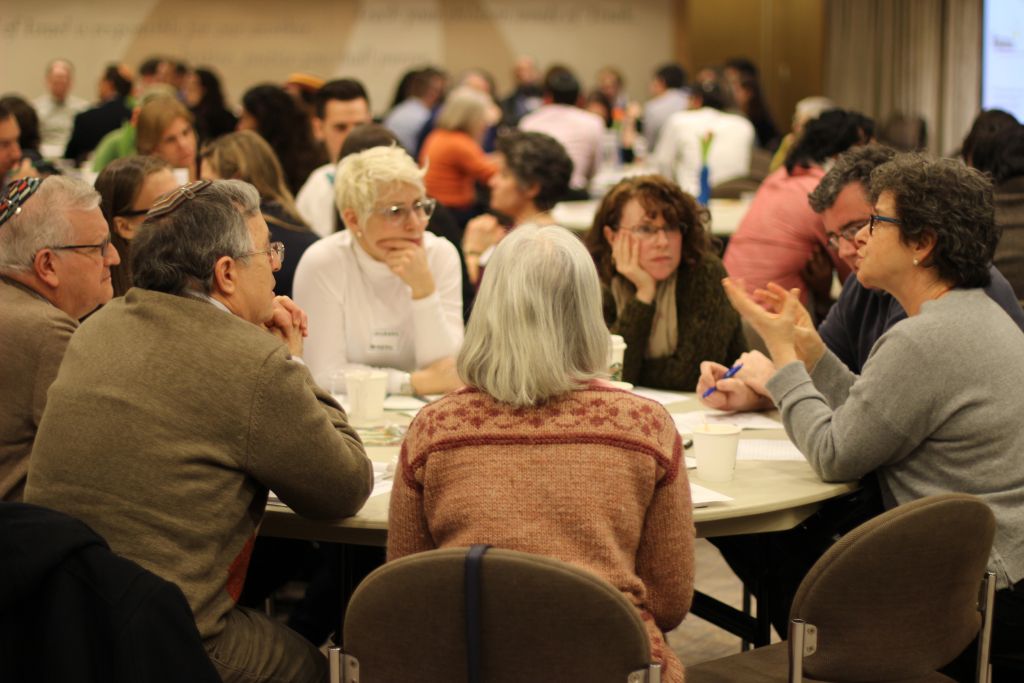
On February 10, the UJA-Federation NY and Hazon held a daylong conference: “Leading Green: Creating a Sustainable Future for the Jewish Community and Beyond.” Karenna Gore, director of Union Forum/Global Social Justice Partnerships at the Union Theological Seminary was among the speakers.
About 100 people attended sessions, which included information on how to inspire staff and volunteers to build a green team, how to set greening priorities, and how to make a more energy efficient facility.
Hazon’s Jewish Greening Fellowship, JGF, has 55 Jewish organizations as members. They include JCCs, synagogues, camps, day schools and social service agencies. In the past six years these institutions have raised more than $3.6 million for green facility improvements and implemented innovative programming.
In 2013 the New YorkUJA-Federation headquarters building was certified as an Energy Star building with a rating of 85
Over at the UJA-Federation, motion detectors for lighting were installed when the building was renovated in 2006. It has also reduced costs and eliminated waste through the purchase of recycled office paper, installed water-saver faucets and low-flow toilets in the restrooms. In 2013 the New York headquarters building was certified as an Energy Star building with a rating of 85.
Other steps include decreasing electrical use during the summer, when demand on the power grid typically increases. The thermostat inside the Park Avenue office gets set a little higher and window shades on the south facing and east facing side come down.
“It’s a way to shift the culture,” said Keith Laskey, Senior Planning Executive, Leadership Engagement and Board Relations for UJA-Federation.
In keeping with the theme of making it personal, all new UJA-Federation employees get a ceramic mug as part of their welcome. It’s a small gesture that sends the message: refill, don’t discard.

Employees will also find that in the dining room and kitchen only Fair Trade coffee is served and only plant-based disposable plates and utensils are used.
“It’s not the UJA-Federation directing down, telling others what to do. It’s also us learning about what other people are doing. The partnerships are really important,” Laskey said.
In Manhattan, the 14th Street Y recently launched community compost program.
The program, open to anyone, accepts a wider variety of items – including meat, bones, cheese and shells — than most NYC urban composting operations. That means people can drop off their food scraps 7 days a week. The New York Sanitation department hauls the compost to a commercial composting facility.
These kinds of partnerships and community outreach mean Jewish institutions are collaborating in new ways, Hazon’s Linden said.
The Joan and Alan Bernikow JCC on Staten Island has the largest citywide solar panel installation
The Joan and Alan Bernikow JCC on Staten Island has the largest citywide solar panel installation. Installed last November, the 312 sun-powered solar panels on the building’s roof will generate 125,578 kilowatts annually. It will reduce the JCC’s carbon footprint by 168,274 pounds a year.
“Our agency has been transformed. We’ve raised over a million dollars towards different projects,” said JR Rich, the Agency Sustainability Officer at the JCC of Staten Island. Other initiatives there include a solar thermal hot water heating system and a PV system that generates electricity.
Aliyah Vinikoor the Greening Fellow at the Jewish Theological Seminary works with undergraduate and graduate students. Vinikoor said the institute’s participation in the Jewish Greening Fellowship was key in getting it to reduce energy usage and introduce more sustainable practices.
“It shifted the culture of the institution to be more focused on our ethical commitment to tikkun olam, and thinking through our environmental impact globally,” Vinikoor said.
http://youtu.be/uH49I6Y6Tpg









The Times of Israel Community.