

The Jews in Orientalism
Jews as Orientals in art from 1832 to 1929
 Add ToI as a Preferred Source on Google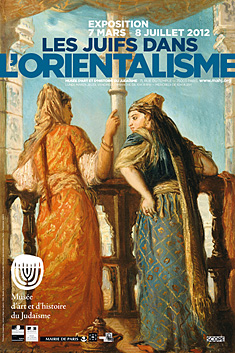
This exhibition explores the world of Orientalist painting, focussing on the representation of the Jew as “Oriental” in art from 1832 to 1929. The artists who travelled to the Orient in the early 19th century discovered the Jewish communities around the Mediterranean rim. This unexpected encounter revealed another picturesque facet of an Orient often imagined before it was visited. Eugène Delacroix in Morocco and Théodore Chassériau in Algeria filled their notebooks with sketches of Jewish figures, using them later in large pictures such as Delacroix’s pioneering Jewish Wedding in Morocco (1841).
Beyond North Africa, the journey to the Holy Land took on a more symbolic dimension. Motivated by religious aspirations and the new archaeological interest in lands ranging from Egypt to Mesopotamia, Europeans went in search of the origins of western civilization in the Middle East. The views of Jerusalem by painters such as David Roberts and Thomas Seddon epitomise this quest.
Elements of the Jewish, Muslim and Christian worlds were freely blended in a new approach to biblical painting. Horace Vernet portrayed Abraham as a Bedouin by his tent, and Tissot and Holman Hunt depicted Jesus preaching in a synagogue in Jerusalem. This “orientalization” of the Bible is particularly manifest in illustrations of episodes set in Egypt (Joseph) and Persia (Esther), drawing on new knowledge of Antiquity.
In a context in which the task of recounting ancient Jewish history fell to painting, the work of a few European Jewish artists also became a means of asserting a national identity. Eduard Bendemann and Henri-Léopold Lévy reinterpreted the theme of the exile in Babylon as an emblematic matrix of the history of the dispersion of the Jewish people. The most fascinating example is Maurycy Gottlieb’s re-examination of the interface between Judaism and Christianity, drawing on literature, in his painting Christ Before His Judges.
The Zionist project formulated by Theodor Herzl, largely in reaction to the mounting anti-Semitism in Europe, and the idea of a “State of the Jews” in Palestine rapidly acquired an artistic dimension. At the Bezalel Academy of Arts and Design in Jerusalem and further afield, artists strove to establish a continuity between Biblical Antiquity and the contemporary Middle East, and to re-embrace an oriental Jewish identity.
The exhibition includes works by Eugène Delacroix, Théodore Chassériau, Alfred Dehodencq, Jean Lecomte du Nouÿ, Wilhelm Gentz, Charles Cordier, Lucien Lévy-Dhurmer, David Roberts, Thomas Seddon, Jean-Léon Gérôme, Gustav Bauernfeind, Alexandre Bida, Gustave Moreau, Alexandre Cabanel, Horace Vernet, Lawrence Alma-Tadema, William Holman Hunt, James Tissot, Maurycy Gottlieb, Lesser Ury, Zeev Raban, Ephraïm Moses Lilien, Abel Pann, Reuven Rubin, Nahum Gutman.
During the Jews in Orientalism exhibition, the MAHJ is highlighting its North African collections in the permanent collection on the 2nd floor: paintings, drawings, etchings and costumes. A selection of photographs of Oriental Jews, from the museum’s collections and several public and private collections, is on display in the Department of Prints and Drawings. Throughout the exhibition, special signs (red disks) indicate works in the museum’s permanent collection (chiefly costumes) depicted in the pictures on display. To view these works, follow the directions in the last room of the exhibition.
The exhibition runs through July 8, 2012.










The Times of Israel Community.