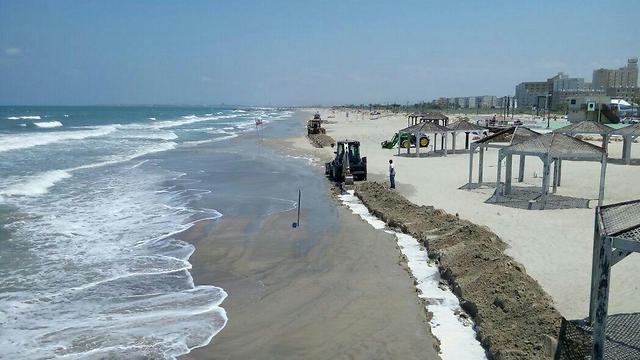
Work to contain an oil spill in Haifa Bay, July 5, 2016. (Environment Protection Ministry)
The Interior Ministry declared Wednesday that beaches in the Haifa area were safe for swimming, a day after they were closed due to a large oil spill.
In a statement, the ministry said that the Kiryat Yam and Kiryat Haim beaches had been reopened with the permission of the Health Ministry, which had checked the water and found it to be clean.
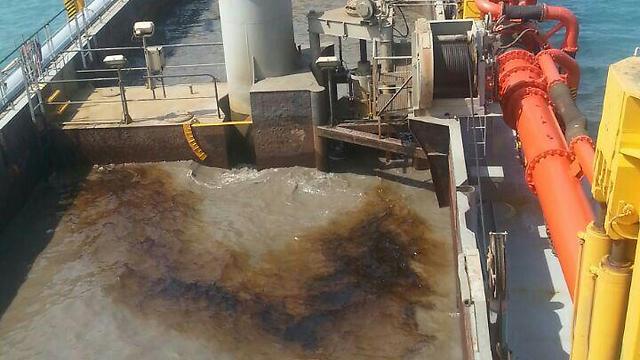
The beaches were closed Tuesday after an oil spill polluted Haifa Bay. A ship upgrading the pipeline hit an old fuel supply line, which ruptured, releasing several thousand liters of oil into the water.
The current carried the slick toward the shore and northward, prompting the closure of beaches north of Haifa as emergency crews worked to contain and clean the spill.
Haifa, home to Israel’s largest seaport, is also a center of chemical production plants and oil refineries.
Get The Times of Israel's Daily Editionby email and never miss our top stories
The spill happened during maintenance work to replace old pipelines operated by the Petroleum and Energy Infrastructures company.
A ship at sea works to clean up an oil spill in Haifa Bay, July 5, 2016. (Environment Protection Ministry)
“In cooperation with, and under the instructions of, the Environmental Protection Ministry, the company is removing old fuel lines from the sea,” the company said in a statement. “During the work, a flexible pipe was hit and oil spilled into the sea.”
It said that, in view of the high chance of a leak occurring, an emergency team had already been on standby together with suitable equipment to deal with a spill, and that the group immediately addressed the problem.
Advertisement
Help us report truthfully on social media
As a multimedia journalist, my job is to take the quality, fact-based journalism produced by The Times of Israel newsroom and make it accessible across every platform — from Instagram posts to podcasts to short-form videos.
This is how many, especially young people, consume news these days. But misinformation is rampant on social media. Our team at ToI produces accurate, responsible short-form reporting on Israel and the Jewish world.
If you believe in the importance of factual social media journalism, please consider joining our reader support group, The Times of Israel Community. Your financial support is essential to sustain responsible multimedia reporting.
We’re really pleased that you’ve read X Times of Israel articles in the past month.
That’s why we started the Times of Israel - to provide discerning readers like you with must-read coverage of Israel and the Jewish world.
So now we have a request. Unlike other news outlets, we haven’t put up a paywall. But as the journalism we do is costly, we invite readers for whom The Times of Israel has become important to help support our work by joining The Times of Israel Community.
For as little as $6 a month you can help support our quality journalism while enjoying The Times of Israel AD-FREE, as well as accessing exclusive content available only to Times of Israel Community members.
Thank you, David Horovitz, Founding Editor of The Times of Israel


 Add ToI as a Preferred Source on Google