

Israeli-US study reveals surprising depth of Jupiter’s ‘Great Red Spot’ storm
New 3D images from Juno spacecraft show that cosmic cyclone hovering around planet is 200-300 miles deep, resembling a fat pancake
 Add ToI as a Preferred Source on Google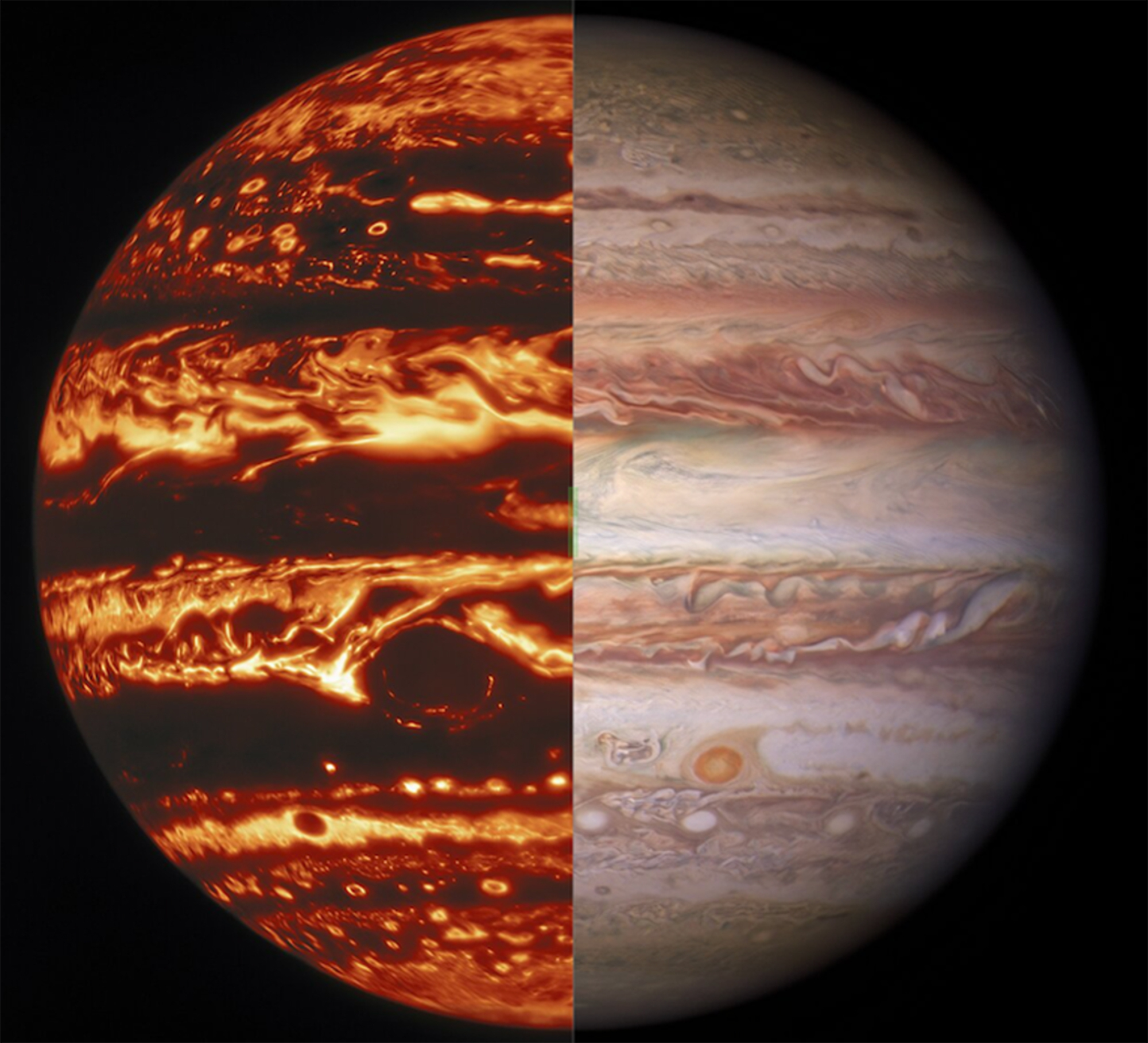
CAPE CANAVERAL, Florida — Jupiter’s Great Red Spot, a storm so big it could swallow Earth, extends surprisingly deep beneath the planet’s cloud tops, scientists from Israel and the US reported Thursday.
NASA’s Juno spacecraft has discovered that the monster storm, though shrinking, still has a depth of between 200 miles (350 kilometers) and 300 miles or so (500 kilometers.) When combined with its width of 10,000 miles (16,000 kilometers), the Great Red Spot resembles a fat pancake in new 3D images of the planet.
The mission’s lead scientist, Scott Bolton of Southwest Research Institute, said there might not be a hard cutoff at the bottom of the storm.
“It probably fades out gradually and keeps going down,” Bolton said at a news conference.
The study, completed in collaboration with researchers from Israel’s Weizmann Institute of Science, was published Thursday in the journal Science.
“Since Juno arrived at Jupiter’s orbit, we’ve been working like archaeologists, only instead of digging below ground, we’ve been exploring what happens below clouds,” said Eli Galanti, a staff scientist from Weizmann who participated in the research.
New findings from Juno spacecraft provide a fuller picture of how Jupiter's distinctive and colorful atmospheric features offer clues about the unseen processes below its clouds. Results offer the first 3D view of Jupiter atmosphere [read more: https://t.co/XU5MGiMNBB] pic.twitter.com/jOBQPX4qRC
— Massimo (@Rainmaker1973) October 29, 2021
The Great Red Spot is probably the tallest Jovian storm measured so far with Juno’s microwave and gravity-mapping instruments, Bolton said. Thousands of storms rage across the gas giant at any given time — beautiful and colorful swirls, plumes and filaments covering the entire planet, as seen by the spacecraft’s camera.
Launched in 2011, Juno has been orbiting the solar system’s largest planet since 2016. NASA recently extended the mission by another four years, to 2025.
Still ahead for Juno: measuring the depth of the polar cyclones, which might penetrate even deeper beneath the clouds.
“I wouldn’t want to be too quick to guess that we’ve seen the deepest,” Bolton told reporters. “But the Great Red Spot is the largest and that makes it special by itself, and you might expect that it might be deeper just because of that.”
By contrast, some of the surrounding jet streams extend an estimated 2,000 miles (3,200 kilometers) into Jupiter.
“The Giant Red Spot was discovered over two centuries ago, but up till now we’ve only known what it looks like from the outside,” Galanti said in a press statement issued by the Weizmann Institute. “Now we have, for the first time, revealed its structure and determined its depth.”
“To get an idea of its dimensions, if a storm of the same size started on the surface of Earth, it would extend all the way up to the International Space Station,” said NASA researcher Marzia Parisi Parisi.










The Times of Israel Community.