

Let’s talk about me: What the press is saying on November 1
Parents rejoice as kids finally get shipped back to school, giving them some peace (and maybe an infection too), and reports on the US vote focus on the Israeli expat demographic
 Add ToI as a Preferred Source on Google
Joshua Davidovich is The Times of Israel's Deputy Editor
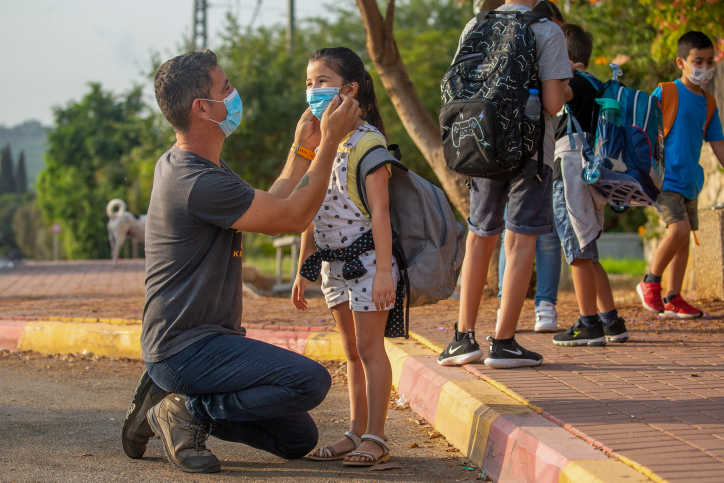
1. Let freedom (and the school bell) ring: Almost a month and a half after they were shuttered, schools are reopening, at least for grades one through four. The return to school appears to get off to an okay start, especially judging from the tweets of reporters joyfully returning their kids for the second first day of school.
- “It’s happening,” writes Channel 13’s Almog Boker with a picture of kids crowded on a sidewalk.
- “It’s inconceivable that he was born just seven years ago and it’s already been a month and a half since the last time he was in school,” tweets journalist Yair Tarchitsky.
- Others are also excited to have a place to dump the kids: “Finally, they are taking my kids to school and kindergarten, and I can start to work without being interrupted,” a Kiryat Gat parent tells Ynet.
- “The parents are smiling, the kids are smiling. They are just hoping it will last a little longer than two weeks this time,” Kan reports from outside a Jerusalem school.
- “Shalom, first capsule,” reads a teaser in Israel Hayom, riffing off the “shalom first grade” cliche that Israeli culture has glommed on to.
- A fourth grader tells Channel 12 news she is also mega pumped: “Finally, we can go back to being with our friends and it’s super super fun. I really missed my friends, playing with them, laughing with them, and messing around and going wild. I also missed learning new things, since Zoom was constantly freezing on us.”
- But Petah Tikvah first grader Maayan tells Army Radio that she’s not super hopeful: “I couldn’t hear the teacher on Zoom. It cut off all the time. With a mask, I still won’t hear her.”
2. Trouble with the capsule: That’s just one of many problems that news organizations predict going forward:
- “Despite the great desire to return to normal, the current plan is expected to run into no small number of problems on the ground. The big question will be how local authorities deal with the need for extra manpower to fill out the capsules,” reports Israel Hayom.
- Among those problems, Kan notes that buses are not being reinstated. “As a result many parents are complaining that they are being forced to take the kids to school themselves because of a lack of transportation options.”
- And for a cherry on top, it notes that despite all the splitting of children into capsules, afternoon care (which most students attend) will see up to three capsules mixed together, raising the chances for infection. “The afternoon programs are mostly run as private businesses, and many of them have said it will not pay to have fewer than 28 kids in a group,” the outlet explains.
- Haaretz’s lead editorial calls the mixing of kids in afterschool programs an “absurdity.” “School has lurched into session three times like this now. It’s inconceivable for the approach to such a large system – 3 million children – to be so amateurish and confused,” it reads.
- Nonetheless, the broadsheet reports that despite whatever problems they may anticipate, teachers are being asked to put on a happy face. “They are being instructed to mark the return to school in a celebratory way, to devote time to getting to re-know the kids, to encourage them to share experiences from the lockdown, ‘by focusing on strengths that helped them get through the period.’”
- Walla reports that despite the compromise agreement meant to make it so everybody gets at least four days of school, poorer Arab municipalities are still having trouble keeping up: ”The poorer local councils are left behind and claim that financial resources, as well as dilapidated infrastructure, do not allow them to keep up with the richer areas. In the Arab communities they are especially worried that the opening of schools will boost the level of infections in their towns and sent all instructional staff to be tested.”
3. Dying to get away: Also leading to fears of a renewed outbreak is a mass funeral held in Majdal Shams, the town with one of the worst outbreaks currently, after a prominent Druze leader there died of the virus.
- Even before the funeral, mobs that broke into a Safed hospital to take his body away for burial had raised more than a few hackles.
- “[They] kidnapped and [they] showed contempt,” reads a holier than though headline in Yedioth.
- “This was not something that represents our town,” Dr. Taysar Mreh tells Yedioth. “This was an out of the ordinary event in which a respected sheikh who was revered by all Druze factions passed away and people acted according to their emotions. It’s true we needed to take control, but sometimes the youths act from their feelings and not thoughts. We could see another outbreak in a week.”
- In fact, many of those at the funeral appeared to observe social distancing guidelines, with chairs for participants placed at a distance from each other, though there also seemed to be some crowding. Most people are photographed wearing masks.
- Druze spiritual leader Sheikh Muafak Tarif tells Kan he condemns the break-in at the hospital: “The incident that happened at Ziv Medical Center in Safed was not with the knowledge of the community’s leadership or the family of the deceased, who had a senior religious status among community members and deserves all respect.”
- Speaking to Kan, he notes not only was the funeral coordinated with authorities, but people were turned away. “If we had allowed attendance, there would have been tens of thousands.”
- Haaretz gives some insider info into the hospital heist and some unfunny hijinks. “A source familiar with the details of the incident told Haaretz that community leaders had asked the hospital to allow the transfer of the sheikh’s body to Majdal Shams, but their request was turned down since he had died of the virus and amid the restrictions imposed on the locality. Officers from the police’s Special Patrol Unit arrived at the hospital after being informed that an attempt to snatch the body would take place. According to a police source, the cops said they saw the hospital’s medical staff releasing the body and assumed it had been approved. The police commented that the matter is being examined.”
4. America the divided: It’s not return to school or Druze news that’s on front pages, though, but rather America’s return to the ballot box, and the chaos that awaits on the other side of November 3.
- “Storming and hunkering,” reads the front page headline of tabloid Yedioth Ahronoth, displaying pictures of US President Donald Trump and challenger Joe Biden alongside someone boarding up his storefront in anticipation of post-election violence.
- Ynet’s Atilla Somfalvi, driving around Washington, expresses shock at the business owners boarding up their buildings. “This is not normal, they are preparing for looting, for civil war.”
- Walla’s Alon Ben David writes that he’s not sure who will benefit more from the scenes of a military-enforced curfew in Philadelphia: “but it’s clear that from a political perspective this is the most important state to both candidates… Three days before the fateful day, the city that has as one of its symbols the Love sculpture has become today a center for the divisions in American society.”
- Haaretz Cassandra Gideon Levy bemoans the fact that in both Israel and America, challenges to the far-right have come from the center rather than what he considers the true left. Biden, he writes, is the “most middling, most nothing of all the candidates. A whiter shade of pale.”
- “America said no to the left once again. Even the tumultuous years of Trump weren’t enough for the country to summon up the courage to try, for the first time in its history, a new way, the way of social democracy, of more ethical foreign and domestic policy, of helping the weak at home and abroad. An America where money wasn’t everything,” he writes.
- Israel Hayom’s Boaz Bismuth, still stumping for Trump, accuses the Democrats of not being for democracy, performing Olympic-medal worthy acrobatics to come to that conclusion based on CNN Don Lemon’s saying he was no longer speaking to his Republican-supporting friends.
- “Democrats did not rush to condemn his divisive remarks about cutting of contact with friends due to their political leanings. This is the same divisiveness that they accuse Trump and his followers of, while at the same time they do not hide their ‘ownership’ of the votes of African Americans and Hispanics, indicating that the political choices of masses of Americans are a danger to democracy and world peace (yes, still), and now are openly talking of cutting ties.”
5. The all-important Sabra vote: As Israeli correspondents fan out into the storm, interviewing Real Americans about their voting choices, they also seem to be drawn to Israelis, finding them in all corners to ask about how they are voting. (It’s probably for the best that they speak to Israelis, since someone seemingly forgot to tell them that it’s still considered taboo in the US for reporters to ask interview subjects, or anyone, how they voted.)
- Haaretz’s Allison Sommer Kaplan travels to the tiny Maine town of Waterville. While Maine is solidly blue, it does divide its electoral votes, she explains, making its northern region kind of important. It’s just one electoral vote out of hundreds that will likely be of no consequence, despite her heroic efforts to make it seem consequential.
- “The sole electoral vote given to the winner of the 2nd district could be very consequential if the presidential race proves to be a close one. There are several scenarios where each candidate could rely on that single vote to get from 269 electoral votes to the winning number of 270. Trump recently held a campaign rally in the district, while Biden’s wife, Jill, has held events with Democratic volunteers in the area.”
- Among the wealthy summer-folks extending their stay in the area to vote and ride out the pandemic is the Israel-born writer Ayelet Waldman, who has become so horrified that one of her neighbors in a house once owned by E.B. White is sporting a Trump/Pence sign in their yard that she has to one-up them with a custom made sign: “At first, in protest, she wanted to design a Trump sign featuring a design of the web Charlotte wove in that story bearing the words ‘Some Pig.’ Ultimately, she worked with designer Tamara Shopsin on a more tasteful version: the words Biden/Harris woven into a web – just as Charlotte, in the book, wove truths about the qualities of Wilbur the pig, the hero of White’s novel.”
- Bismuth is on the other terminus of I-95, traipsing around Miami, where he interviews the regular man on the street, the man being his friend who happens to live in the area (and support the same candidate, and know how all the Israelis are voting).
- “I immigrated from a socialist country and I don’t want a similar fate like that for America,” the Venezuela-born friend says. “Most Jews here are for the Democrat, as usual, but that’s not the case with the Israelis. The lion’s share are for Donald Trump.”
- Army Radio’s Idan Kweller travels to “north Florida” (actually Clearwater, in southwest Florida) where he interviews Amnon Eshel, who owns a falafel shop and calls himself the “biggest Trumpist in the city.”
- “He’s real. He’s not a politician. Everything he says, comes to be,” says Eshel.
- Kan’s Yaron Dekel, broadcasting an Israeli-free report from northeast Ohio, finds himself being interviewed by local news curious about the strange Israeli news team that came to visit.
- Reporteth WMFL21 in Youngstown: “Deckel said that the Israeli people support President Donald Trump after keeping his promise to move the U.S. Embassy to Jerusalem. As for Biden, he said he’s a good partner of Israel.”





The Times of Israel Community.