

Likud’s bleak, lifeless primary — good news for Netanyahu
Wednesday’s vote offers a window into the troubled inner world of Israel’s ruling party
 Add ToI as a Preferred Source on Google
Haviv Rettig Gur is The Times of Israel's senior analyst.
Twenty thousand new members joined in the past two weeks, half of them under 34. A new constitution offers sweeping powers to the charismatic leader. Each week, new celebrities declare their candidacy for the party’s Knesset slate.
Eager for battle, trusting in its cause and ultimate victory, it exudes the energetic confidence of a ruling party.
Except it’s not. The party that matches this description, the right-wing Jewish Home, holds just 12 seats in the outgoing Knesset and is polling at a medium-sized but still modest 16 in recent days.
Yet while Jewish Home has little chance of becoming Israel’s ruling party in the foreseeable future, it has tapped into a remarkable energy on the political right. Under the dynamic leadership of Naftali Bennett, an online membership drive that ended earlier this week swelled the ranks of the Orthodox-nationalist Jewish Home to 77,000 members, second only to Likud. Its rank and file are increasingly young, passionate and devoted.
But Wednesday’s political headlines in Israel didn’t dwell too much on Jewish Home, and for good reason. The actual ruling party of Israel, Likud, was holding its primaries, and the contrast couldn’t be more stark.
Instead of an eager, energized confidence, Likud’s poll was a moribund affair conducted by and for an aging activist base. Instead of a rallying leader, Likud offered the spectacle of a party strangely distant from its chief.
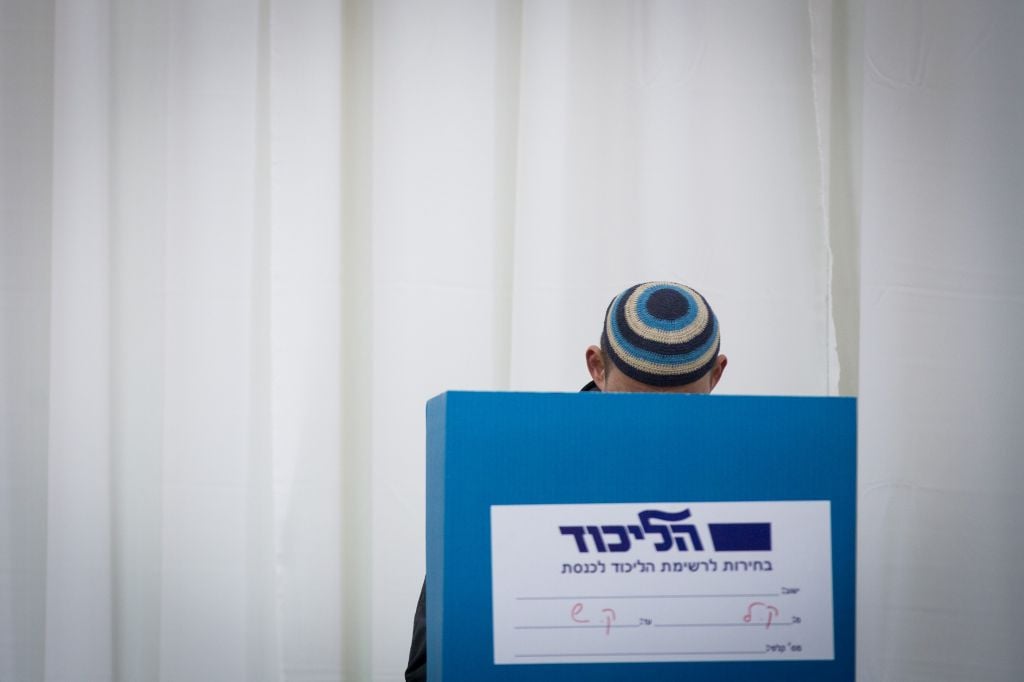
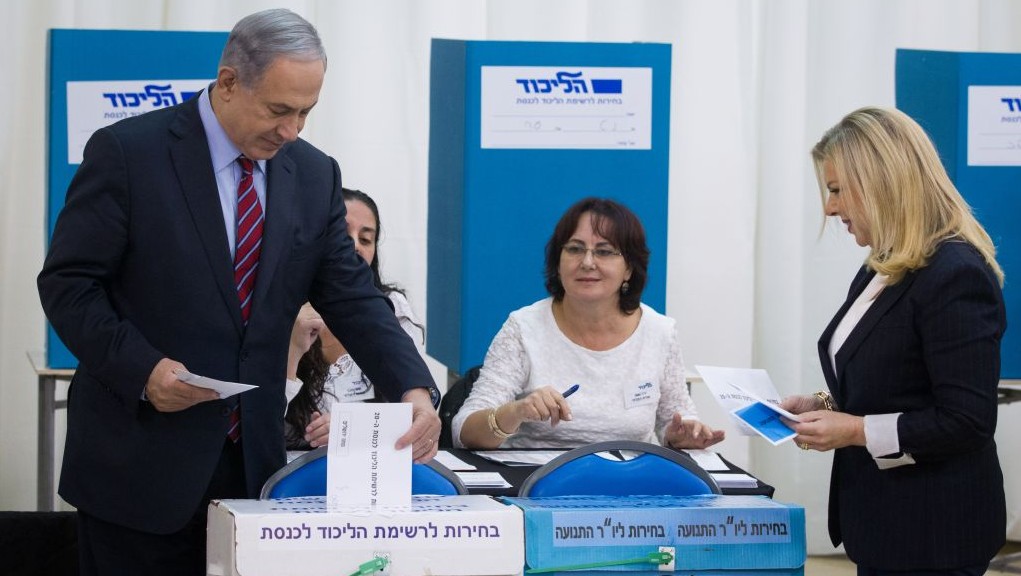
The party opened 115 ballot locations nationwide on Wednesday to accommodate its 96,000 primary voters. At Jerusalem’s International Convention Center, one didn’t have to search long to find groups of voters who admitted freely they were not planning to vote for Likud in March, but had joined the party for more cynical, tactical considerations, hoping to influence the ruling party’s Knesset slate before selecting one of its competitors on election day itself, March 17, 2015.
With few new candidates – former Shin Bet chief Avi Dichter and former Likud minister Michael Ratzon are the only viable “new” competitors of any renown, and both are ex-MKs – these political tacticians can only hope to reshuffle the same deck of politicians. Indeed, it is profoundly revealing that while parties such as Jewish Home, Yesh Atid and Labor attract fresh faces, Likud, the ruling party, slated to grow by six seats according to polls, does not.
At primary headquarters in the Tel Aviv Fairgrounds, scuffles broke out Wednesday morning as the line for one particular ballot stretched into dozens. In an effort to clamp down on the widespread phenomenon of pressure groups busing in armies of primary voters, the party instituted a new requirement in recent years: each voter had to vote at the ballot location closest to their home. An exception was made for the large cities, where commuters who had come in for work were allowed to vote in a single non-resident booth.
So when busloads of organized union activists – in this case, the Israel Aerospace Industries workers’ union – were forced to queue for the single available non-resident booth, the clash between the old ways and the new led to seething frustration.
Yet the moments of anger in Tel Aviv were at least a sign of life. Wherever journalists went, the report was the same. Likud’s rank and file was older. The primaries were a dreary, quiet affair. The atmosphere, dispirited.
Yet the Likud’s despondency is not entirely without its advantages for Prime Minister Benjamin Netanyahu.
As former Likud cabinet minister Danny Naveh noted on Wednesday, there is a significant gap between Netanyahu and his party’s activist base. The prime minister, like many of his party’s voters, supports in principle some form of Palestinian statehood, and has agreed to US-brokered negotiations toward that goal. The Likud’s primary-voting base largely rejects the idea and opposes the negotiations.
And so, in recent years, the equation for Netanyahu was straightforward: the more active and energized the base, the more limited his maneuvering room in dealing with international pressure on the Palestinian issue.
This gap between the prime minister and the party faithful has created profound tensions in Likud in recent years, tensions that enabled the rise of significant power centers that have sought to challenge Netanyahu’s control of its institutions. One leader of these efforts is MK Danny Danon, a populist who, while not considered a credible alternative to Netanyahu — he lost his bid to challenge Netanyahu for party leader on Wednesday by a four-to-one margin — has managed to engineer multiple showdowns over control of the party’s political agenda in the past two years.
Netanyahu also worries about the party base electing a Knesset list dramatically more right-wing than Likud’s center-right electorate, a gap that risks alienating vast numbers of the undecided centrist voters Netanyahu will need if he hopes to form a stable coalition. One need only look to the 10 Knesset seats polls predict for former Likud minister-turned-centrist Moshe Kahlon to understand why Netanyahu views his party’s appeal to centrists as a critical factor in the election.
This concern led Netanyahu to push a reform to party rules that will allow him to personally appoint two MKs to viable slots on the Knesset slate, numbers 11 and 23, in an effort to help balance out a list he fears may be unpalatable to center-right voters he is trying to woo.
The question that looms over the Likud primaries, then, is this: Will Netanyahu emerge on Thursday with a Likud he can lead, a list that will follow him into peace talks while also backing him in the face of international pressure, appeal to the vast cohort of undecided centrists while still attracting the right-wing base that seems increasingly willing to consider Jewish Home?
Rumors among the party’s political managers overnight Wednesday suggest a mixed result. The right-most faction in the Likud, led by Moshe Feiglin, is said to have suffered a blow — good news for the prime minister. Defense Minister Moshe Ya’alon, a close Netanyahu ally and a popular figure in his own right, but an unskilled politician who has not been able to muster significant bases of support within the party’s institutions, may have dropped on the list — bad news from Netanyahu’s perspective.
But these changes, though dramatic within the party, are ultimately marginal to its electoral fortunes. At the end of the day, Netanyahu’s most pressing desire is to put the primaries and their uncertainties safely behind him and get on with a campaign focused not on his moribund party or its distressingly boisterous MKs, but on himself.






The Times of Israel Community.