

Live updates (closed)
 Add ToI as a Preferred Source on Google


The Times of Israel liveblogged Sunday’s events as they unfolded.
Families of hostages, fallen soldiers to push for general strike, though main labor union won’t back it
Groups representing families of hostages and of fallen soldiers are leading a push for a general strike of Israel’s economy over the government’s plan to escalate the war and take over Gaza City, though the national labor union indicates it won’t declare one.
The families intend to announce the demand and further steps at a press conference tomorrow in Tel Aviv, according to Hebrew media reports.
They will push private companies, organizations, trade unions and ordinary citizens to participate in the strike, under the slogan: “Silence kills — the country grinds to a halt to save the hostages and the soldiers.”
Many remarks by relatives of hostages today have amplified the call for a nationwide strike, including in anti-government, pro-hostage deal rallies this evening.
However, Hebrew media cites the national Histadrut labor federation as saying a strike “is not expected” in the near future, though its head Arnon Bar-David plans to meet representatives of the families this coming week.
The option of a Histadrut-backed strike is reportedly off the table after Tel Aviv’s labor court last year ruled that a labor action aimed at pressuring the government to seal a ceasefire and hostage deal in Gaza following the murder of six hostages was illegal because it was political and not related to workers’ rights.
Hamas-run authorities claim 37 killed from IDF fire Saturday, mostly aid seekers
Gaza’s Hamas-run civil defense agency claims at least 37 people were killed by Israeli fire on Saturday, including 30 civilians who were waiting to collect aid.
Civil defense spokesman Mahmoud Bassal tells AFP that 12 people were killed and nearly 200 wounded when Israeli forces allegedly opened fire on them as they gathered near a border crossing in northern Gaza that has been used for aid deliveries.
Six more people were killed and 30 wounded after Israeli troops allegedly targeted civilians assembling near an aid point in central Gaza, he asserts.
Strikes in central Gaza also resulted in multiple casualties, according to Bassal, while a drone attack near the southern city of Khan Younis killed at least three people and wounded several others.
They reportedly include two nephews of senior Hamas leader Khalil al-Hayya.
The IDF has denied targeting aid seekers, saying it has fired warning shots toward people viewed as a threat after they veered off approved routes. It says it seeks to minimize civilian fatalities and stresses that Hamas uses Gaza’s civilians as human shields, fighting from civilian areas including homes, hospitals, schools and mosques.
Hundreds rally outside military prison to protest Haredi draft-evaders’ detention
Hundreds of members of the Gur and Boyan Hasidic groups, as well as from the extremist Jerusalem Faction, are protesting outside the Beit Lid military prison to decry the detention of ultra-Orthodox draft-dodgers arrested and held there.
According to Army Radio, the demonstrators are chanting against the “heretic” State of Israel, holding prayers, and calling the names of those arrested.
Some Jerusalem Faction members are reportedly trying to persuade the demonstrators to try to break into the prison, but no such action is taken.
האדמו"ר משבט הלוי בתפילה משותפת עם חסידי גור לשחרור העצורים החרדים, בהפגנה מול כלא 10 pic.twitter.com/hKGxzbqMYQ
— דניאל גרובייס daniel grovais (@daniel_grovais) August 9, 2025
"אברהם יצחקוב, כולנו איתך" | המפגינים מהפלג הירושלמי מלמדים את המפגינים חסידי גור איך להפגין וקוראים בשמם של העצורים החרדים בכלא pic.twitter.com/y1fretQFWU
— דניאל גרובייס daniel grovais (@daniel_grovais) August 9, 2025
On Thursday, prominent Haredi leader Rabbi Dov Lando visited the prison to offer support to yeshiva students arrested for draft evasion, telling them that the entire Haredi community stands behind them.
For the past year, the Haredi leadership, including Lando, has rejected any attempt to find a compromise to draft at least some of the ultra-Orthodox youth to the military, after last year the High Court ruled that the decades-long blanket exemptions from army duty traditionally afforded to the Haredi community were illegal.
Lando, who serves as the spiritual leader for the United Torah Judaism party’s Degel HaTorah faction and is one of the most prominent figures in the non-Hasidic ultra-Orthodox community, has repeatedly told yeshiva students to ignore draft orders.
Sam Sokol contributed to this report.
Trump nominates State Dept. spokeswoman Bruce as US deputy representative to UN
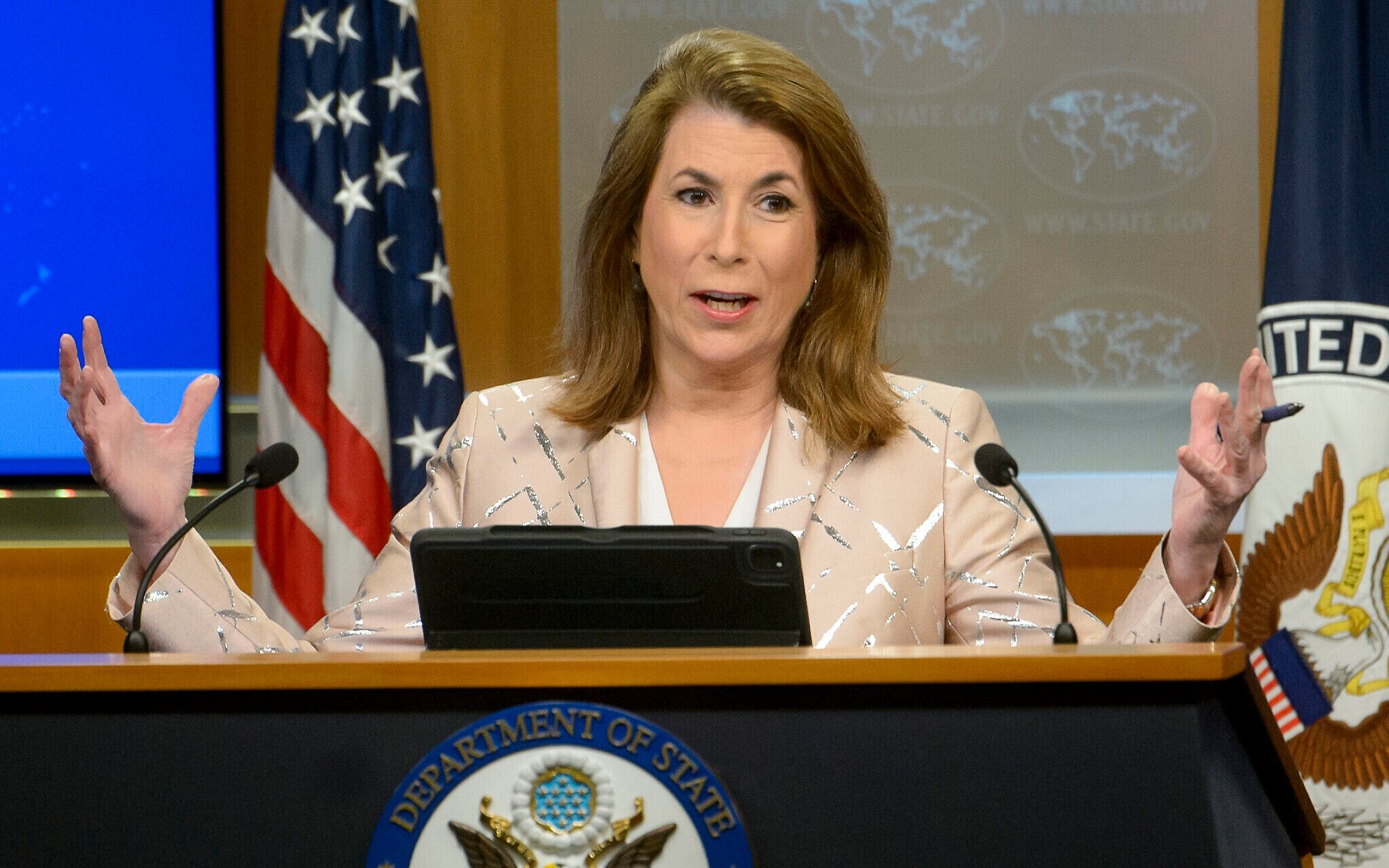
US State Department spokesperson Tammy Bruce speaks during a briefing at the State Department, April 15, 2025, in Washington. (AP Photo/Rod Lamkey, Jr.)
US President Donald Trump says he is nominating State Department spokesperson Tammy Bruce as the next US deputy representative to the United Nations.
Bruce has been the State Department spokesperson since Trump took office in January.
In a post on social media in which Trump announced her nomination, the president says she did a “fantastic job” as State Department spokesperson.
She has defended the Trump administration’s foreign policy decisions ranging from immigration crackdown and visa revocations to US responses to Russia’s war in Ukraine and Israel’s war in Gaza, including defending a widely condemned armed private aid operation in the Palestinian enclave.
Bruce was a political contributor and commentator on Fox News for over 20 years.
She has also authored books like “Fear Itself: Exposing the Left’s Mind-Killing Agenda” that offer criticism of liberals and left-leaning viewpoints.
Four injured, including one seriously, by grenade launched at Ashdod home
Four women were injured earlier tonight when a grenade was thrown at a home in Ashdod, sparking a fire.
Among those injured is a 16-year-old girl, who is said to have been seriously injured.
The other three, ages 17, 21, and 23, were moderately injured.
They are undergoing medical treatment at Ashdod’s Assuta Medical Center.
Police have opened an investigation into the incident, which is not believed to be terrorism.
Report: Smotrich threatened during cabinet meeting to bring down government

Finance Minister Bezalel Smotrich attends a press conference at the Finance Ministry in Jerusalem on August 6, 2025. (Yonatan Sindel/Flash90)
Finance Minister Bezalel Smotrich reportedly threatened to bring down the government and force a new election during Thursday night’s cabinet meeting.
According to a report in the Kan public broadcaster, during the security cabinet meeting to discuss the future of operations in Gaza, Smotrich said “from my perspective we can stop everything and let the people decide.”
The coalition currently holds just 60 seats in the 120-seat Knesset, after the United Torah Judaism faction quit followed by far-right MK Avi Maoz several weeks ago. An election will only be triggered however if the parties agree to vote in the Knesset to bring down the government.
In an unusually sharp public criticism, Smotrich last night released a statement that he has “lost faith that the prime minister is able and wants to lead the IDF to a decisive victory.”
Close to 1,900 trucks of aid picked up and distributed in Gaza this week, says COGAT
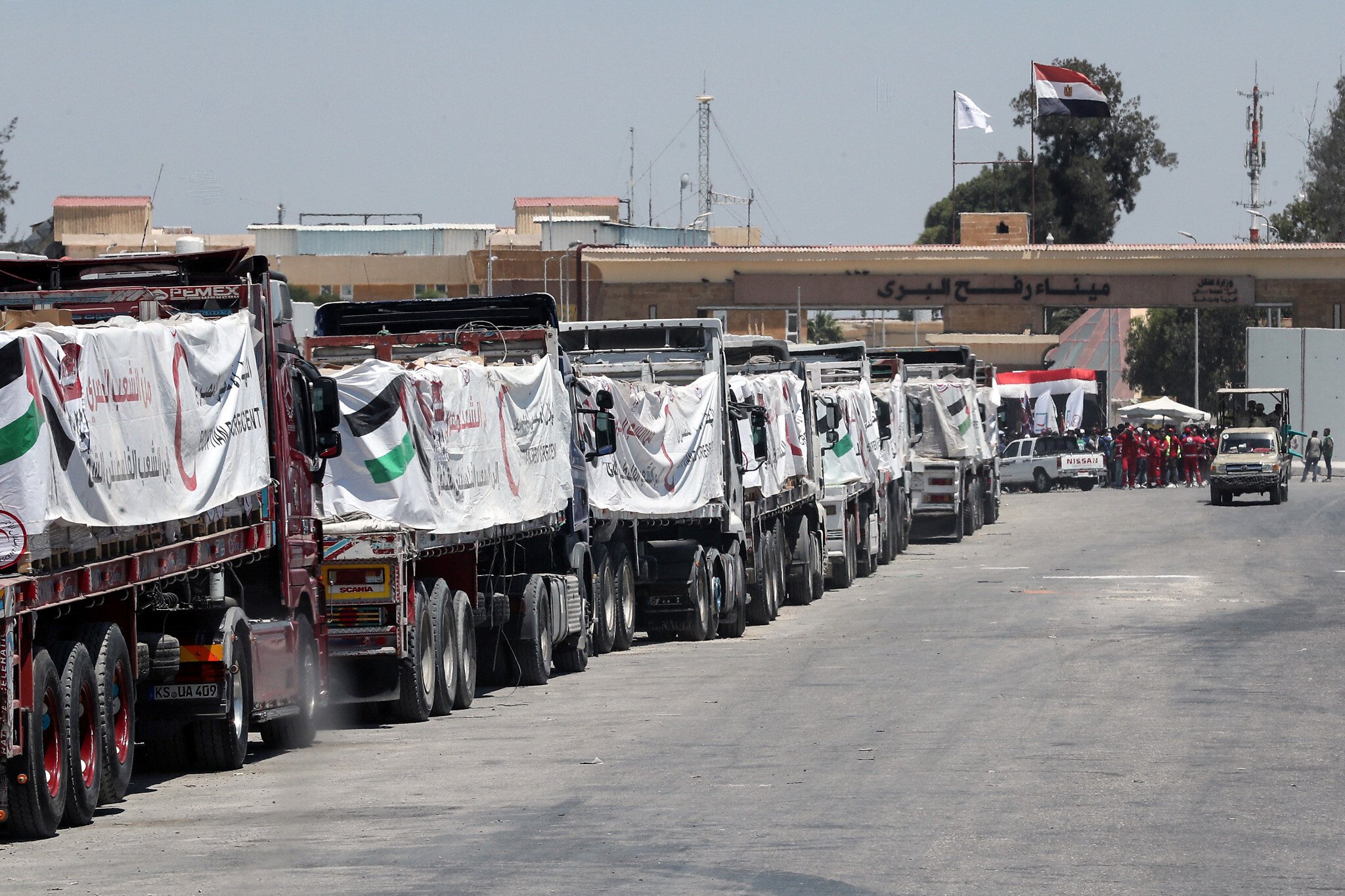
Trucks loaded with humanitarian aid await permission on the Egyptian side of the Rafah crossing with the Gaza Strip, to enter the Palestinian territory on August 6, 2025. (AFP)
COGAT, the Israeli body which coordinates activity in Gaza and the West Bank, says that over the past week close to 1,900 trucks of aid “were collected and distributed” from the Gazan side of the Kerem Shalom and Zikim Crossings.
More than 1,310 trucks of aid, mostly carrying food, crossed into Gaza this week, says the body, which operates as part of the Defense Ministry.
“We will continue facilitating humanitarian aid into Gaza for the civilian population — not Hamas,” the organization adds.
Over the past week:
????Close to 1900 trucks were collected and distributed this week from the Gazan side of the Kerem Shalom and Zikim Crossings.
????Over 1310 humanitarian aid trucks primarily containing food, entered through the crossings this week.
We will continue… pic.twitter.com/bwukG8eN7S
— COGAT (@cogatonline) August 10, 2025
Israel has accused aid agencies of not picking up aid that has sat waiting inside Gaza, while the agencies have blamed Israel for not allowing safe passage.
The United Nations estimates that between 500 and 600 truckloads of aid a day are needed to meet the needs of Gaza’s more than two million inhabitants. Many trucks are looted by Gazans before reaching their destinations.
Police shut down popular hiking routes due to extreme hot weather conditions
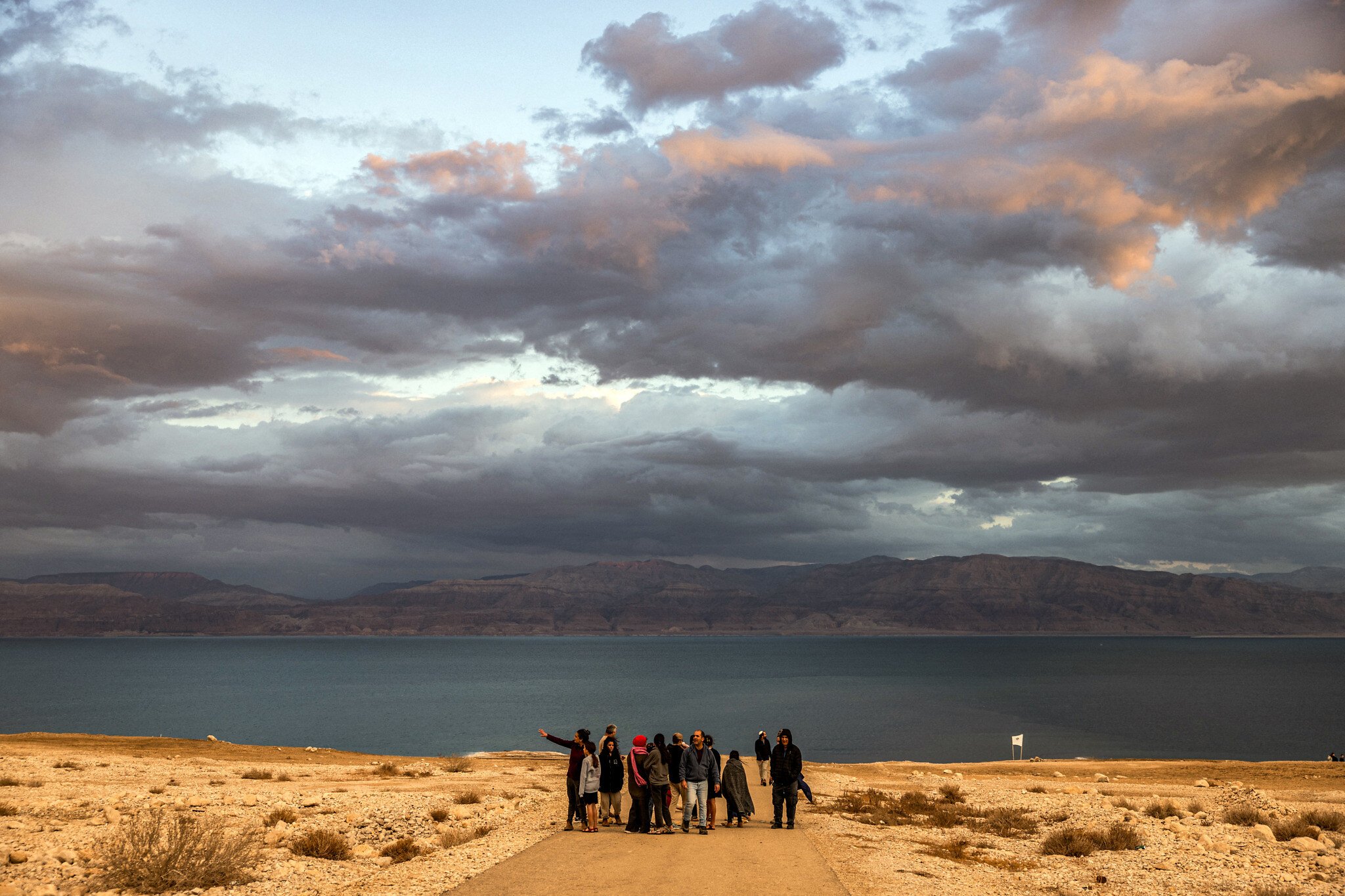
Hikers walk during an excursion along the Dead Sea shore near Kibbutz Ein Gedi in eastern Israel on December 30, 2024. (Menahem Kahana / AFP)
Due to blazing hot temperatures expected this week across Israel, the Israel Police announce that a number of hiking routes will be closed until at least Tuesday.
Paths in the northern Judean Desert, Nahal Prat and in the Jordan Valley will be shut for at least a few days, police say.
Around the Dead Sea area, temperatures are expected to hit 47°C (116°F) later this week. The high in Jerusalem this week is slated to be 39°C (102°F) and in Tel Aviv 36°C (97°F).
Religious Zionism MK: Without an aggressive Gaza war plan, ‘we need an election’
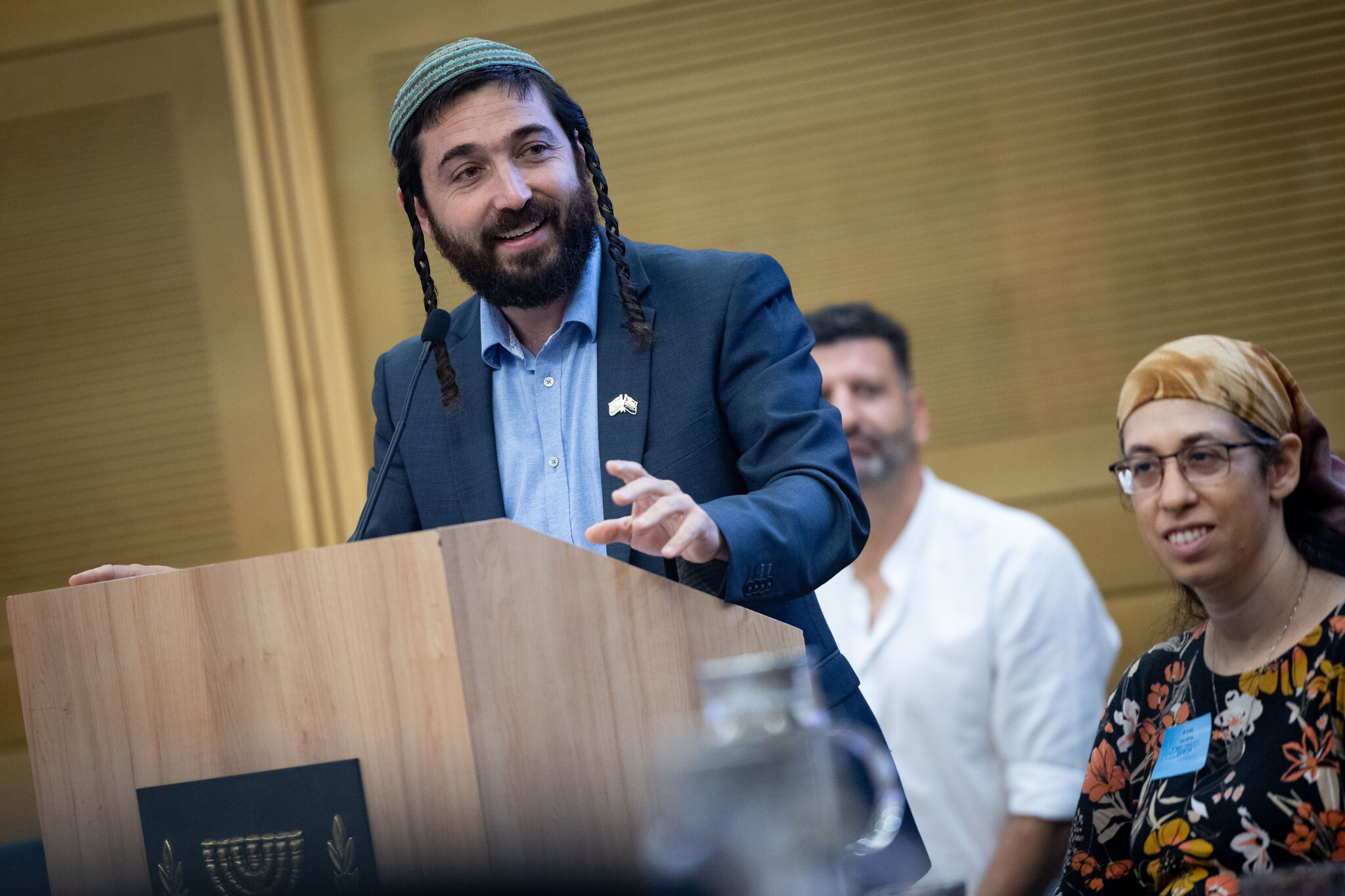
Religious Zionism MK Zvi Sukkot speaks at the 'Israel's Return to the Temple Mount' conference at the Knesset in Jerusalem, July 24, 2024. (Yonatan Sindel/Flash90)
Religious Zionism MK Zvi Sukkot appears to threaten to bring down the government unless it adopts a more aggressive strategy in Gaza, arguing that “if we return to October 6, 2023, and decide to abandon the war’s objectives, it is an existential danger to the State of Israel.”
“If this is the situation, in my humble opinion we need to go to elections,” he tweets.
Sukkot’s post follows a video message by Religious Zionism chairman Finance Minister Bezalel Smotrich last night in which he said that he no longer believes Prime Minister Benjamin Netanyahu is willing to do what it takes to win the war, and called the security cabinet’s approval on Thursday of a plan to conquer Gaza City a half-measure.
Smotrich said that he was previously able to set aside his reservations because he believed that “we were striving for a decisive victory,” but that now he has “lost faith that the prime minister is able and wants to lead the IDF to a decisive victory.”
According to national broadcaster Kan, Smotrich threatened to bring down the government and force a new election during Thursday night’s cabinet meeting.
“From my perspective we can stop everything and let the people decide,” he was quoted as saying.
Senior Israeli rabbi complains to pope over his comparison of Gaza and Ukraine wars

Rabbi Eliezer Simcha Weisz attends a swearing in ceremony for the Rabbinate Council at the President's Residence in Jerusalem, October 24, 2018. (Yonatan Sindel/Flash90)
Rabbi Eliezer Simcha Weisz, a member of the Inter-Religious Council of the Chief Rabbinate of Israel, has sent a letter to Pope Leo XIV, sharing his concern over the pontiff’s recent remarks comparing the situation in Gaza and in Ukraine.
“The instinct to show compassion for those in pain is admirable and deeply human. However, by naming Gaza and Ukraine in the same breath —without drawing a moral distinction, and without any reference to the Israeli hostages still being held by Hamas — many in the Jewish world heard a painful equivalence that deeply wounded us,” Weisz wrote on Wednesday, according to the letter shared with The Times of Israel by a rabbinate spokesperson.
Addressing a crowd of about one million young people who flocked to the outskirts of Rome for the “Jubilee of Youth” last Sunday, Leo said, “We are with the young people of Gaza, we are with the young people of Ukraine.”
Since his election in May, Leo has regularly spoken about peace and expressed his concern for the situation in Gaza, only at times also mentioning the Israeli hostages held there. There are still 50 hostages held by terror groups in Gaza — 49 who were taken during the Hamas massacres on October 7, 2023, and the body of an Israeli soldier killed and captured in 2014. Twenty of the hostages are believed by Israeli authorities to still be alive.
“We must never allow compassion for one people to come at the cost of justice for another,” Weisz wrote. “All suffering is worthy of prayer, but not all suffering is caused by the same hands, nor should all conflicts be spoken of in the same terms.”
The rabbi also cautioned Leo that, on the 60th anniversary of Nostra Aetate — the landmark declaration rejecting the notion of collective Jewish guilt for Jesus’s death and calling for dialogue with non-Christian faiths — the hard-won reconciliation now faces the risk of being eroded.
“It is in the spirit of that covenant that I raise this concern,” Weisz wrote. “At a time when antisemitism is spreading once more — on the streets of Western capitals, in universities, and tragically even within some churches — moral clarity is more essential than ever. The absence of empathy for Israeli victims, particularly those still in captivity, sends a painful message and risks undermining the extraordinary reconciliation achieved since Nostra Aetate.”
Weisz is also a member of the powerful Chief Rabbinate Council, a governing body of 10 rabbis headed by Israel’s two chief rabbis. The organization serves as the main authority on Jewish law for the government and provider of religious services in the country.
Jihadist terrorists said to kill police officer in Iran’s southeast
Jihadists killed one policeman in Iran’s restive southeastern province of Sistan-Baluchistan, Iranian media reports, adding that three assailants also died.
“A policeman from Saravan was killed while terrorists were trying to enter the police station” in that area of Sistan-Baluchistan, the Tasnim news agency says.
The attackers were members of the Sunni jihadist group Jaish al-Adl (“Army of Justice” in Arabic) based in Pakistan and active in Iran’s southeast, the agency says.
“Three terrorists were killed and two were arrested,” Tasnim adds.
Sistan-Baluchistan, which shares a long border with Pakistan and Afghanistan, has been the site of frequent clashes between security forces and insurgents or smugglers. The province hosts a significant population from the Baloch ethnic minority, which practices Sunni Islam in Shiite-majority Iran.
IDF chief orders snap inspection of military HQs to test readiness
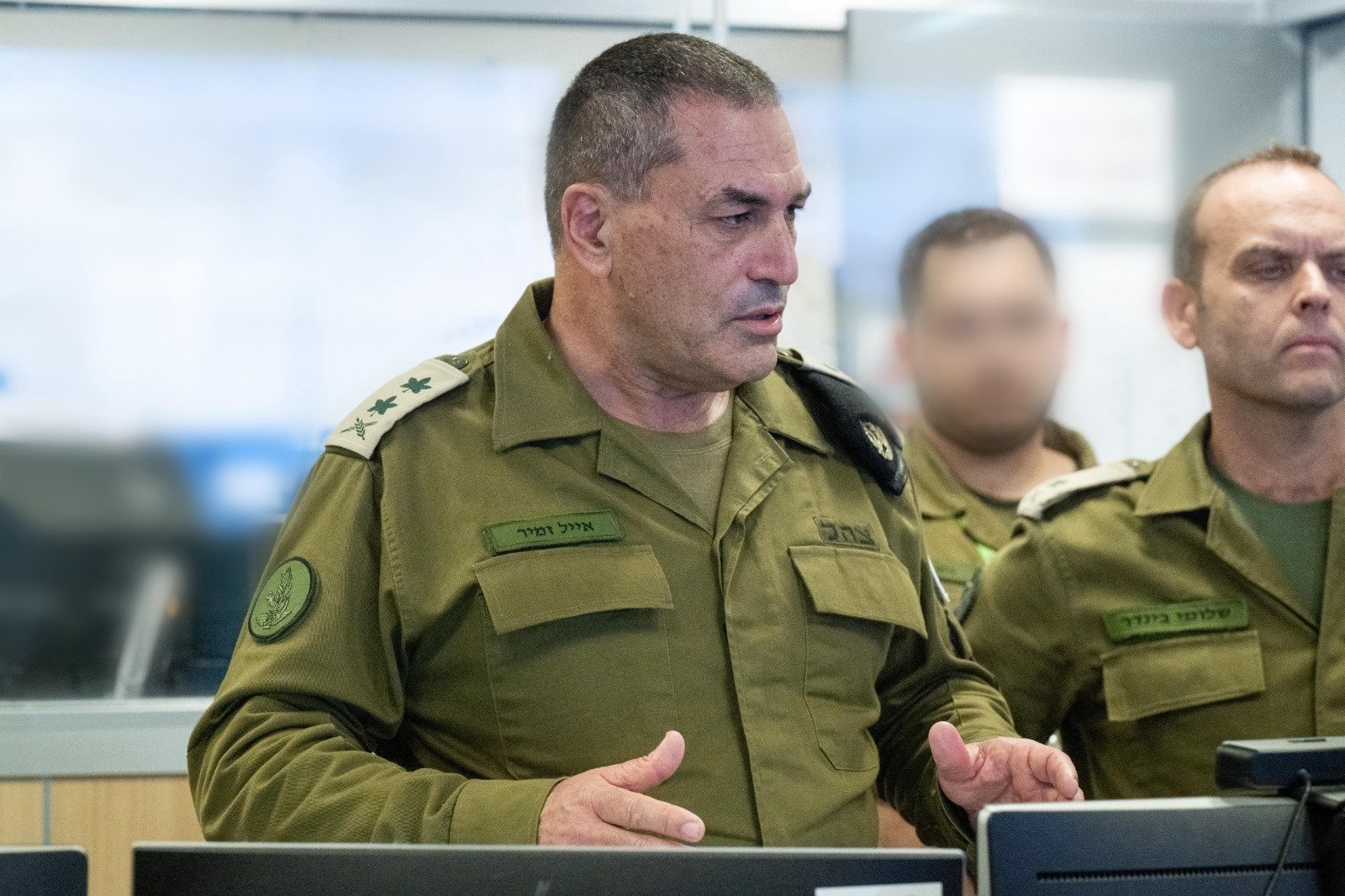
IDF Chief of Staff Lt. Gen. Eyal Zamir speaks with officers at the Military Intelligence Directorate's Research Division headquarters, June 18, 2025. (Israel Defense Forces)
IDF Chief of Staff Lt. Gen. Eyal Zamir this morning ordered a snap inspection of all the military’s top headquarters to test their readiness.
The military says the inspection, led by IDF Comptroller Brig. Gen. (res.) Ofer Sarig, will examine the headquarters’ “emergency order of battle, and the ability to handle a sudden, large-scale, complex, multifront event.”
“Surprise scenarios and multifront events will be drilled in every front of the war,” the IDF says.
Deputy IDF chief cancels appearance at Tel Aviv University conference
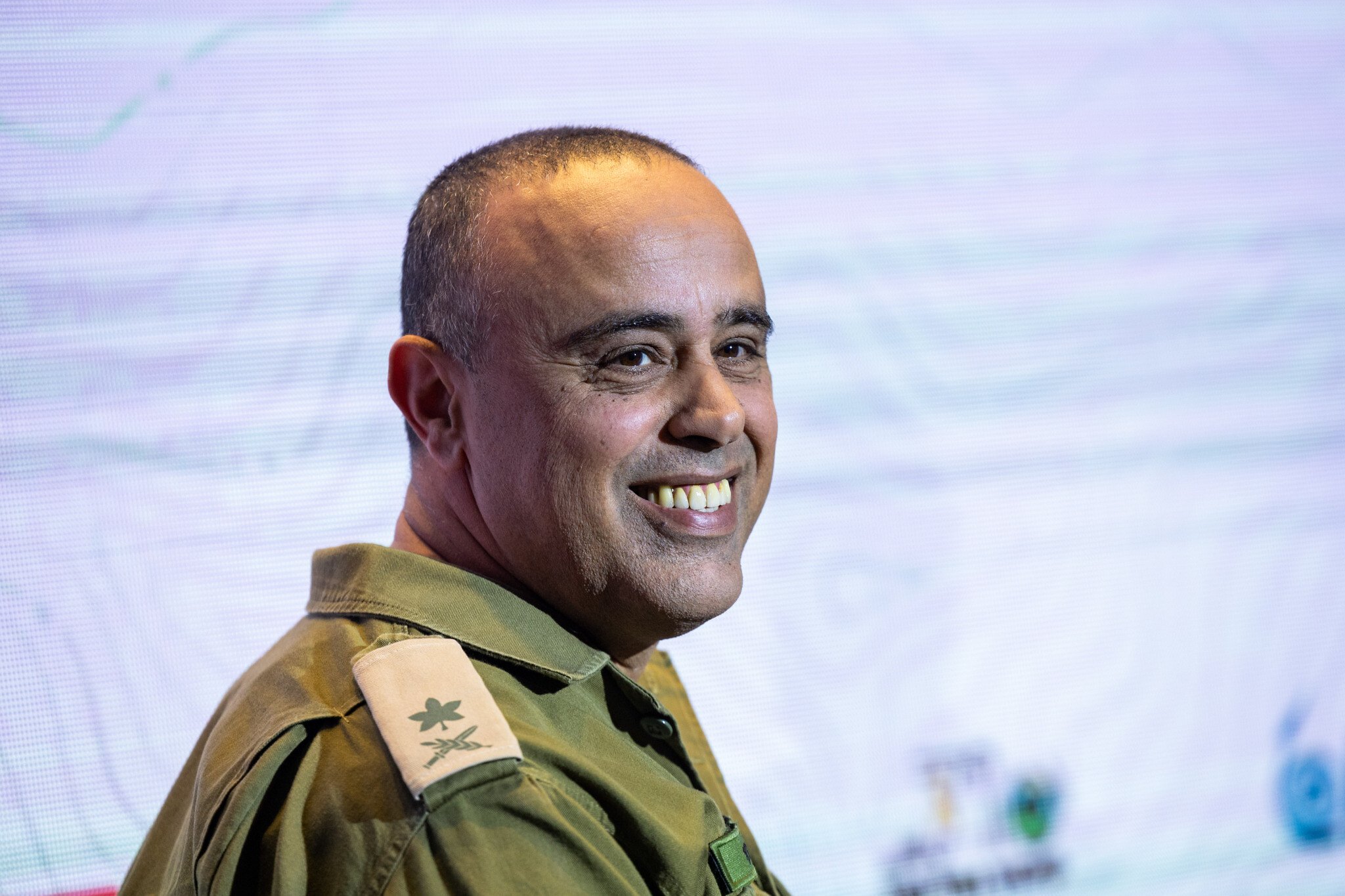
Deputy IDF Chief of Staff Maj. Gen. Tamir Yadai attends an Israel Hayom security conference in Jerusalem, December 1, 2024. (Yonatan Sindel/Flash90)
Deputy IDF Chief of Staff Maj. Gen. Tamir Yadai has reportedly canceled his attendance at a conference at Tel Aviv University this morning.
Army Radio reports that the deputy army chief was set to talk about the lessons learned from the war in Iran, but due to preparations for the military’s offensive against Hamas in Gaza City, he canceled his appearance.
Former Yesh Atid MK Idan Roll quits Knesset after leaving party
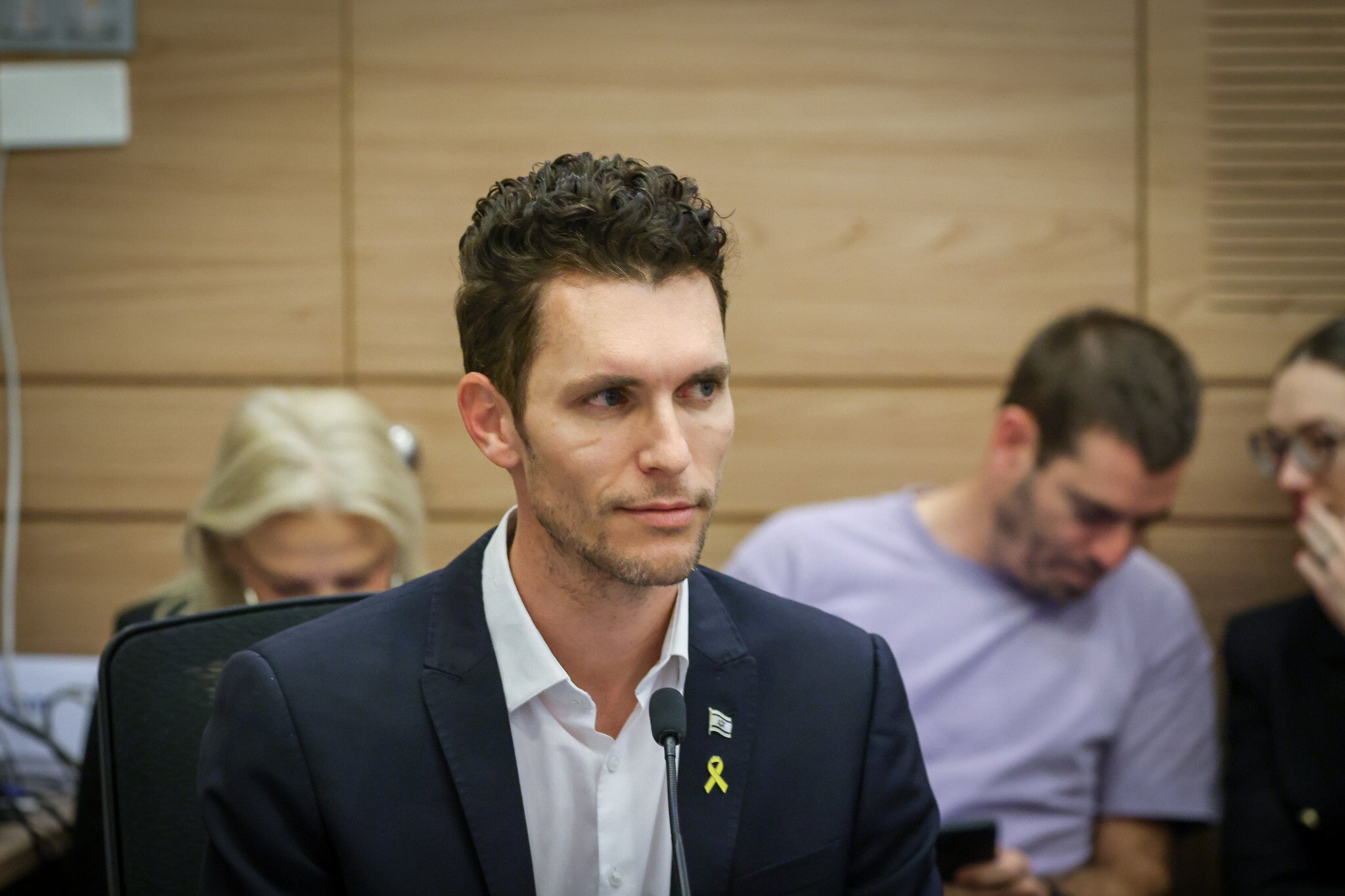
MK Idan Roll during a Knesset House Committee meeting on January 14, 2025. (Noam Moskowitz/Office of the Knesset Spokesperson)
Independent MK Idan Roll announces his resignation from the Knesset, stating that because he does not plan on running in the coming election, he believes that it is “appropriate to step down now at the beginning of the recess.”
The Knesset began a recess of nearly three months on July 27. It will reconvene on October 19 for the winter session.
In a lengthy post on X, Roll writes that he had done his best to serve the Israeli people through five election cycles, a global pandemic and a “bloody war” and was “grateful for the opportunity to advance the rights of the LGBTQ community,” and that he had attempted to promote a liberalism combining the promotion of human rights “alongside an uncompromising stance on our security.”
“I pray that in the next elections, a broad Zionist government will arise in Israel, one that will wisely leverage the many and unprecedented achievements of the war and shape a better future for our children in a new Middle East,” he adds.
In a statement, Yesh Atid chairman Opposition Leader Yair Lapid wishes Roll “much success going forward.”
This January, the Knesset House Committee voted 11-0 to approve Roll’s request to resign from Yesh Atid. At the time, Roll harshly criticized Lapid, writing in Haaretz that the opposition leader believes that “a Knesset member has no status, only the party.”
Roll is now forbidden by law to run in the next election under any party currently in the Knesset — a rule put in place to prevent sitting lawmakers from joining rival parties in return for material favors.
While Roll has previously stated that he plans on establishing a new faction that will be called National Majority, he did not mention this in his post today, instead stating that he was “retiring from the Knesset and political life.”
Ben Gvir calls on PM to work toward ‘toppling the Palestinian Authority’
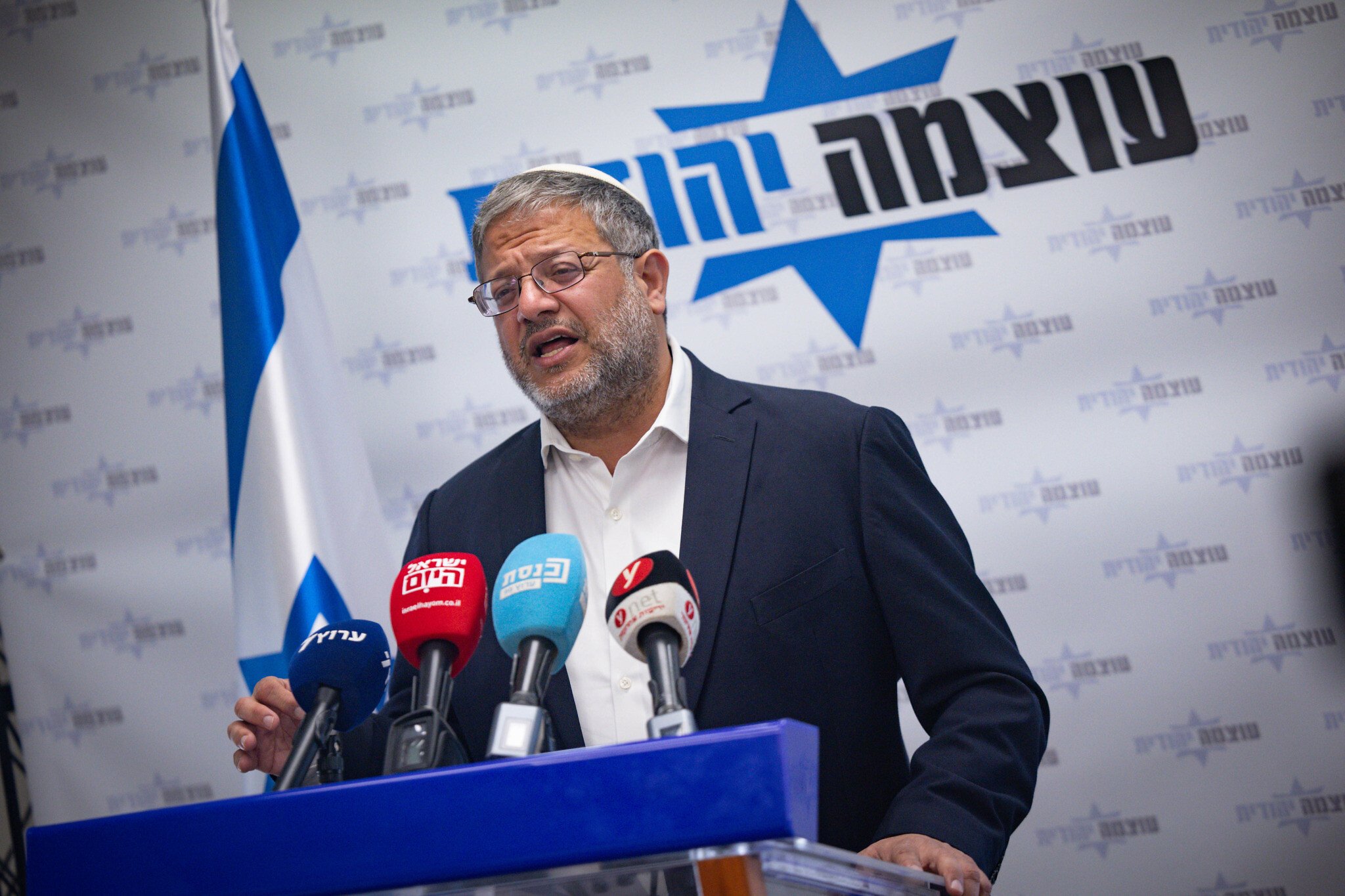
National Security Minister Itamar Ben Gvir leads an Otzma Yehudit faction meeting at the Knesset in Jerusalem on July 21, 2025. (Yonatan Sindel/Flash90)
National Security Minister Itamar Ben Gvir says that he will appeal to Prime Minister Benjamin Netanyahu during the next cabinet meeting to implement “immediate” measures “to topple the Palestinian Authority.”
“This must be the response to the terrorist Abu Mazen’s fantasies of a ‘Palestinian state’ — crushing the terror authority at whose head he stands,” Ben Gvir tweets.
The far right minister’s statement comes on the heels of a report by the Al-Arabi Al-Jadeed newspaper that Abbas is weighing unilaterally declaring a Palestinian state during the UN General Assembly this September.
Several countries have announced plans to recognize a Palestinian state during the annual diplomatic gathering in New York.
Yesh Atid’s Adi Ezuz to replace Idan Roll in the Knesset

Adi Ezuz (Courtesy)
Adi Ezuz is set to enter the Knesset on behalf of the Opposition Leader Yair Lapid’s Yesh Atid party following the resignation of independent MK Idan Roll, who quit the party earlier this year but until now has retained his seat.
In a statement, Yesh Atid welcomes Ezuz, an attorney, former Lapid adviser and disability rights activist who currently heads The Woman’s Courtyard organization, which “promotes social justice, equal opportunities and the right of every woman to achieve self-fulfillment in accordance with her will.”
Roll announced today that he is resigning from the Knesset because he does not plan on running in the coming election and it is thus “appropriate to step down now.”
Katz says IDF troops will remain deployed to refugee camps in northern West Bank

Defense Minister Israel Katz visits an IDF post in the Gaza Strip buffer zone, August 5, 2025. (Ariel Hermoni/Defense Ministry)
Defense Minister Israel Katz says IDF troops will remain deployed to the northern West Bank refugee camps at least until the end of the year.
In January, the military launched an offensive against terror operatives in the northern West Bank, focusing on the refugee camps in the Jenin and Tulkarem areas.
Katz says the Jenin, Tulkarem and Nur Shams camps were hotbeds of terror, funded and armed by Iran, to act as another front against Israel.
In the past eight months, Katz says the IDF carried out an “intensive” offensive, during which residents of the camps were evacuated, gunmen were killed, and infrastructure used by terror groups were destroyed.
“The IDF will remain inside the camps at this stage, at least until the end of the year, under my directives,” Katz says in statement.
“Today there is no terror in the camps, and the scope of terror alerts in Judea and Samaria [West Bank] has dropped by 80%,” he adds.
Family members of hostages demand general strike next Sunday against government’s war plan
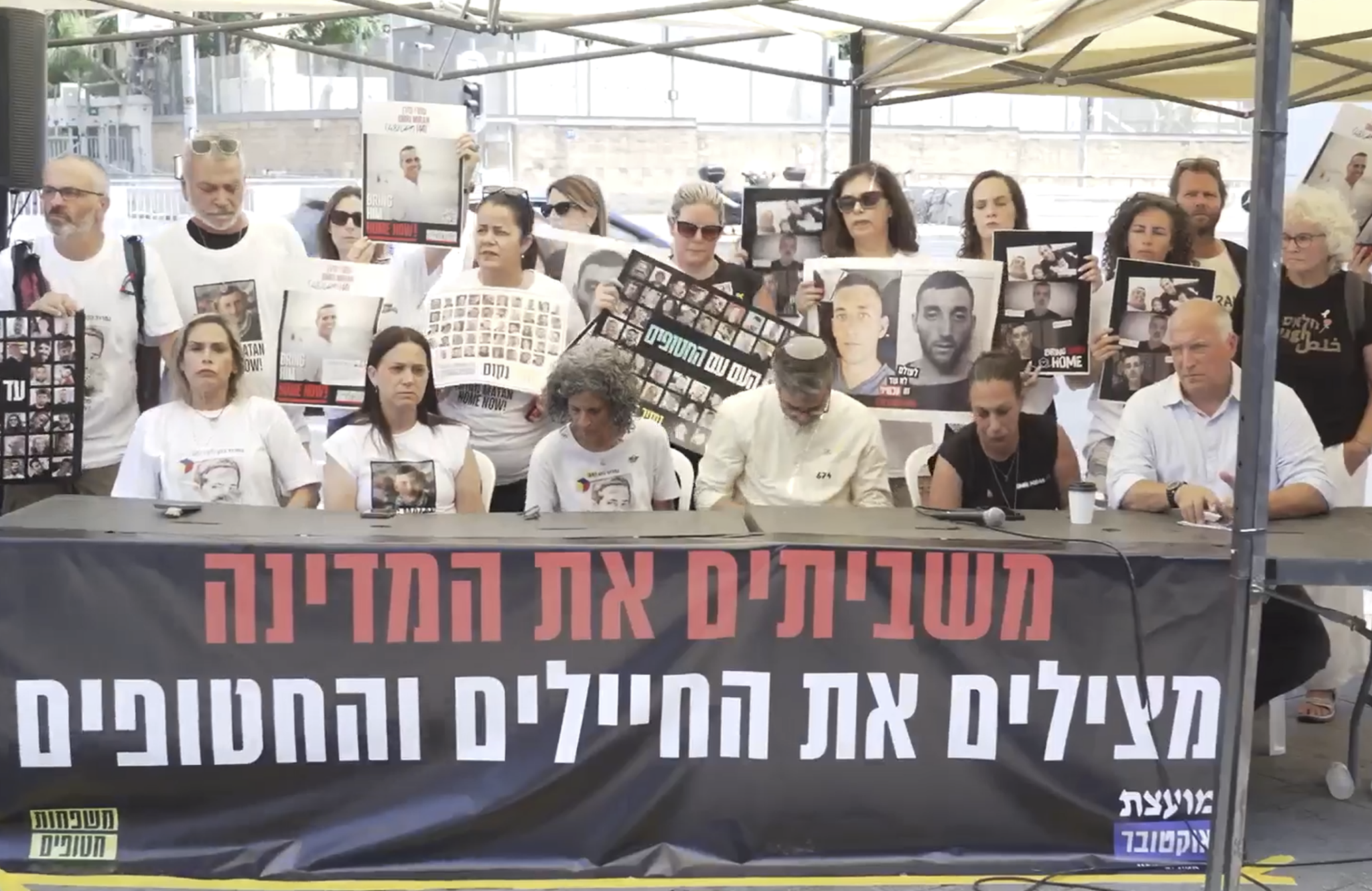
Family members of hostages and those slain on October 7 hold a press conference in Tel Aviv on August 10, 2025. (Screenshot/Facebook)
Groups representing families of the hostages, slain soldiers and victims of Hamas’s October 7 massacre call for a general strike to take place next Sunday, against the war and the government’s plan to take over Gaza City.
“We will all pause next Sunday and say: ‘Enough, stop the war, return the hostages.’ It is in our hands,” says bereaved mother Reut Recht-Edri, whose son Ido Edri was murdered by Hamas at the Nova music festival, at a press conference in Tel Aviv.
Anat Angrest, the mother of Hamas hostage Matan Angrest, decries the decision to occupy the densely populated city, saying it will endanger those who remain in captivity.
“The government decided to occupy the Gaza Strip, to send soldiers to come closer to Matan. They are trying to bring him back, but in practice are endangering him,” she says.
She evokes the events of last September, in which six hostages were murdered in a tunnel by Hamas terrorists when IDF troops were nearing their location, and warns that the plan to conquer Gaza City approved on Thursday night will lead to a similar outcome for her son.
“The army came close to them [the six murdered hostages] as the prospect of a deal was being undermined. This is in addition to dozens of hostages that were kidnapped alive and murdered in captivity as a result of military pressure,” she continues.
The general strike, which has already received backing from leading figures in the opposition, is organized by the October Council, which represents families affected by Hamas’s October 7 massacre.
It lacks the support of the powerful Histadrut labor federation, however, after a Tel Aviv court barred it last year from calling a strike to pressure the government into sealing a hostage and ceasefire deal in Gaza, defining the matter as political rather than related to workers’ rights.
Opposition Leader Yair Lapid comes out in support of the countrywide strike, tweeting that the hostage families’ call “to shut down the economy is justified and worthy. We will continue to stand by their side.”
Likewise, The Democrats chief Yair Golan comes out in favor of the strike, calling on “all citizens of Israel” to participate and arguing that it is impossible to continue with regular routines while “our brothers and sisters in Gaza” are being abandoned.
Netanyahu to hold a press conference today for foreign media
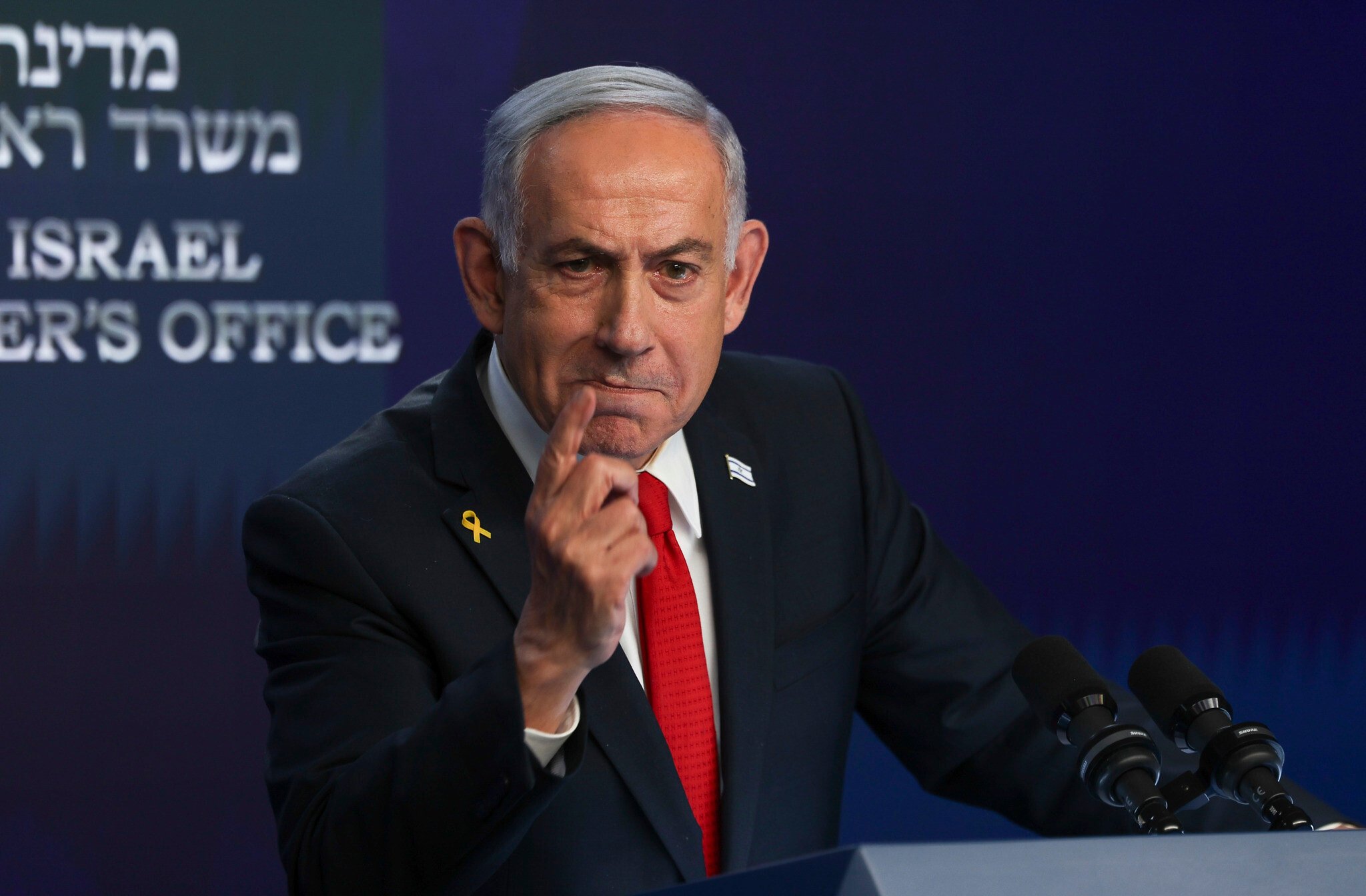
Prime Minister Benjamin Netanyahu speaks during a press conference in Jerusalem, May 21, 2025. (Ronen Zvulun/Pool Photo via AP)
Prime Minister Benjamin Netanyahu will hold a press conference for foreign press at 4:30 p.m. today, the Prime Minister’s Office announces.
The press conference will take place at the premier’s Jerusalem office and be broadcast live, adds the PMO.
Netanyahu will reportedly also hold a press conference in Hebrew later this evening for local media.
Arab parties set to discuss potentially reuniting into Joint List bloc

MK Ayman Odeh (left), head of the Joint List, and MK Ahmad Tibi attend a faction meeting at the Knesset in Jerusalem on March 7, 2022. (Yonatan Sindel/Flash90)
The four Arab parties — Hadash, Ra;am, Ta’al and Balad — are set to meet tomorrow to discuss reviving the Joint List bloc ahead of the next elections, with the question of leadership shaping the talks, according to a source close to the joint Jewish-Arab party Hadash.
The party is insisting that former Hadash MK Yousef Jabarin, who is expected to win Hadash’s October primaries, lead the list.
Jabarin is well-known within the Arab community as an active political figure and is seen as a fresh, “statesmanlike” alternative to outgoing Hadash leader Ayman Odeh, who was recently almost expelled from the Knesset, although he is less well-known than Odeh among Jewish voters.
Meanwhile, the source says that Islamist Ra’am party’s Mansour Abbas and Ta’al’s Ahmad Tibi are willing to compromise on the leadership of the list to keep the alliance intact, though leaders want the Joint List to remain merely a technical alliance to allow them the option to split after the elections and join a governing coalition separately.
As a result, Abbas, who may also step down from the leadership of the party, is reportedly insisting on at least five seats on the combined list in order to preserve Ra’am’s political influence and coalition potential.
The source says that the meeting follows Balad’s recent agreement to rejoin the Joint List, albeit with “ideological” conditions. The secular-nationalist party is demanding that the list define clear red lines on the war, the current government and any future coalition.
However, Balad’s position is largely symbolic, the source says, since, having failed to enter the Knesset in the last election, the party lacks leverage and knows it cannot run independently due to legal disqualification and funding shortages. Realistically, Balad is seeking two seats within the list.
Border Police officer indicted for beating reporter in Jerusalem’s Old City last year
Prosecutors file an indictment against a Border Police officer accused of assaulting a journalist last year with a baton, breaking his arm.
The defendant, Yazan Joaeh from Maghar, an Arab city in northern Israel, had been securing an area near the scene of a terror attack in the Old City in February last year.
Police ordered journalists covering the event — in which a 16-year-old Palestinian tried to stab several police officers — to leave the area. However, one reporter, Itamar Cohen of the news platform News360, kept coming back to the scene.
Rather than detain Cohen, prosecutors say the indicted officer ran at him and started beating him with a baton, striking his lower body without relenting, even after knocking him to the ground.
When Cohen begged to be taken to the hospital, the defendant ignored his request and asked: “You want some more?” then continued to batter him, according to the indictment.
Joaeh then told the reporter — who sustained leg injuries and a broken arm — to call an ambulance on his own. He is charged today in the Jerusalem Magistrate’s Court with assault causing bodily harm.
Air raid sirens sound in Nahal Oz and Kfar Aza
Rocket sirens sound in the Gaza border communities of Nahal Oz, Kfar Aza and Sa’ad.
The IDF says it is looking into the details.
IDF: Two rockets fired from Gaza toward Israel, interceptors launched
Two rockets were launched from the Gaza Strip at southern Israel a short while ago, the military says.
The IDF says it made attempts to intercept the rockets, the results of which are under investigation.
Sirens sounded in the Gaza border communities of Nahal Oz, Kfar Aza and Sa’ad.
There are no immediate reports of injuries or damage in the attack.
Protesters demanding release of hostages set to march in London this afternoon
Police in London are bracing for another day of demonstrations today as the war in Gaza continues to inflame tensions across the United Kingdom.
Demonstrators demanding the immediate release of all the remaining hostages in Gaza plan to march through central London to the prime minister’s residence at No. 10 Downing Street this afternoon. The march comes a day after police arrested 474 people at a protest in support of a banned pro-Palestinian organization.
Among those expected to attend the rally is Noga Guttman, a cousin of 24-year-old hostage Evyatar David, who was featured in a video that was released by Hamas last week. The video showed an emaciated David saying he is digging his own grave inside a tunnel in Gaza.
“We are united in one clear and urgent demand: the immediate and unconditional release of all hostages,” Stop the Hate, a coalition of groups organizing the march, says in a statement. “Regardless of our diverse political views, this is not a political issue — it is a human one.”
Lapid calls on Smotrich to join efforts to bring down coalition, force new election
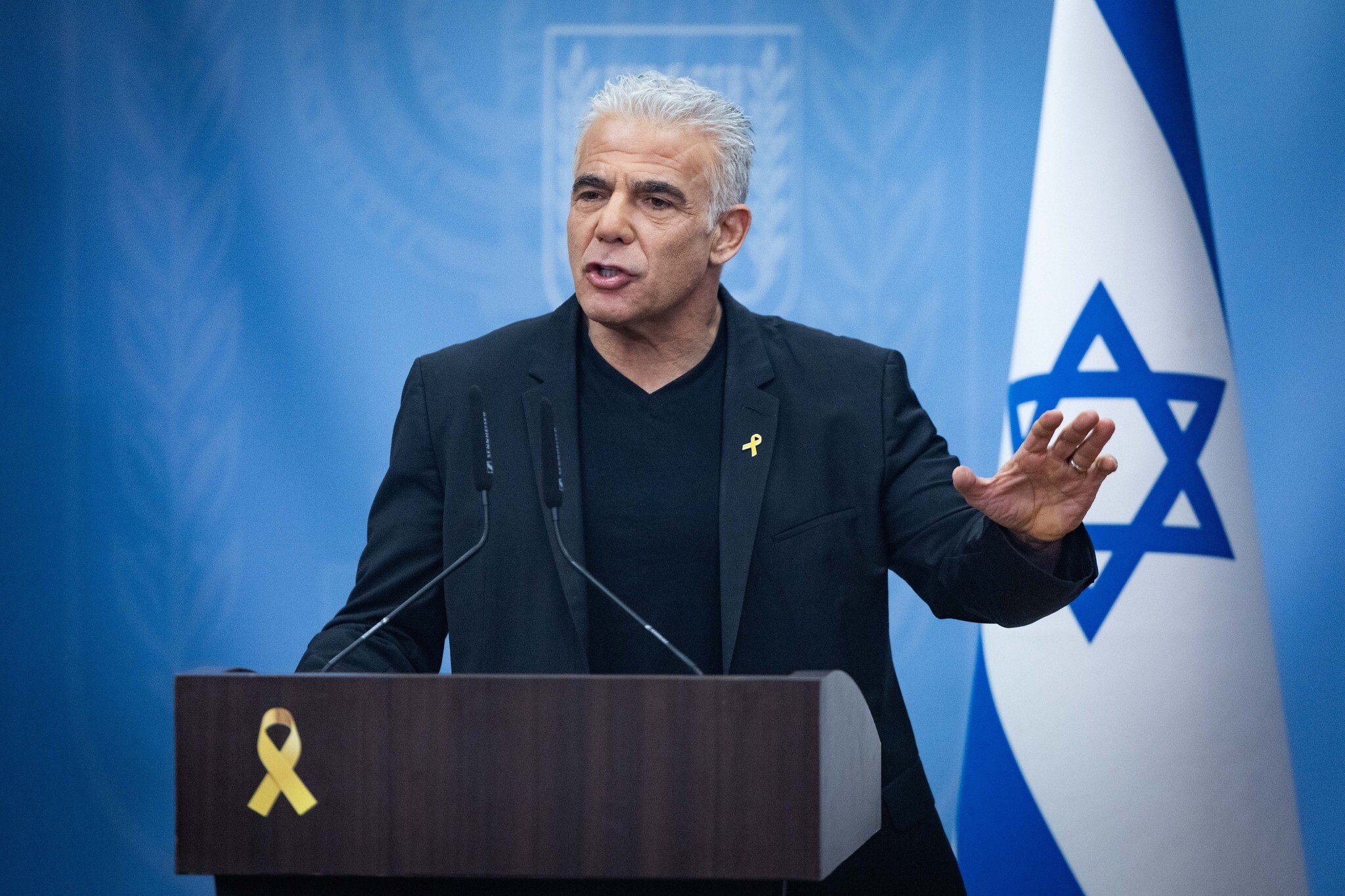
Opposition Leader MK Yair Lapid leads a Yesh Atid faction meeting at the Knesset in Jerusalem, on July 21, 2025. (Yonatan Sindel/Flash90)
Opposition Leader Yair Lapid calls on Finance Minister Bezalel Smotrich to join him in advancing a bill to dissolve the Knesset and hold new elections in the wake of Smotrich’s statement that he had “lost faith that the prime minister is able and wants to lead the IDF to a decisive victory.”
“In your own words, you admitted that the prime minister’s policy is not leading to a decisive outcome in Gaza, is not returning our hostages, and is not winning the war,” writes Lapid. “You also added that you can no longer stand behind the prime minister and back him up.”
“In light of this, I call on you to join me in a joint letter to the Knesset speaker in which we will announce a substantial change of circumstances that justifies resubmitting the bill to dissolve the 25th Knesset,” Lapid adds.
Lapid announced last month that he had begun the process of collecting 61 signatures in order to submit a so-called “change of circumstances” letter to Knesset Speaker Amir Ohana requesting permission to hold a vote on dissolving the Knesset. An opposition-backed bill to disperse the Knesset and call early elections failed to advance in June after ultra-Orthodox lawmakers backed away from their threats to bring down the government over a deadlock in efforts to legislate exemptions from army service for the young men of their community.
Under parliamentary rules, because the legislation was defeated, lawmakers have to wait six months to bring another Knesset dissolution bill to a vote. However, according to the Knesset bylaws, a defeated bill can be submitted for reconsideration before six months have passed if circumstances have significantly changed.
Such a change can be shown by collecting 61 MKs’ signatures.
Arab Israeli man reportedly shot dead by IDF troops in West Bank

Abdallah Atiyat (Facebook)
An Arab Israeli man from Nazareth was shot dead by IDF troops in the West Bank city of Jericho last night, local Arab outlets report.
Abdallah Atiyat, 24, had been visiting his aunt in Jericho over the weekend when he was shot in the head amid clashes during an army raid in the city’s downtown, according to the Arab Israeli radio station Radio Shams.
In an interview with the station, Atiyat’s mother, Amina, says that her son had been struggling to get back to Nazareth amid widespread closures due to the raid. He was reportedly killed while searching for a taxi to take him home.
He was taken in critical condition to a hospital in Jericho, then shuttled to Hadassah Hospital in Jerusalem’s Ein Kerem neighborhood, where he succumbed to his wounds.
Responding to a request for comment, the IDF tells The Times of Israel that its forces had been operating in the Jericho region Saturday night, when Atiyat was killed.
During the army operation, IDF forces “identified a suspect approaching them who posed a threat. The forces fired at the suspect, a hit was identified and the incident is under investigation,” says a spokesperson.
91-year-old Holocaust survivor dies after being wounded in Iran missile strike in June
Olga Weissberg, a 91-year-old Holocaust survivor who was wounded in an Iranian missile attack in June, has reportedly died.
According to Hebrew media outlets, she died last night in Rehovot, close to two months after a missile strike on the city.
No further details were immediately available.
Thirty other people in Israel were killed by Iranian missiles during the 12-day war, of whom 29 were civilians and one was an off-duty soldier at home with his family.
AG to PM: Delaying state inquiry into October 7 is harming investigation

Attorney General Gali Baharav-Miara attends a Constitution, Law and Justice Committee at the Knesset in Jerusalem, on April 27, 2025. (Yonatan Sindel/Flash90)
Attorney General Gali Baharav-Miara tells Prime Minister Benjamin Netanyahu that the government’s ongoing delay in establishing a mechanism to investigate the failures leading up to the October 7 Hamas invasion and atrocities is harming the ability of any future investigation to uncover what went wrong.
The government has steadfastly refused to establish a state commission of inquiry into the October 7 disaster, initially claiming such an investigation could not be conducted during a war, and then arguing that a state commission, which would be led by a senior judge, would be politically biased against it.
The government has said in response to petitions to the High Court that it is examining alternatives to a state commission, but has yet to decide what form such an investigation would take.
“By default, refraining from making a decision changes the reality on the ground in an irreversible manner, and harms a future investigation and the possibility of arriving at the truth,” Baharav-Miara tells Netanyahu in a letter.
“The substantive amount of time [which has passed since October 7] leads naturally to evidentiary damage and injury to the effectiveness of any investigation that will take place, including harm to testimony that will be given.”
The attorney general also asserts that a state commission of inquiry — which by law has the power to summon witnesses, compel them to answer questions, and compel state agencies to provide the investigative materials it seeks — is the best mechanism for investigating the events surrounding the October 7 attacks.
The High Court ordered the government in December 2024 to hold a hearing on how it would investigate the October 7 catastrophe, which it did. The government has subsequently requested and received two extensions for answering how it will do so.
Today is the court’s deadline to the government to provide it with its latest update on the matter.
After press conference for foreign outlets this afternoon, PM to hold another for local reporters
Prime Minister Benjamin Netanyahu delivers a pre-recorded message from his office in Jerusalem on July 29, 2025. (Screen capture/PMO)
Prime Minister Benjamin Netanyahu will hold a press conference for Israeli media at 8 p.m., the Prime Minister’s Office announces.
The press conference will be held at the premier’s Jerusalem office and be broadcast live, following a separate conference for foreign press scheduled to be held this afternoon.
Italian FM warns Israel that Gaza war plan ‘risks turning into a Vietnam’

Italy's Foreign Minister Antonio Tajani in London, May 12, 2025. (Adrian Dennis/Pool Photo via AP)
Italy warns Israel to heed its own army’s warnings against embarking on a widespread military campaign to conquer all of the Gaza Strip.
“The invasion of Gaza risks turning into a Vietnam for Israeli soldiers,” Foreign Minister Antonio Tajani says in an interview with daily Il Messaggero.
He reiterates calls for a United Nations mission led by Arab countries to “reunify the Palestinian state” and says Italy is ready to participate.
The UN Security Council is likely to discuss the humanitarian crisis in Gaza and the prospect of its worsening if the Israeli plan goes ahead, but there has so far been little appetite among Arab states to send their troops in.
IDF says it foiled weapons smuggling attempt from Egypt using drone

Weapons and a drone that were seized by IDF troops following an attempted smuggling on the Egyptian border, August 10, 2025. (Israel Defense Forces)
The IDF says it foiled another attempt to smuggle weapons into Israel from Egypt using a drone today.
The drone had been identified crossing the border from Egypt into Israel before it was downed.
Troops located the drone, which was found to be ferrying 10 rifles, the military says, adding that the contraband and drone were handed over to the police.
In the past year, there have been frequent attempts to bring weapons and drugs over the Egyptian border using drones. There have also been attempts to smuggle similar contraband from Israel into Gaza using drones.
UTJ lawmaker: A ‘civil war’ is brewing between Haredi and secular Israelis over IDF draft
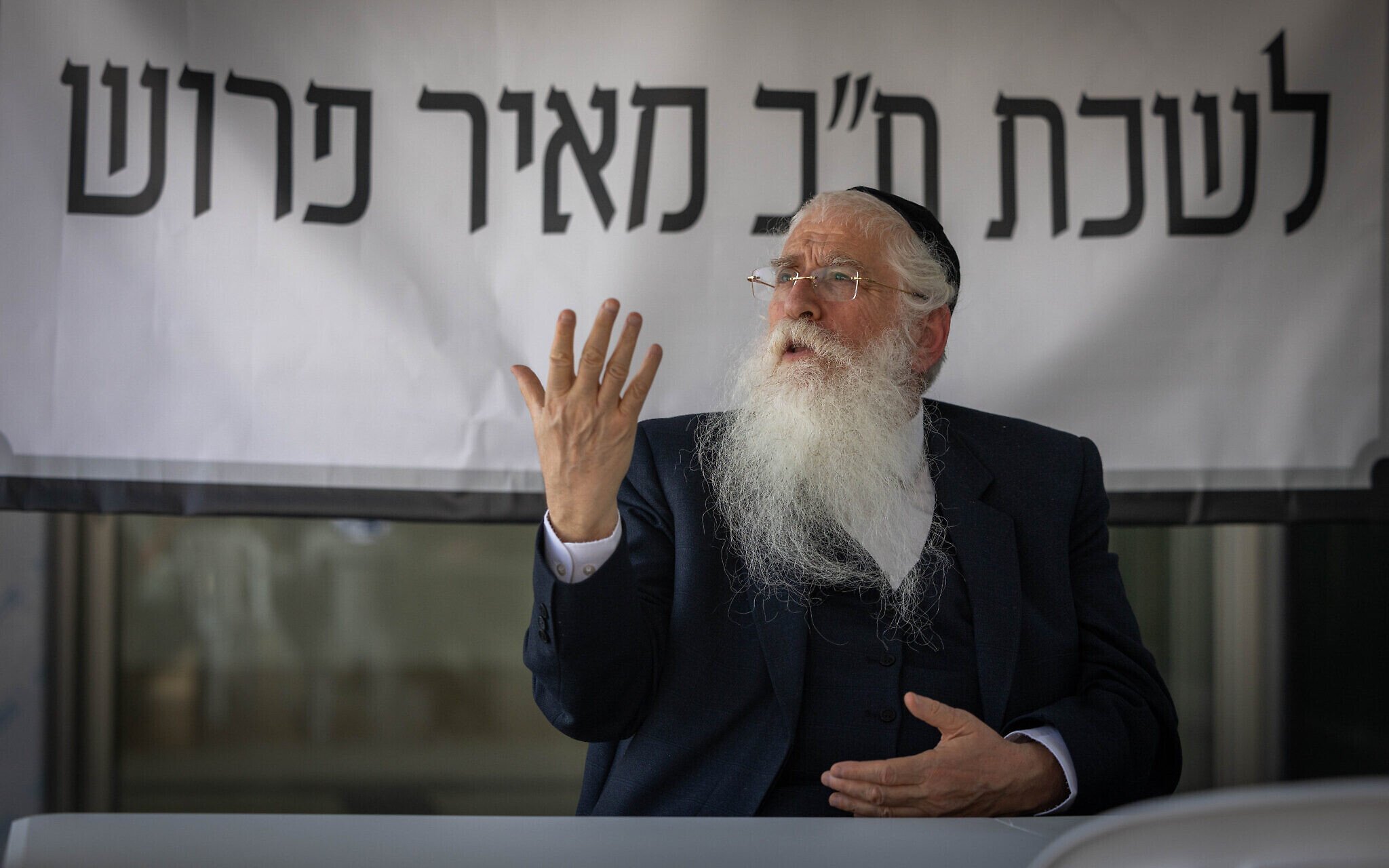
MK Meir Porush sits in front of a banner reading "Office of MK Meir Porush" as he demonstrates outside the Justice Ministry in Jerusalem on August 7, 2025. (Chaim Goldberg/Flash90)
United Torah Judaism MK Meir Porush warns that the conflict over ultra-Orthodox enlistment could escalate into a civil war if legislation is not passed regulating military service exemptions for yeshiva students.
Speaking with the Haredi news site Kikar HaShabbat from a protest tent he pitched outside the Justice Ministry, the former Jerusalem affairs minister declares that “a civil war is developing between Haredim and secular” Israelis and warns against mass arrests of draft evaders.
“You can’t go to war with about a million and a quarter ultra-Orthodox citizens who want to live here in a certain way,” he says, arguing that unless action is taken now to deal with the issue “it will develop and grow and no one will be able to stop it.”
“If young men get arrested it will definitely escalate into a conflict… there would definitely be a terrible fight here,” he says.
היום השלישי לשביתת הרעב: ח״כ מאיר פרוש בלשכת המחאה מחוץ למשרד המשפטים pic.twitter.com/XM1TJ5m9Bl
— אבי מוסקוב Avi moskoff (@AviMoskov) August 10, 2025
In response, Yisrael Beytenu chairman Avigdor Liberman tweets: “Instead of threatening civil war, join the effort to defeat the enemy.”
Porush set up shop outside the Justice Ministry late last week to protest the arrest of yeshiva students who evaded military draft orders, declaring in a statement that he intended to move his office’s activities to a spot outside the ministry and to forgo food for nine hours a day.
Meanwhile Moshe Hillel Hirsch, the head of the Slabodka Yeshiva in Bnei Brak and a leading ultra-Orthodox rabbi, goes to the military prison in Beit Lid to visit brothers Rafael and Baruch Yitzhakov — yeshiva students from Tel Aviv who were arrested after failing to report to the draft office.
He is accompanied by members of the Shas party’s ruling Council of Torah Sages, including Rabbi Moshe Maya. The rabbis were initially blocked from entering the prison but were eventually allowed inside.
Prior to visiting the prison, Hirsch met with Rabbi Dov Lando, the spiritual leader of the Degel HaTorah party at his home in Bnei Brak. According to a spokesman for Lando, during their discussion Hirsch “suggested several additional protest steps in the struggle for the Torah world” and these ideas “were forwarded for in-depth discussion and professional examination.”
According to the ultra-Orthodox Behadrei Haredim news site, Haredi leaders are currently discussing the possibility of launching protests to shut down Ben Gurion Airport this week.
Speaking with The Times of Israel last night, a source with knowledge of the senior rabbis’ thinking said that they are considering holding demonstrations outside of Israeli embassies worldwide.
Rothman: Decision to conquer Gaza City brings Religious Zionism closer to leaving government
Last week’s cabinet meeting, in which the government approved a plan to conquer Gaza City, has brought the Religious Zionism party closer to leaving the government, MK Simcha Rothman tells the Knesset Channel.
Asked why party leader Finance Minister Bezalel Smotrich has not already quit after announcing that he’d “lost faith” in the premier’s war strategy, Rothman replies that “it’s definitely on the table. It’s something that’s been said many times… that the moment we are convinced that they have dropped the goals of the war… we will no longer be a part of the government.”
Last week’s cabinet meeting brought Religious Zionism very close to such an eventuality, Rothman says, although nothing is certain yet.
“I suppose the coming hours and days will tell,” he says, demanding that the cabinet cancel its decision and “go all the way to the end to defeat Hamas.”
On Saturday night, Smotrich posted a video on X saying that in light of the Gaza City plan, he has “lost faith that the prime minister is able and wants to lead the IDF to a decisive victory.”
While his public message was strongly worded, Smotrich didn’t outright threaten to quit the government.
However, this morning, Religious Zionism MK Zvi Sukkot wrote on X that if Israel decides “to abandon the war’s objectives,” then “we need to go to elections.”
Three arrested on suspicion of planning terror attacks against Israeli civilians, soldiers
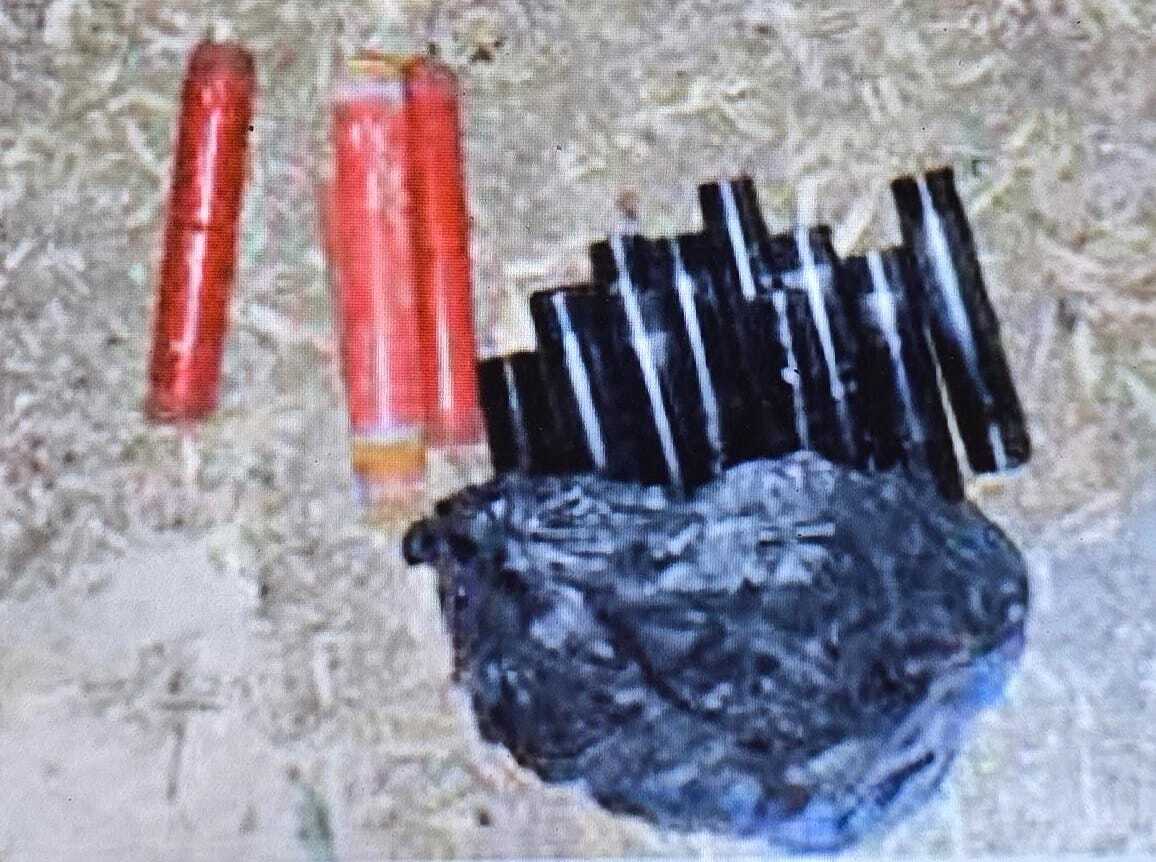
Explosives seized during a raid on an apartment that police say was used by a Palestinian father and son to plan terror attacks, photo published August 10, 2025. (Israel Police)
Police officers and Shin Bet agents nabbed three people, including a father and son, suspected of plotting terror attacks against Israeli civilians and security forces.
The suspects — all currently in custody — planned to stage a bombing attack at a checkpoint in northern Jerusalem, assassinate someone they believed to be an Israeli air force pilot, and shoot up a nightclub in central Israel, police say.
A senior police investigator tells Ynet that the probe represents “one of the most serious cases we’ve handled in the unit,” saying the arrest of the three suspects prevented a mass casualty attack.
The investigation was opened after the father, who resides with his son in Kufr Aqab, reached out to an undercover cop with an offer to sell him explosives meant for terror attacks.
The father and son had both been employed as cooks at a restaurant and retirement home, respectively, in central Israel, according to Ynet.
The outlet reports that the father is an Arab Muslim who married and had a son with a Jewish Israeli woman. The two have since divorced.
The detained son, Jewish by virtue of his mother, reportedly converted to Islam after he was disqualified from serving in the IDF, for reasons that remain unclear.
The pair was arrested by the Jerusalem District police’s investigations and intelligence unit in late June. Officers seized bombmaking components, ammunition and ready-to-use pipe bombs when raiding apartments that the two had stayed in, police say.
The third suspect, a resident of East Jerusalem in his 20s, was arrested on suspicion of preparing explosives with the father and hiding them in his home. He also planned to attack security forces.
A prosecutor’s declaration was filed against the three, and they will be charged with security offenses in the coming days, law enforcement announces.
Watch: Netanyahu holds press conference for foreign media
Prime Minister Benjamin Netanyahu begins his press conference for foreign media.
He will hold a second press conference at 8 p.m. for Israeli media.
Hostages forum: PM must use press conferences to reiterate commitment to hostage deal ‘before it is too late’
As Prime Minister Benjamin Netanyahu begins the first of two scheduled press conferences today, the Hostages and Missing Families Forum asks him to “take advantage” of the opportunity and reiterate his commitment to recovering the remaining 50 hostages from Gaza and ending the war.
“Over 80% of Israelis support ending the war with a comprehensive deal and want to see all of the hostages home,” the forum says. “Enough with dragging your feet and surrendering to the political considerations of a delusional and extremist minority, before it is too late.”
“This is the only mandate given to you,” the forum stresses, “this is your duty to the people of Israel… act now before it is too late.”
PM: Israel not looking to occupy Gaza with expanded military op, but to ‘free it from Hamas’
Prime Minister Benjamin Netanyahu holds a press conference for foreign media, on August 10, 2025. (GPO screenshot)
Prime Minister Benjamin Netanyahu tells foreign media that Israel does not wish to occupy Gaza as part of its recently approved military plan to take over Gaza City, but strictly to free the territory of Hamas terrorists, while maintaining “overriding security responsibility.”
Opening a press conference at his Jerusalem office with a prepared statement, he says he has come “to puncture the lies and tell the truth: And the truth is that Hamas still has thousands of armed terrorists in Gaza” and is vowing to repeat the savagery of October 7 and destroy Israel.
He says many Gazans “are begging us, they’re begging the world: Free us. Free us and free Gaza from Hamas.”
He says “no nation can accept a genocidal terrorist organization, an organization committed to its annihilation, a stone’s throw from its citizens.”
“Our goal is not to occupy Gaza. Our goal is to free Gaza, free it from Hamas terrorists,” Netanyahu says.
“The war can end tomorrow if Hamas lays down its arms and releases all the remaining hostages,” he says.
Describing his postwar vision for the Strip, Netanyahu says: “Gaza will be demilitarized. Israel will have overriding security responsibility. A security zone will be established on Gaza’s border with Israel to prevent future terrorist incursions. A civilian administration will be established in Gaza that will seek to live in peace with Israel. That’s our plan for the day after Hamas.”
He summarizes his “five principles” for ending the war in Gaza: “One, Hamas disarmed. Second, all hostages freed. Third, Gaza demilitarized. Fourth, Israel has overriding security control. And five, non-Israeli peaceful civilian administration.”
He emphasizes that the Palestinian Authority is not an acceptable option, as he has done since early in the war, accusing it of promoting terrorist activity against Israel.
“That’s our plan. Given Hamas’s refusal to lay down its arms, Israel has no choice but to finish the job and complete the defeat of Hamas,” says Netanyahu, referring back to the new operational plan.
IDF says two rockets fired from Gaza earlier today struck open areas
The IDF says the two rockets fired from the Gaza Strip at southern Israel earlier today struck open areas.
Unsuccessful interception attempts were made.
No injuries were caused in the attack.
Charges filed against Jewish man who assaulted, robbed Arab bus driver

Bus security camera footage of three teenagers attacking an Arab driver in Jerusalem overnight on July 15, 2025. (Courtesy/Bus Drivers Association)
Police prosecutors have filed charges against a Jewish resident of Jerusalem accused of beating and robbing an Arab bus driver last month.
The suspect, a young man in his 20s, was filmed by the bus security camera attacking driver Ahmad Shehadeh the night of July 15, while he was working an overnight route in the city’s Neve Yaakov neighborhood.
The defendant faces assault charges filed today by the Israel Police’s prosecution unit, after a weeks-long probe into the brutal beating. He is accused of attacking Shehadeh, as well as a police officer who tried to detain him later that night, law enforcement says.
Another individual who allegedly came up behind Shehadeh and choked him as the defendant battered him with his fists and smartphone has not been indicted. This is likely due to a lack of video evidence proving his involvement.
Shehadeh was taken to the hospital after bolting the bus to get away from his attackers, who he says also stole his phone. He received stitches under his left eye, and his right eyeball was ruptured.
“My eyes bled a lot, and I wasn’t able to see,” Shehadeh said at the time to Channel 13. “I had never experienced anything like this in my life.”
The Jerusalem Magistrate’s Court released the defendant to house arrest in late July following the attack. The Jerusalem District Court rejected the prosecution’s appeal against the move, citing the fact that Shehadeh struck back in self-defense at his assailant.
Today’s indictment is a rare instance of legal action being taken against perpetrators of violence against bus drivers in the capital, an increasingly common phenomenon in recent months, according to the Bus Drivers’ Association.
Many of the attacks are explicitly racially motivated, with assailants shouting “Death to Arabs” and other anti-Arab curses.
PM insists plan to conquer Gaza City is best, fastest way to end the war
Prime Minister Benjamin Netanyahu defends the recently approved military plan to take over Gaza City, calling it “the best way to end the war.”
“Contrary to false claims, this is the best way to end the war and the best way to end it speedily,” the premier argues, speaking about the plan at a press conference for foreign media in Jerusalem.
Outlining the plan’s strategy, Netanyahu explains: “We have about 70 to 75% [of Gaza] under Israeli control, military control. But we have two remaining [Hamas] strongholds. These are Gaza City, and the central camps and the Mawasi.”
The premier gestures to a map where the strongholds are “schematically presented,” with Gaza City in the north encircled, and the refugee camps in the central Strip grouped together with the Mawasi area, which lies farther south along the coast near Khan Younis.
The IDF has been instructed “to dismantle the two remaining Hamas strongholds in Gaza City and the central camps,” he says.
He adds that Israel will begin the plan “by first enabling the civilian population to safely leave the combat areas to designated safe zones. In these safe zones, they’ll be given ample food, water, and medical care.”
Addressing humanitarian concerns, Netanyahu says, “Our policy throughout the war has been to prevent a humanitarian crisis, while Hamas’s policy has been to create it.”
He denies allegations that the IDF enforced a starvation policy in Gaza, insisting that Israel allowed sufficient aid in throughout the war, while Hamas has disrupted aid flow and the United Nations has failed to properly distribute it. Since the beginning of the war, Israel has let in “close to 2 million tons of aid,” he says. “If we had a starvation policy, no one in Gaza would have survived after two years of war. But our policy has been the exact opposite.”
He says Hamas has “violently looted the aid trucks” and deliberately created shortages. Because the UN was unwilling to deliver all of it, he says, tons and tons of humanitarian aid sat rotting on the Gaza side of the border. Now Israel is designating safe corridors for aid distribution, boosting safe distribution points managed by the Gaza Humanitarian Foundation, and air drops by Israel and others. “The result has been a humanitarian surge… and hundreds of trucks have gone in in recent days.
Asked to provide a timeline for the new plan, Netanyahu says, “The timeline that we set for the action is fairly quickly,” adding that “We want to, first of all, enable safe zones to be established, facilities to be brought…, so the civilian population of Gaza City can move out.”
He says when Israel took over Rafah, it took “about eight days or six days” to move out the Gazan civilians there,” so “we think we can achieve a similar result” that safeguards the civilian population and enables the IDF to tackle the last major Hamas stronghold.
“I don’t want to talk about exact timetables, but we’re talking in terms of a fairly short timetable because we want to bring the war to an end,” he says.
Hebrew media reported last week that the plan to take control of new areas of the Strip could take as long as five months to implement.
Jordan to host US, Syrian officials on Tuesday to discuss rebuilding Syria
Jordan is to host a meeting with US and Syrian officials on Tuesday to discuss supporting the rebuilding of Syria after more than a decade of civil war and the ouster of former leader Bashar al-Assad by an Islamist-led rebellion in December.
Syrian foreign minister Asaad al-Shibani and US envoy to Syria Thomas Barrack will attend, Jordan’s foreign ministry says in a statement.
On Wednesday, Damascus signed 12 agreements worth $14 billion, including a $4 billion agreement with Qatar’s UCC Holding to build a new airport and a $2 billion deal to establish a subway in the Syrian capital with the United Arab Emirates’ national investment corporation.
IDF officials say unclear how many troops needed for Gaza City op but reservists to be called up
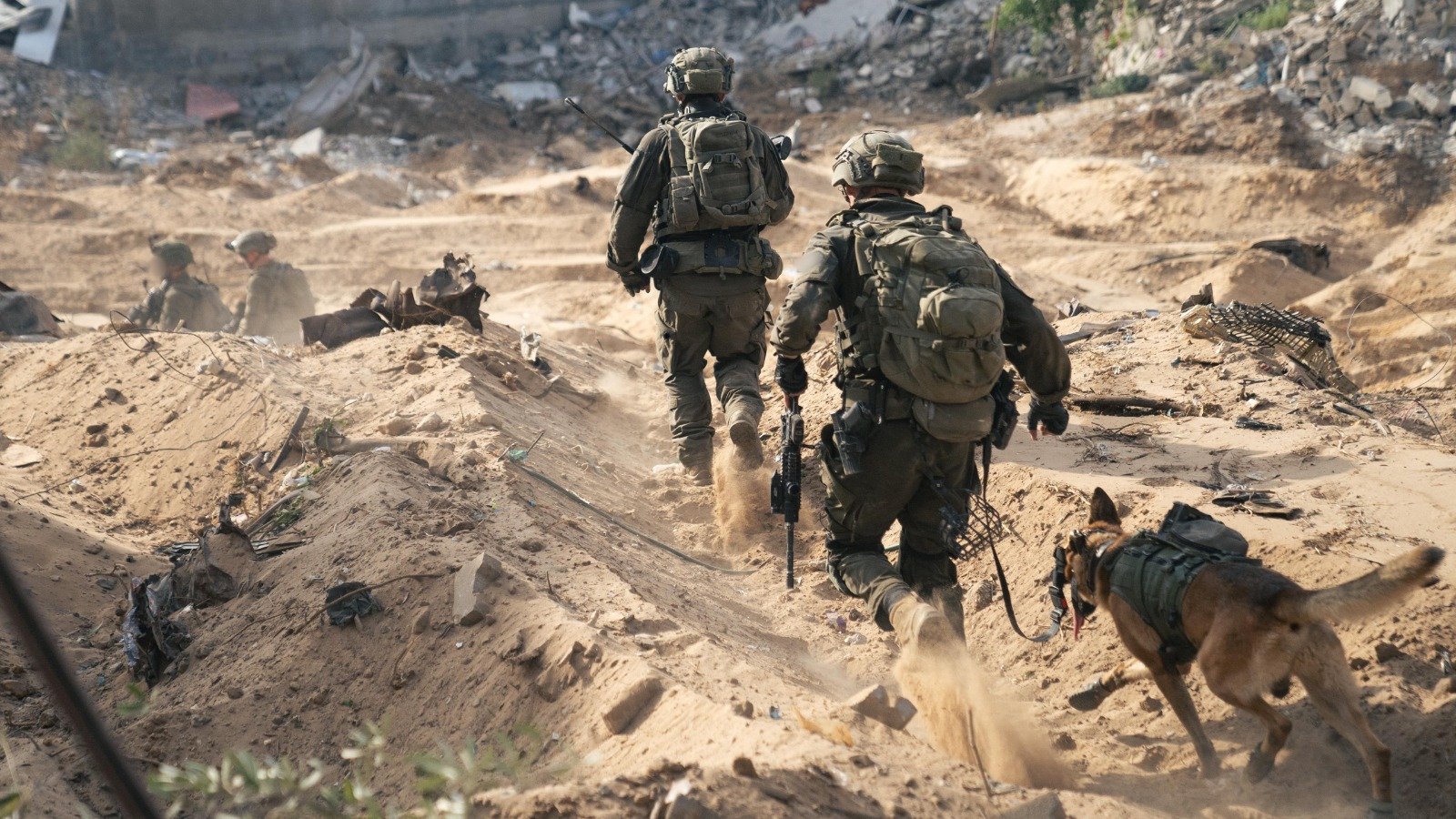
IDF troops operate in the Gaza Strip, in an image published on July 14, 2025. (Israel Defense Forces)
The IDF is still examining how many troops it will need for the planned offensive against Hamas in Gaza City, according to military officials.
Military officials say it may take at least another week to complete the general outline of the plans, and from there, the IDF will know how many troops are required and for how long.
Regardless, reservists will need to be drafted for the offensive itself and/or in order to swap out standing army forces on other fronts, the officials say.
‘A lot’ of foreign journalists to be allowed into Gaza, PM says
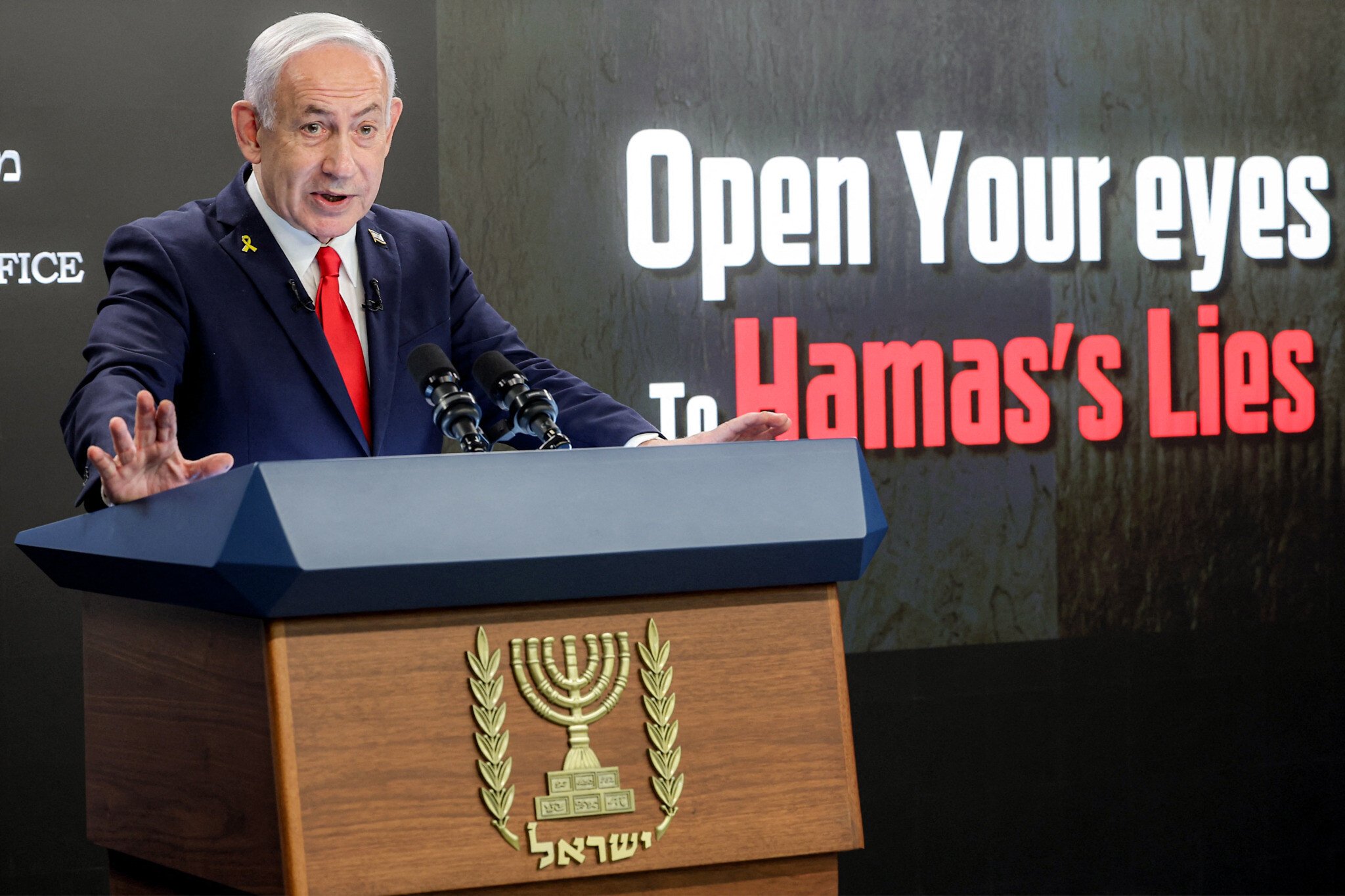
Prime Minister Benjamin Netanyahu gives a press conference at the Prime Minister's Office in Jerusalem on August 10, 2025. (Abir Sultan/Pool/AFP)
Prime Minister Benjamin Netanyahu says that Israel plans to allow more foreign journalists into Gaza to verify activities in the Strip, and that the United States is aligned with Israel’s goals in the territory.
“I’ve ordered, directed the military to bring in foreign journalists, more foreign journalists – a lot,” says Netanyahu, adding the order went out about two days ago and is subject to security considerations, including to ensure journalists’ safety. “I think you should see” what’s going on in Gaza.
He claims that on such visits to the Strip, journalists would witness the efforts by Israel to feed civilians, Gazans fighting against Hamas, and the IDF working to destroy terrorist infrastructure. Almost all buildings are booby-trapped by Hamas, and the destruction that the world sees is the IDF destroying those buildings after civilians have been evacuated.
Asked about reported disagreements between the premier and United States President Donald Trump on the status of the humanitarian crisis in the Strip, with Trump having stated that there is starvation in Gaza, Netanyahu says he “very much appreciates President Trump’s support” throughout the war.
According to Netanyahu, Trump “says two things: He says all 20 hostages have to be released. And he says Hamas should not be there.”
There are 50 hostages still held by terror groups in Gaza, of whom 20 are believed to be alive.
“I think that like me, [Trump] recognizes the fact that there have been deprivations in Gaza caused by Hamas. Hamas has been the cause of that. And what we have to do is overcome it. So we’re working together to overcome it,” Netanyahu says.
Snap IDF drill simulating multifront attack highlighted issues with deployment along Jordanian border
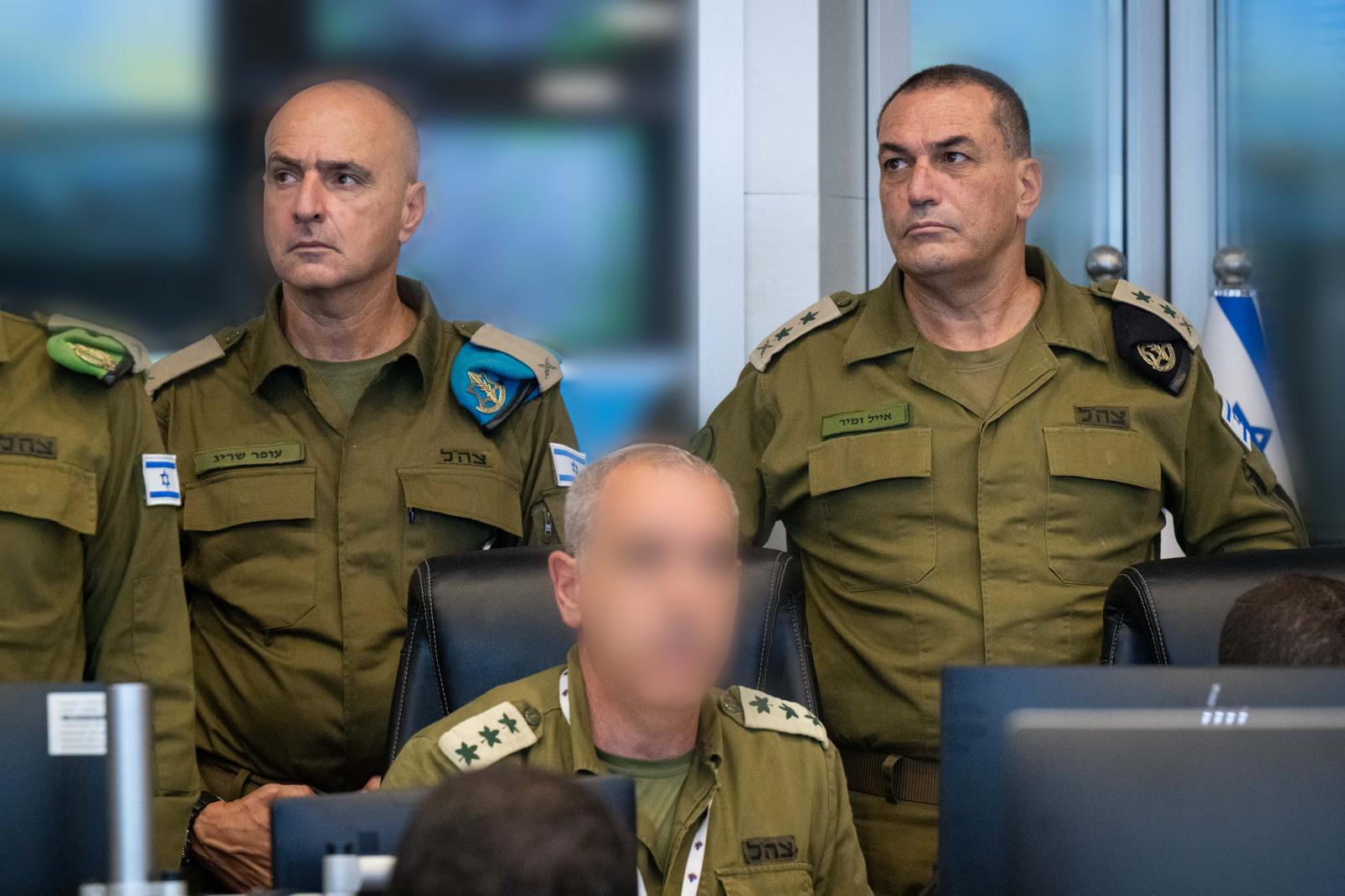
IDF Chief of Staff Lt. Gen. Eyal Zamir (left) and IDF Comptroller Brig. Gen. (res.) Ofer Sarig are seen at the Operations Directorate's headquarters during a military drill, August 10, 2025. (Israel Defense Forces)
A snap Israeli military drill today simulated a multifront attack on Israel, with an emphasis on a ground invasion from the Jordanian border.
The exercise began at 5:30 a.m., after IDF Chief of Staff Lt. Gen. Eyal Zamir ordered a surprise inspection of the military’s top headquarters to test their readiness.
The military says the inspection, led by IDF Comptroller Brig. Gen. (res.) Ofer Sarig, examined the headquarters’ “emergency order of battle, and the ability to handle a sudden, large-scale, complex, multifront event,” as part of the “implementation of lessons learned from the events of October 7.”
According to military officials, the scenario involved a simultaneous ground invasion from the Jordanian border at three points; a explosive drone attack on the Ramon Airport in southern Israel; two shooting attacks in the West Bank, with one of the cells reaching Israel’s Route 6 highway; rocket fire on the north; a drone attack from Yemen on an offshore gas field; and missile fire from Iran.
The entire drill lasted five hours, with Zamir touring the headquarters of the Operations Directorate, Israeli Air Force, and Israeli Navy, alongside Sarig and his representatives from the IDF Comptroller Unit.
Officers involved in the drill say that one of the main issues that emerged was the rate at which troops and the air force were deployed to defend the Jordanian border.
UN official warns Israel’s Gaza City plans risk creating ‘another calamity’ for Gaza, wider region
A UN official on Sunday warns the Security Council that Israel’s plans to control Gaza City risked “another calamity” with far-reaching consequences.
The UN Security Council is holding a rare emergency weekend meeting after Israel said its military would “take control” of Gaza City, sparking a wave of global criticism.
“If these plans are implemented, they will likely trigger another calamity in Gaza, reverberating across the region and causing further forced displacement, killings, and destruction,” UN Assistant Secretary Miroslav Jenca tells the UNSC.
Slovenia’s ambassador to the UN Samuel Zbogar, speaking on behalf of the five European members of the Security Council ahead of the meeting, says, “This decision by the Israeli government will do nothing to secure the return of the hostages and risk further endangering their lives.”
“It will also worsen the already catastrophic humanitarian situation in Gaza and risk further death and mass displacement of Palestinian civilians.”
Netanyahu says the 3 ‘most celebrated photos’ accusing Israel of starving Gaza children are ‘all fake,’ threatens possible suit against NY Times

Prime Minister Benjamin Netanyahu details the cases of three Gaza children whose medical conditions he says have been misrepresented internationally as caused by Israeli-imposed starvation, at a press conference on August 10, 2025. (Left to right): Osama al-Rakab; Abdul Qader al-Fayoumi; Mohammad Zakaria Ayoub el-Mutawaq. (GPO screenshot)
Prime Minister Benjamin Netanyahu blames Hamas and the international media for promoting false allegations of Israeli-imposed starvation in Gaza — describing a “global campaign of lies,” and saying that the facts he has set out in his press conference thus far can be “verified easily.”
While 2 million people in Gaza are now getting access to humanitarian aid, “the only ones who are being deliberately starved in Gaza are our hostages,” he says.
He shows a still of the emaciated Israeli hostage Evyatar David, as seen in a recent Hamas propaganda video. “Look at his hand, at his arm. He is being deliberately starved by these Hamas monsters,” says Netanyahu, pointing also to the plump arm in the shot of one of the Hamas captors who, he says, is plainly “eating well.”
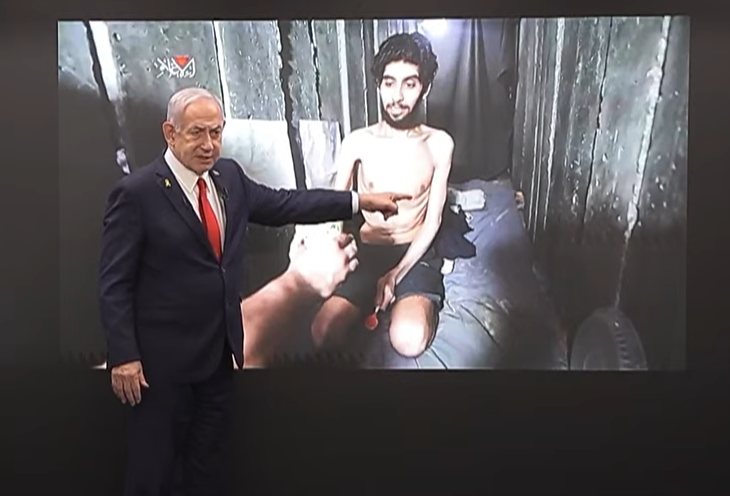
The distorted reality of Gaza “has been propelled around the Earth almost the way that the Jewish people were maligned in the Middle Ages.”
“Every massacre of the Jewish people was preceded by massive vilification,” he notes. “We were said to be spreading vermin to Christian society. We were said to be poisoning the wells. We were said to slaughter Christian children for their blood. And as these lies spread around the globe, they were followed by horrific massacres, pogroms, displacements, finally culminating in the worst massacre of them all: The Holocaust.
“Today, the Jewish state is being maligned in a similar way,” he charges.
Netanyahu accuses the international press of having “bought hook, line, and sinker” Hamas propaganda.
He points to viral images of three malnourished children as “fake” photos whose publishers ignored their preexisting health conditions.
First, he refers to 5-year-old Osama al-Rakab, who suffers from a serious “genetic disease that damages the lungs and digestive system that makes it hard to absorb nutrients and gain weight,” and who underwent treatment in Italy “because Israel got him out… Israel facilitated Osama’s travel to Italy where he got the medical aid” that he needed, says Netanyahu.
Second, he points to Abdul Qader al-Fayoumi, who reportedly died of starvation in Gaza, saying the teen suffered from “a genetic neurological disorder, spinal muscular atrophy, a degenerative condition that causes muscle-wasting weakness and severe weight loss unrelated to nutrition. This was the real cause of his real appearance, not starvation,” says Netanyahu. He was treated in Israel in 2018, but his disease defies most treatments, the prime minister adds.
Finally, he turns to what he calls the “most celebrated” case — a New York Times front-page photograph showing Muhammad Zakaria Ayoub al-Mutawaq and his mother. He says Muhammad suffers from cerebral palsy, and notes that “his mother is well fed and his brother is healthy.”
“I’m looking right now into the possibility of a governmental suit against the New York Times because this is outrageous,” Netanyahu says. He notes that the New York Times issued a correction regarding the story, a correction that he says was small and that the paper “buried.”
“These are the three most celebrated photos, and they’re all fake,” he fumes. “We won’t allow it to go unchallenged, and this is the purpose of this press conference,” he says. “I hope you can open your eyes to the simple fact that Hamas lies.”
While the photos of al-Mutawaq failed to mention the serious illness he suffers from, senior Israeli doctors have said that his severely emaciated state is not the result of his preexisting condition alone, and that it is likely exacerbated due to an inability to access the proper nutritional supplements.
After ex-soccer player said killed while waiting for aid in southern Gaza, IDF says it’s unaware of any casualties in area that day

Palestinian soccer player Suleiman al-Obeid in an undated photo. (X; used in accordance with Clause 27a of the Copyright Law)
After it was reported that a former soccer player for the Palestinian national team was killed while waiting to get aid supplies in the southern Gaza Strip last week, the IDF says it is unaware of any casualties in the area that day.
Suleiman al-Obeid, 41, was killed Wednesday when Israeli forces “targeted people waiting for humanitarian aid in the southern Gaza Strip,” the Palestinian Football Association claimed in a statement.
In response, the military says that “from an initial and thorough examination, no casualties are known to have resulted from IDF fire in the distribution center areas in the Gaza Strip on August 6.”
Palestinian killed in clash with settler filmed his own final moments, new footage shows

Awdah Hathaleen (right) in Umm al-Khair. (Courtesy)
The B’Tselem human rights organization has released new footage of the death of Awdah Hathaleen, a resident of Umm al-Kheir in the southern West Bank, who was killed about two weeks ago in his village in the South Hebron Hills during a clash with a settler.
The footage was filmed by Hathaleen himself, moments before his death.
It shows Yinon Levy, the extremist settler who was briefly arrested on suspicion of negligent homicide, confronting Palestinians.
After several people positioned between Levy and Hathaleen are seen throwing stones, Levy fires in the direction where Hathaleen is located.
The recording then cuts off.
Levy was arrested by police after the incident, but was released to house arrest, which ended about a week and a half ago.
Last Monday, he returned to overseeing construction work on a new neighborhood in the Carmel settlement, adjacent to the village of Umm al-Kheir.
בצלם פרסמו תיעוד חדש של עודה האדלין עצמו, שצילם את רגעיו האחרונים pic.twitter.com/0cDgPUcmg0
— Nurit Yohanan (@nurityohanan) August 10, 2025
Netanyahu says he doesn’t want to ‘prolong the war,’ claims Gaza City op will allow for ‘creative’ ways to recover remaining hostages
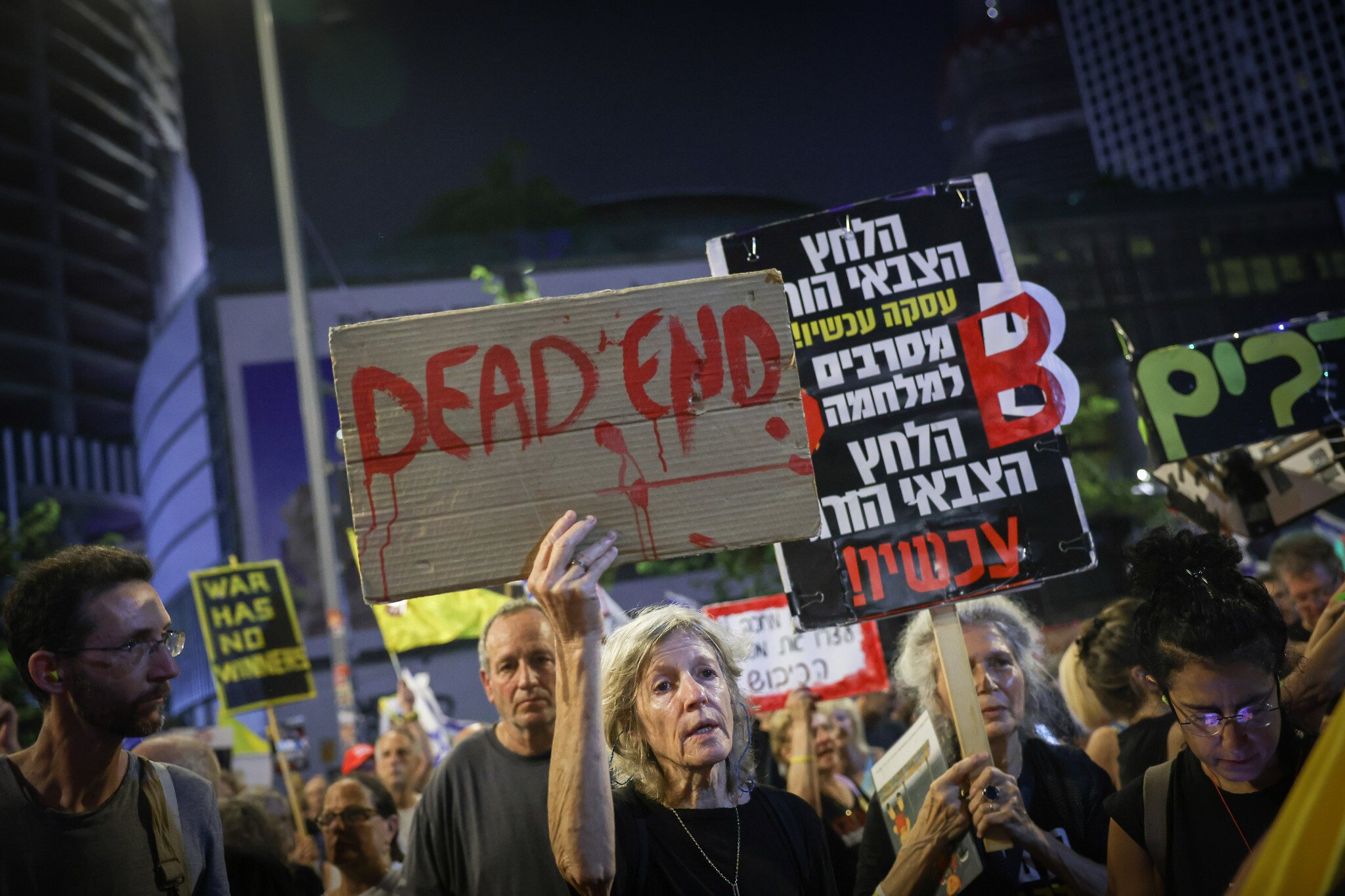
Anti-government, pro-hostage deal protesters demonstrate outside the Kirya military headquarters in Tel Aviv, August 9, 2025. (Miriam Alster/Flash90)
Prime Minister Benjamin Netanyahu says his military plan to take over Gaza City could aid efforts to retrieve the remaining living and dead hostages in the Strip — most of whom are believed to be held in the central Strip area — through “various” and “creative” methods.
“The move that I’m talking about, I think, has the possibility of getting them out. We’re talking about… I don’t want to go into details, but how to get the remaining hostages alive as we close in on Hamas,” Netanyahu says at a press conference for foreign media.
“There are various ways that I think — creative ways — that this can be done, but again, I won’t go into that now,” he continues.
“The option of doing a war of attrition from defensive positions has not proven itself. I think it… won’t get them out, but I think it will draw us into a protracted conflict that doesn’t bring the war to an end,” the premier adds.
Israel’s top security officials, including IDF Chief of Staff Lt. Gen. Eyal Zamir, Mossad chief David Barnea, and National Security Adviser Tzachi Hanegbi are all said to believe that conquering Gaza City will endanger the hostages.
Netanyahu insists that he does “not want to prolong the war,” saying, “I want to end the war. I think the other suggestions [for future actions in Gaza] would have prolonged it.”
There might have been a “dripping” of hostage releases over an “endless” period, he says, unless Israel was ready to “capitulate, and even then I don’t think we’ll get all the hostages. And if we capitulate, it means that Hamas will rearm, regroup, and carry out all the threats that it openly professes every day” to destroy Israel. “You can’t leave them there. We’re not going to do that.”
“I think that prolonging the war means that many of [the hostages] could be starved to death… and I don’t want that,” he adds, addressing the videos recently published by Hamas and Palestinian Islamic Jihad of two hostages appearing in a severely emaciated state.
Netanyahu says Israel eyeing several candidates to govern Gaza Strip after Hamas is disarmed
Prime Minister Benjamin Netanyahu says Israel has identified “several candidates” for a “transitional authority” to govern Gaza after the war, stressing that Hamas disarmament would come first in any postwar plan and that Israel does not seek to remain in the Strip.
Netanyahu says multiple Arab countries agree with Israel on the requirement for Hamas disarmament: “It’s instructive that some of the Arab countries, quite a few of them actually, said that Hamas has to be disarmed. I think this is the starting point.”
“There are several candidates that we’re talking about, several constructs. And it’s a transitional period, a transitional authority,” he continues, emphasizing, “We don’t want to stay in Gaza, that’s not our purpose.”
He adds that he makes this clear even “to those who disagree with me – there are some who do,” likely referring to far-right members of his coalition who openly call for permanent occupation of Gaza.
“Our goal is to make sure that Hamas isn’t there and that what replaces Hamas does not educate for terrorism, pay for terrorism, launch terrorism, but is willing to live in peace. There are candidates… the chances of succeeding here… I think they’re real… providing we finish the job,” he says.
“We can’t talk about the day after until eternity. No one’s going to go in there unless we finish Hamas. And we’re able to finish Hamas. And we will finish Hamas,” he says.
Germany’s Merz ‘buckled under’ pressure to impose arms embargo on Israel, Netanyahu asserts
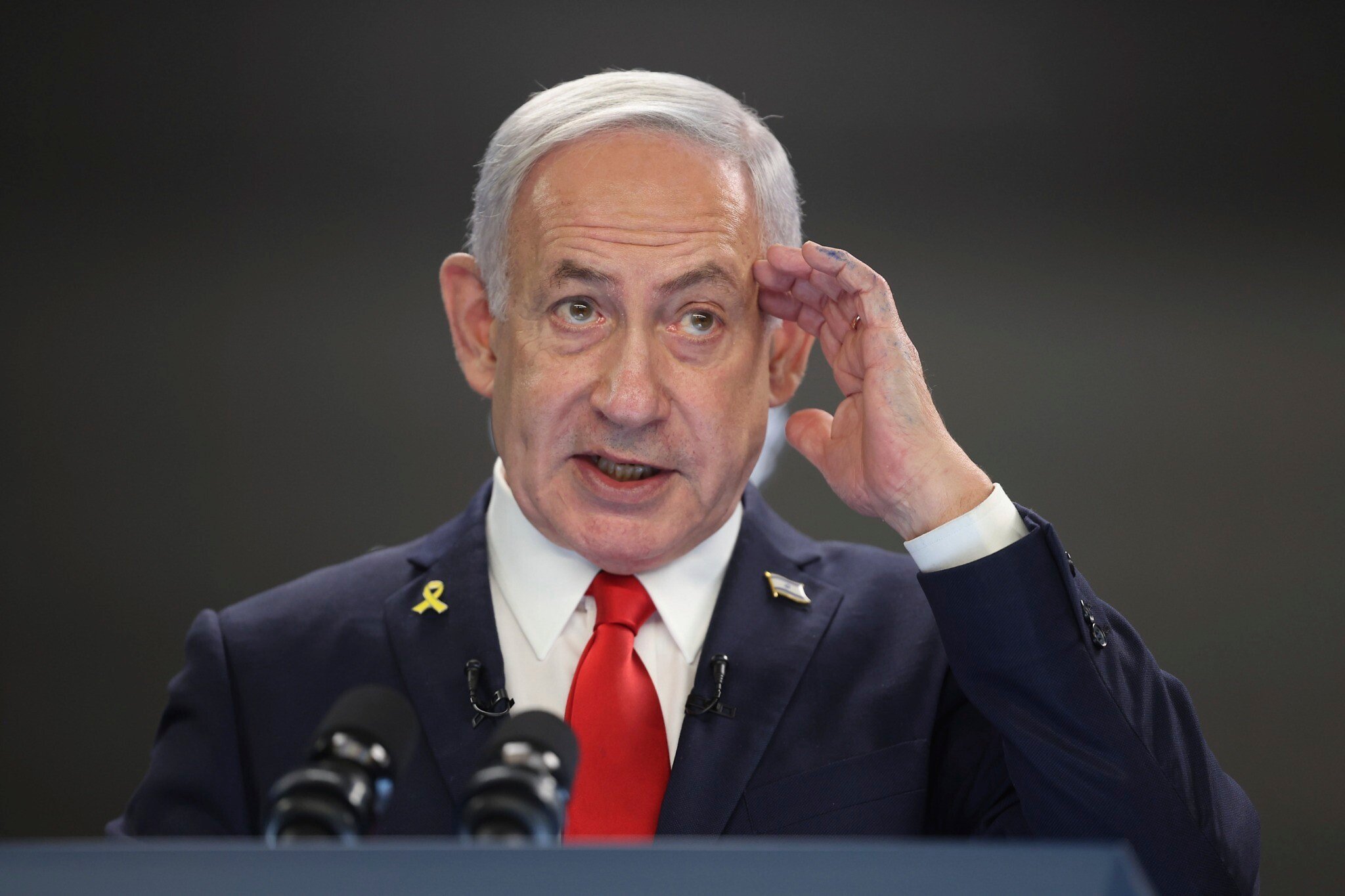
Prime Minister Benjamin Netanyahu gives a press conference at the Prime Minister's Office in Jerusalem on August 10, 2025. (Abir Sultan/Pool Photo via AP)
Prime Minister Benjamin Netanyahu says German Chancellor Friedrich Merz has “buckled under” pressure from foreign and domestic groups opposing Israel, after the chancellor imposed a partial arms embargo in response to Israel’s plans to expand the war in Gaza, and vows that Israel will fight Hamas “with or without the support of others.”
“I think [Merz has] been a good friend of Israel, but I think he’s buckled under the pressure of false TV reports, the internal pressure from various groups,” Netanyahu says during a foreign press conference, in response to a question about the embargo.
“I don’t want to talk about [Merz] specifically, but I want to say this: Maybe some choose to forget October 7. We will not forget what happened, and we will do whatever it takes to defend our country and defend our people, defend our future. We will win the war, with or without the support of others,” Netanyahu continues.
Turning to what he calls “another issue,” Netanyahu says that many leaders, “especially European leaders,” have told him: “Look, we know you’re right, but we can’t stand in the face of the public opinion in our country… They tell me that over and over again.”
“And I say, that is your problem. It is not our problem,” he continues.
He notes that everybody celebrated the Munich peace conference, “capitulation in Munich,” as “peace in our time,” and that “everybody lambasted Churchill, who opposed it.”
“The difference now is maybe they thought then that there was a real chance for peace by succumbing to the Nazis,” he says. “But I don’t believe anybody seriously thinks that now. And we’re facing neo-Nazis.
He adds that Merz’s predecessor, Olaf Scholz, visited Israel shortly after Hamas carried out its October 7, 2023, attack that triggered the war in Gaza, and described the terror group as “exactly like the Nazis. And they are.”
“We’re not going to leave the remainder of the Nazi army in the equivalent of Berlin,” he says, equating stopping the war before destroying Hamas with stopping World War II before capturing Berlin and fully ending Nazi rule.
“We’re going to do what we need to do, and I hope that Chancellor Merz changes his policy. And you know when he’ll change his policy for sure? When we win,” the premier says.
High Court orders government to respond to petition demanding it explain hostage negotiation policies
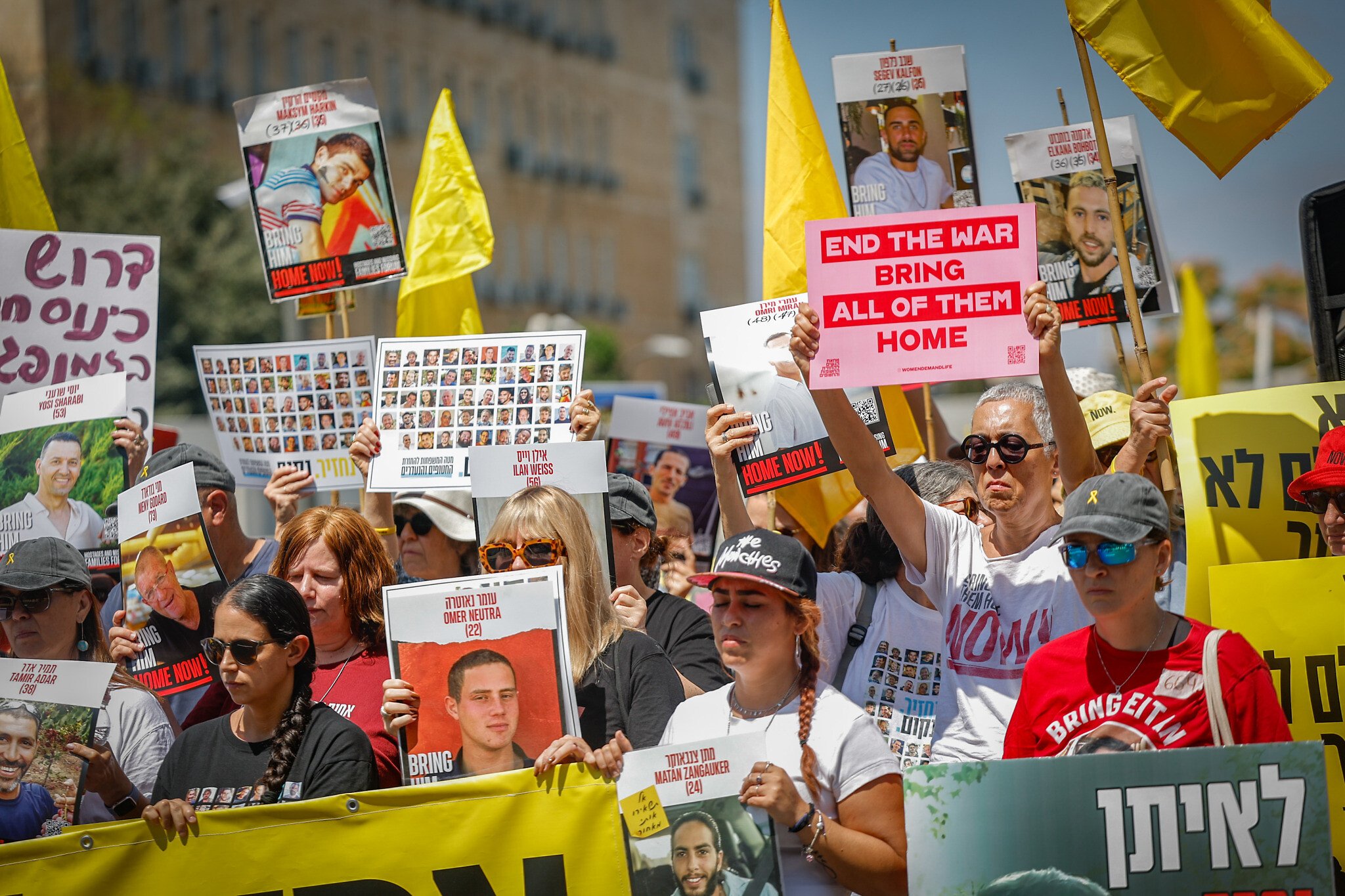
Mothers of Israeli hostages and their supporters take part in a demonstration calling for their release outside the Prime Minister's Office in Jerusalem, July 31, 2025. (Yonatan Sindel/ Flash90)
The High Court of Justice orders the government to respond to a petition demanding that it explain its policy regarding negotiations for the release of the hostages being held by Hamas in Gaza.
The petition was filed by the Hostages and Missing Families Forum and requests that the court order the government to explain its various considerations when weighing whether to accept a deal for obtaining the release of the hostages.
“The principle essence of the petition is the demand that the government provide a detailed justification for its policy [on the issue of negotiations for the return of the hostages] so that it can stand up to the test of the public,” writes Judge Chaled Kabub.
The judge therefore instructs the government to submit a response to the petition detailing how governmental discretion is exercised “in all matters relating to determining the conditions for ending the war and releasing the hostages.”
Kabub gives the government until August 24 to file its response.
IDF: Air Force struck Hamas launch point used to fire two rockets at Israel earlier today
An Israeli Air Force fighter jet bombed a Hamas rocket launching position in Gaza City’s Shejaiya neighborhood, which was used to fire two rockets at Kibbutz Sa’ad earlier today, the military says.
The site was struck within an hour of the rocket attack, according to the IDF.
The two rockets struck open areas, without causing injury.
Thousands rally in London to demand UK step up pressure on Hamas to release hostages

Demonstrators hold placards as they take part in the March for Hostages, in London, August 10, 2025. (AP Photo/ Alberto Pezzali)
Relatives of the hostages seized by Gazan terror groups on October 7, 2023, rallied earlier today with supporters in London, demanding their release and criticizing the UK government’s decision to potentially recognize a Palestinian state next month.
Organizers Stop the Hate UK and several Jewish organizations say the march and rally at Downing Street was in part aimed at urging Prime Minister Keir Starmer to prioritize the release of the remaining hostages.
Out of 251 hostages captured during Hamas-led invasion, 49 are still being held in Gaza, along with the body of an Israeli soldier who was killed in Gaza in 2014. Of those still captive, 20 are believed to still be alive.
The rally comes after Starmer announced on July 30 that the UK will formally recognize the State of Palestine in September, unless Israel takes various “substantive steps,” including agreeing to a ceasefire in Gaza.
The UK leader also detailed several demands for Hamas, including releasing all the hostages, but has not said that that is a precondition for the UK recognition step.
????️National March For The Hostages????️
Sunday 10th August | 3PM | Central London
The entire Jewish community is coming together — with allies from across the country — to march to Downing Street, calling for the immediate release of the hostages.
We will gather from 2pm at in… pic.twitter.com/NMy7EagATP
— Stop The Hate UK (@StopTheHate_UK) August 7, 2025
Noga Guttman, the cousin of 24-year-old hostage Evyatar David, was among the hundreds to attend Sunday’s London event, according to organizers.
Hamas released a video last week in which David, emaciated, was shown digging what he feared would become his own grave, sparking worldwide revulsion.
Organizers say other attendees included the relatives of Avinatan Or, who was kidnapped from the Nova music festival with his girlfriend Noa Argamani.
Argamani was rescued by Israeli forces last June.
The UK’s Chief Rabbi Ephraim Mirvis also took part in the march.
The rally, which featured speeches by various relatives of some of the 251 hostages, was endorsed by almost all denominations of Judaism represented in the UK, including the Modern Orthodox United Synagogue, the Sephardi community, Reform Judaism, Liberal Judaism, and Masorti Judaism.
“The situation for the hostages is absolutely desperate,” a spokesperson for the Campaign Against Antisemitism, one of the groups attending, says.
“People from right across the Jewish community, from every denomination, are uniting with us to say that the UK must focus all of its diplomatic pressure on securing the return of the hostages.”
IDF says some 131 tons of food aid airdropped into Gaza today by 7 countries
Aircraft from the United Arab Emirates, Jordan, Germany, Belgium, France, the Netherlands, and Italy, airdropped 131 pallets of humanitarian aid in the Gaza Strip today, the IDF says.
Each pallet contains around one ton of food.
Since July 26, when Israel adopted a new policy to let more aid into the Strip, over 1,100 humanitarian aid packages have been airdropped in the Gaza Strip by 12 countries, including Israel, according to the military. The packages the IDF airdropped were supplied by international aid groups.
Israel re-adopted the policy in light of mounting international criticism over the hunger crisis in Gaza. But airdrops are only able to deliver a small fraction of what can come into Gaza by land. They also pose safety risks for the civilians who can be hit by the packages from above.
Netanyahu acknowledges Israel losing online ‘propaganda war,’ should be doing more
Prime Minister Benjamin Netanyahu says that he and United States President Donald Trump have not spoken since the security cabinet approved a plan last Thursday to take control of Gaza City, but that he plans to speak with him soon.
“I haven’t spoken to him since last Thursday…I intend to speak with him very soon,” the premier says in response to a reporter’s question at his press conference about whether the two have discussed the plan since its approval.
Turning to a second question from the same reporter about “the propaganda war” Israel faces against anti-Israel media content, Netanyahu says: “I think that we’ve not been winning [the propaganda war], to put it mildly… There are vast forces arrayed against us.”
He describes a “big issue we have to contend with,” as “the algorithms of the social network that are driving a lot of everything else.”
“People who really know — they’re the foremost people in this field in the world — they’re telling me that about 60% of the responses on the social media are bots… They’re bots that, especially in America, want to attack the support that Israel has from the Republican side,” he says. “They describe themselves as homespun southerners, except that they’re writing from Asia somewhere.”
Netanyahu adds that “We also have to stand up and tell the truth, probably at a greater frequency than we’re doing now.” That, he says, is his purpose in the press conference.
He further says, “If you want to win this war, end it speedily. Expose the lies as much as you can… You win the war, the propaganda will die.”
Coalition of mothers march to memorial for slain female soldiers with demand to end war
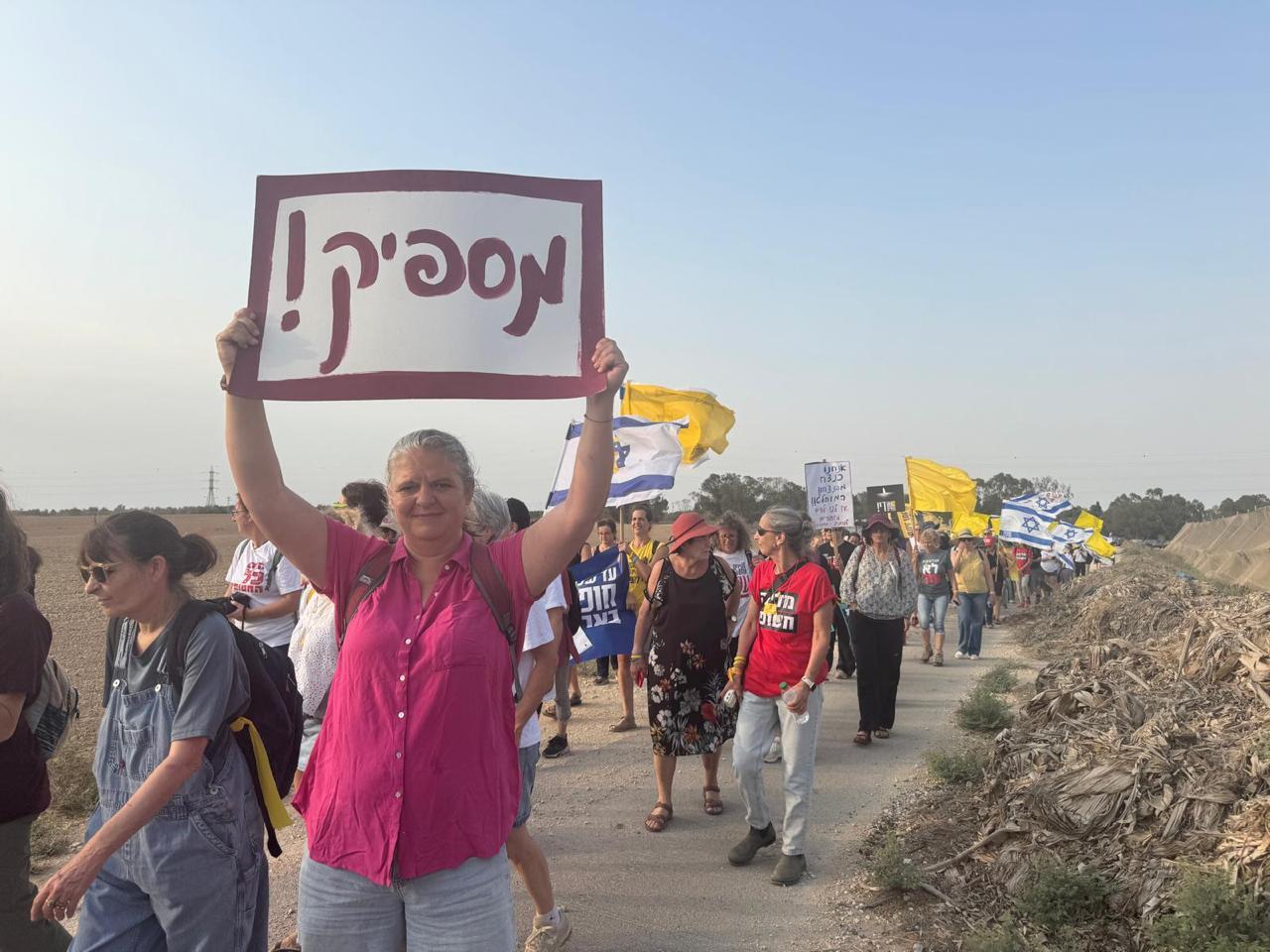
Alice Miller, who in the 1990s successfully sued the IDF for the right of women to enlist in the Israeli Air Force Flight Academy to become pilots, carries a placard saying 'Enough!' at a march close to the Gaza border, August 10, 2025. (Naama Zevi Rivlin/ Pro-Democracy Protest Movement)
A coalition of mothers marches leads a march to a site near the Gaza border memorializing female soldiers killed at Kibbutz Nahal Oz on October 7, 2023, to launch a new movement aimed at stopping the war in Gaza and returning the remaining 50 hostages.
The women will camp for at least five days next to Kibbutz Sa’ad in southern Israel.
On the night between Thursday and Friday, Israel’s war in Gaza took a new turn, when the security cabinet approved a proposal by Prime Minister Benjamin Netanyahu to take over the densely populated Gaza City.
The decision came in spite of warnings from the IDF that such an operation would risk the lives of the remaining hostages and Israeli soldiers, and would likely worsen the humanitarian situation for Gazan civilians.
Omer Steinmetz Haskel, from the women’s group, Building an Alternative, says the movement is inspired by the “Four Mothers” campaign launched in 1997 to bring the IDF out of southern Lebanon — something the Israeli leadership finally ordered in May 2000, with the Four Mothers earning much of the credit.
Orna Shimoni, one of the original Four Mothers, addresses Chief of Staff Eyal Zamir, suggesting that he present the prime minister with additional alternatives that do not involve occupation.
Israel has already proposed a hostage deal, she says, which can be used to end the war. “We are one step away from a clearly illegal order that must not be carried out,” she states.
Steinitz Haskel says that the memorial for the fallen female soldiers marks not only the place where blood was shed, but where a line was also broken “between Israel and Gaza, between responsibility and lawlessness, between human life and moral loss.”
She continues, “On October 7, Israel entered the most just war there is. Our army fought bravely. It scored great military achievements. But almost two years have passed, and these achievements have not been translated into any diplomatic reality.”
“Instead of using this military power to bring about an agreement that will return the kidnapped and end the war, this government insists on continuing a political war.”
She charges that the government has chosen ” the ideology of eternal war and the death of soldiers over human lives.”
“We will be here until our leaders choose life, not death,” she pledges. “And we will remember, as the four mothers remembered then, that there is no victory without life, and no security without freedom. This struggle will not end until the last of the kidnapped men and women return home, alive.”
Sigal Price, whose daughter, Staff Sgt. Noa Price was killed on October 7, when Hamas terrorists overran the Nahal Oz military outpost, also addresses the crowd.
“Here at the memorial we erected in their memory, I, Sigal, mother of Noa Price, would like to express the pain of all the bereaved families, call for the return of the kidnapped and an end to the war, and pray for the safety of the regular and reserve soldiers who have been fighting bravely and with sacrifice for almost two years, and for the recovery of all those wounded in body and mind,” she says.
IDF announces new Air Force technicians unit for ultra-Orthodox men

Ultra-Orthodox Israeli Air Force technicians are seen at an Israeli Air Force base, August 10, 2025. (Israel Defense Forces)
The IDF says it has established a second Israeli Air Force technicians unit for male members of the ultra-Orthodox community, allowing them to maintain their religious lifestyle while serving in the military.
The unit is based out of one of the 109th Squadron’s reinforced aircraft shelters at the Ramat David Airbase in northern Israel. The squadron operates F-16 fighter jets.
The military says the Haredi soldiers in the unit recently completed their training and are now certified “level A” technicians for the F-16.
Last year, the IDF established the first-ever IAF technicians unit for Haredi soldiers at one of the 105th Squadron’s aircraft shelters, also at Ramat David.
The technicians will “maintain the readiness and operations of F-16 aircraft, alongside preserving their ultra-Orthodox way of life,” the military says.
Netanyahu: Hamas created a problem of food deprivation; we’re now solving it
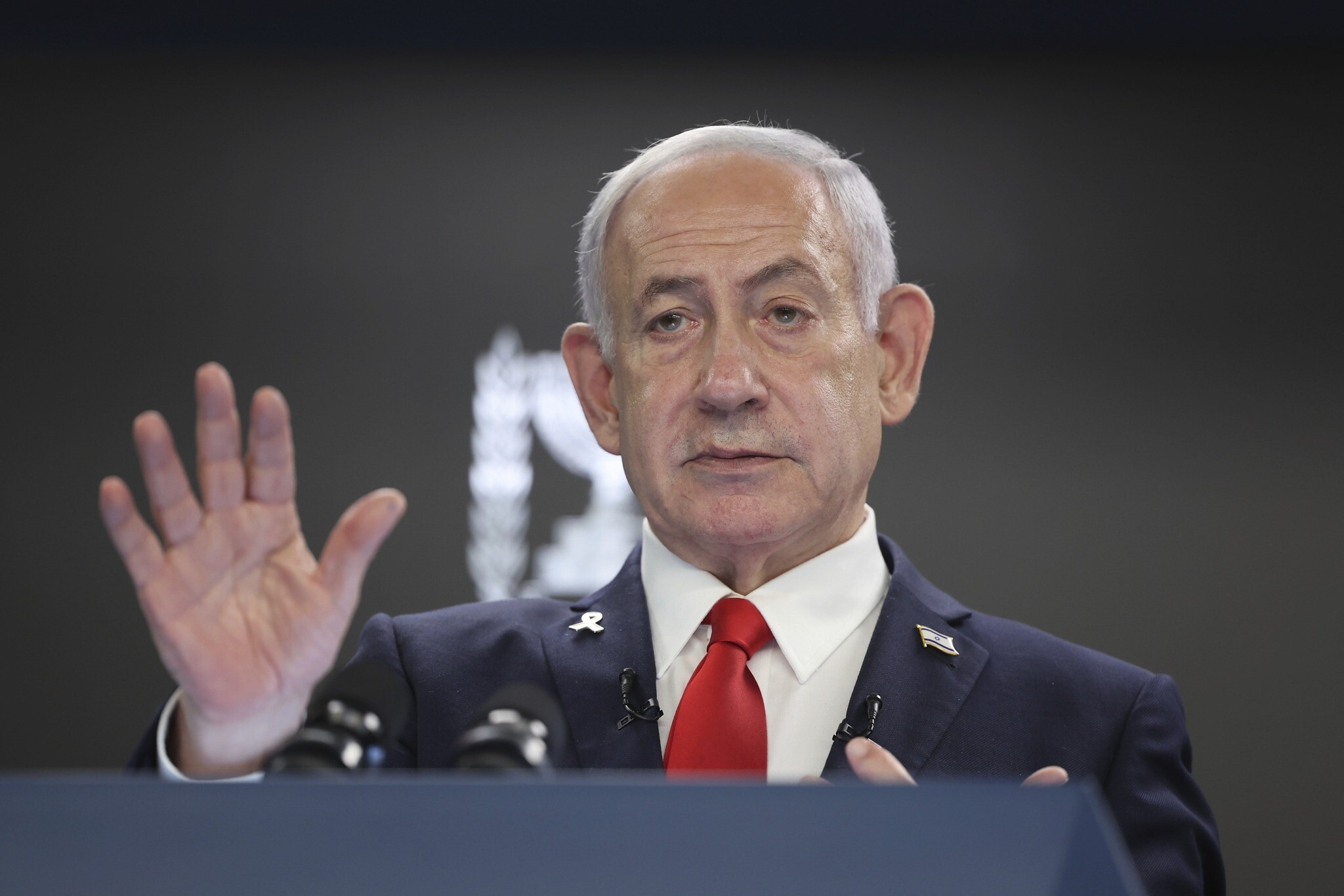
Prime Minister Benjamin Netanyahu speaks during a press conference at the Prime Minister's Office in Jerusalem, August 10, 2025. (Abir Sultan/ Pool Photo via AP)
Netanyahu is asked at his press conference about the Integrated Food Security Phase Classification (IPC) report on the specter of famine in Gaza, on Israel’s 11-week blockade on aid between March and May, and on how he can guarantee that “disaster will not happen when you have a million more people displaced” under the Gaza City operation.
“We tried to do two things simultaneously. Stop the trucks and bring in the trucks through the [Gaza Humanitarian Foundation] distribution points,” Netanyahu says.
However, the two actions were not taken simultaneously. Israel maintained a complete aid blockade over Gaza for 78 days from March 2 until May 19. Only then did it begin allowing a small amount of aid into Gaza through existing, largely UN-facilitated mechanisms before the GHF gradually began operating as many as three distribution sites in southern and central Gaza.
“It wasn’t successful… among other things because Hamas interdicted also the GHF program, the distribution point,” he says.
But GHF has long denied that Hamas or any other body has been able to loot any of its aid. In June, the IDF published footage of what it claimed was a Hamas operative shooting at Gazan aid seekers. But that video was not filmed near a GHF site.
In a subsequent Hebrew press conference, Netanyahu adds that the other problem plaguing the GHF’s rollout was the lack of distribution sites. GHF for months has said that it was urging Israel to allow it to establish an additional site in northern Gaza; but those calls apparently went unanswered.
Hamas “created this problem” of insufficient aid, and then Israel was alleged to have “a starvation policy, which is completely false, any more than we have a genocide policy, which is equally false. We don’t. Not this, not that,” Netanyahu stresses.
“I don’t know of a country that texts millions of messages to civilians to get out of harm’s way, giving up the element of surprise, or calling them individually on the cell phones,” he goes on. “Yet Israel is accused of genocide. It’s absurd.”
“There was a problem of deprivation,” the prime minister continues. “No question about it. And so we had to solve it.”
Hundreds of trucks are now going into Gaza, he says. “Now we want to increase the number of distribution sites.”
“You solve this problem by the law of supply and demand,” he elaborates. “If you have a lot of supply, if you flood Gaza with food,” some will be looted by Hamas. “But if enough food reaches the marketplace, so to speak, then you’ll see a difference.”
He says the price of food in Gaza has “plummeted ever since we decided to do the humanitarian surge. It’ll plummet more if the other countries join us.” That is why he says he called other countries to help airdrop food, and the UN to deliver the trucks. When there are no shortages, “then you don’t have also the crowding around the distribution points.”
“A lot of the firing [near the GHF sites] was done by Hamas, seeking to [prompt a] response by our forces,” he says. And “very often,” IDF forces did not respond: “They stood back, they held their fire, even though their own lives were on the line.”
Report: Hamas delegation set to visit Cairo, Doha, possibly signaling interest in restarting negotiations
As Israel continues to prepare for its operation to take over Gaza City, Channel 12 reports that its negotiating teams may nevertheless return to indirect negotiations with Hamas in Qatar and Egypt.
The news outlet reports that a delegation of Hamas officials based in Turkey is expected to depart for Cairo and Doha in the coming days, leading mediators to believe that ceasefire and hostage deal talks will be able to resume after they ground to a halt last month.
The mediators expect that this time around, both sides will be able to compromise on their demands enough to reach an agreement that all parties find acceptable, it says.
According to the report, the deputy head of the Shin Bet, identified only as “Mem,” told a recent security cabinet meeting that he believes Hamas is becoming more flexible in its demands, due to Israel’s successes in Operation “Gideon’s Chariots.”
“Returning to negotiations is a likely scenario,” he is said to have told the cabinet.
Channel 12 acknowledges, however, that some cabinet members believe Mem’s expectations are too high, and that Hamas is nowhere even close to being ready to return to the negotiating table.
Netanyahu slams world leaders for ‘absurd’ belief that giving Palestinians a state would stop their efforts to destroy Israel
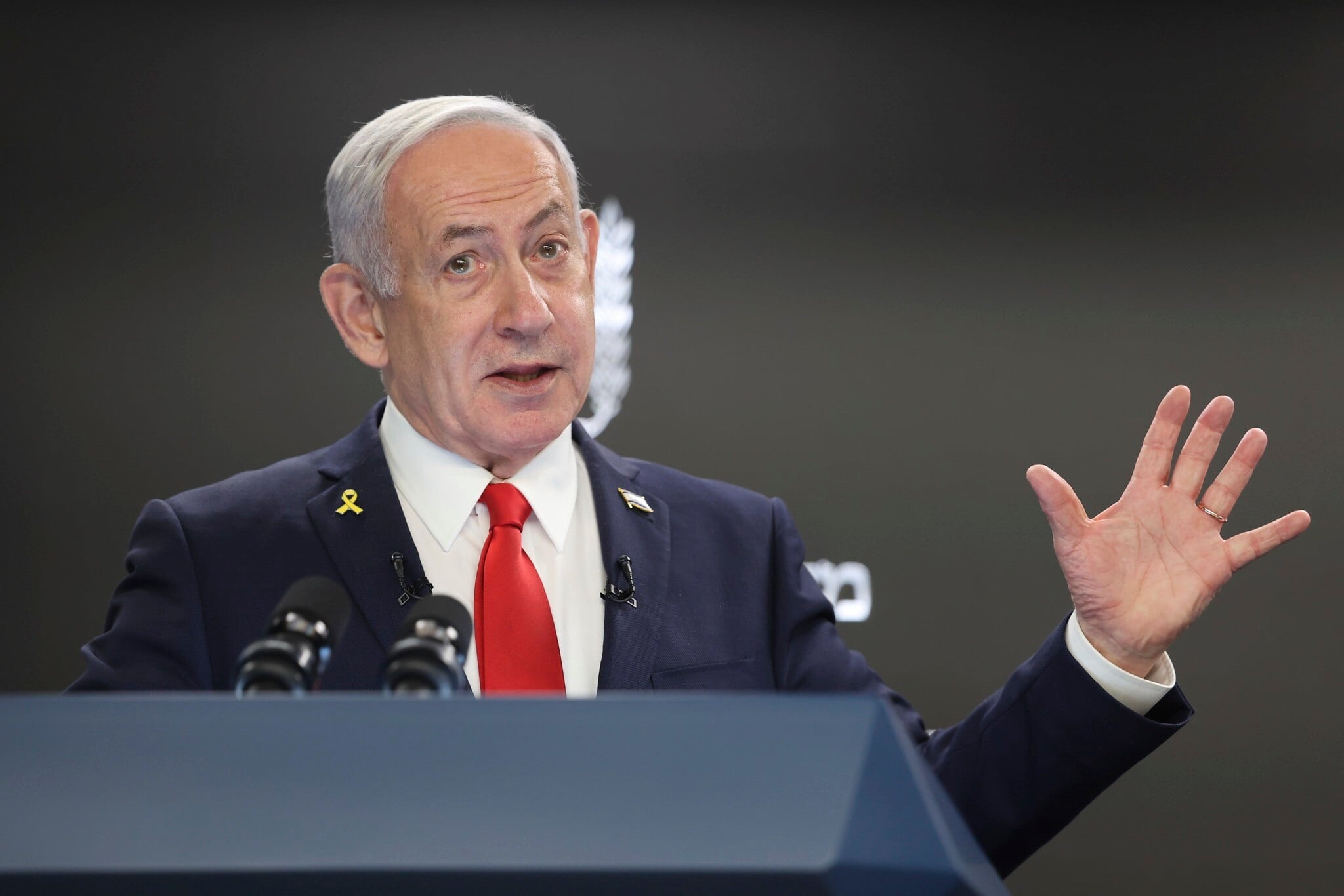
Prime Minister Benjamin Netanyahu speaks during a press conference at the Prime Minister's Office in Jerusalem, August 10, 2025. (Abir Sultan/ Pool Photo via AP)
In the final question of his English-language press conference, Netanyahu is asked about his bitter description of countries’ preparing to recognize Palestinian statehood as rewarding terror. But perhaps, it is put to him, those countries do recognize Israel’s right to defend itself, and “are now struggling to stomach what they’re seeing you and your military doing in Gaza?”
“First of all,” Netanyahu responds, “those who say that Israel has a right to defend itself are also saying, ‘But don’t exercise that right.’ When we do what any country would do, faced with this genocidal terrorist organization that has performed the worst attack on Jews since the Holocaust,” he says, “I think we’re actually applying force judiciously, and they know it. They know what they would do if right next to Melbourne, or right next to Sydney, you had this horrific attack. I think you would do at least what we’re doing… [although] maybe not as efficiently and as precisely as we’re doing it. We’ve lost quite a few soldiers in that effort.”
He then dismisses “the prevailing assumption… that the problem that we have with the Palestinians is the absence of a Palestinian state. And [that] if they were given a Palestinian state, they would stop the efforts to destroy the Jewish state. But the Palestinians were offered a state many times, including in the partition resolution, and they turned it down,” he says. “They were offered statehood by my predecessors, with lavish, lavish concessions. They turned it down.”
This, he says, is “because the Palestinians are not about creating a state. They’re about destroying a state. That’s why they opposed the Jewish National Movement to create a state. It’s called Zionism. They opposed it before the inception of the Jewish state, and they’ve opposed it since. They’ve opposed it when they had Judea and Samaria, the West Bank, and Gaza in their hold. They didn’t say, Let’s start. Let’s create a state there. They didn’t say that. Because, again, their goal is the destruction of a state.
“It defies imagination or understanding how intelligent people around the world, including seasoned diplomats, government leaders, and respected journalists, fall for this absurdity,” he marvels. “It’s so easy to verify.”
He says Hamas had a de facto state in Gaza, which it used “to launch a war of terror against Israel,” and that it will do so again if it is able.
As for the Palestinian Authority, he goes on, it seeks first to reduce Israel to “indefensible boundaries” via organs like the ICC and UN, “and then deliver the blow. Because Israel is too strong in its present configuration.”
The PA and Hamas “have no difference about the goal.” He says that is why Palestinian children in Gaza and the West Bank “are educated with exactly the same textbooks,” and why the PA maintains a “pay for slay” policy to encourage the murder of Jews. “The real reason that this conflict persists is not because of the absence of a Palestinian state, but the persistent Palestinian refusal to recognize the Jewish state in any boundary,” he charges.
Giving the Palestinians a state, he says, would not see them abandoning the “goal of destroying the Jewish state. All you’re doing is you’re bringing the next war closer.”
“Again, Hamas had a state. It just brought the war closer. If you did the same thing in Judea and Samaria, right above Tel Aviv, enveloping Jerusalem, some say cutting Jerusalem into two… you’re going to have the radicals again take it over, Iran take it over, and start a war from improved boundaries.”
The Palestinians should have “all the powers to govern themselves in the places where they live and none of the powers to threaten Israel,” he says. “They should obviously reform their whole education system. They should… accept that Israel is here to stay, not as a fact, as a physical or geographic fact, but as a fact of historical equity. If they want to live here, next to us, they have to stop seeking our destruction. To give them an independent state with all the trimmings is to invite a future war, and a certain war.
“That’s something that today, the Israeli public forcefully opposes,” he notes. Most of the Jewish public and the vast majority of MKs oppose a Palestinian state “for the simple reason that they know it won’t bring peace, it will bring war. To have European countries and Australia march into that rabbit hole… and buy this canard, it is disappointing. And I think it’s actually shameful.”
But, he vows, “it’s not going to change our position. We will not commit national suicide to get a good op-ed for two minutes,” he concludes. “We won’t do that.”
Levin slams High Court for ordering government to explain hostage negotiation policies
Justice Minister Yariv Levin denounces High Court Judge Khaled Kabub for requesting the government respond to a petition demanding it explain its hostage negotiation policy.
“By what authority and what right, Judge Khaled Kabub, do you request to intervene in the discretion of the government of Israel in how it manages the war,” demands Levin.
“I say to you plain and simple: This is not your authority.”
“Whoever does not respect the law and the authorities of the government should not expect that they or their decisions will be respected.”
The High Court very rarely intervenes on matters of security and diplomacy as a matter of principle.
Three arrested on suspicion of hurling grenade into Ashdod home last night
Police today arrested three young men suspected of hurling a grenade at a home in Ashdod last night, which sparked a fire in the building and injured four young women.
The suspects are residents of Ashdod, aged 20, 23 and 24, police say. Officers will bring them before the Ashkelon Magistrate’s Court tomorrow to request to keep them in custody.
Among those wounded in the Saturday night attack was a 16-year-old girl, who was shuttled to a nearby hospital with serious injuries. The other three, aged 17, 21, and 23, were also hospitalized with moderate injuries.
The attack is thought to be connected to a power struggle between warring gangs in the Lachish region, according to Hebrew outlets.
Police determined that the four victims had no connection to the criminal feud, and that the attackers targeted the wrong building.
Netanyahu: I want to end war ASAP, told IDF to shorten timeline for capturing Gaza City
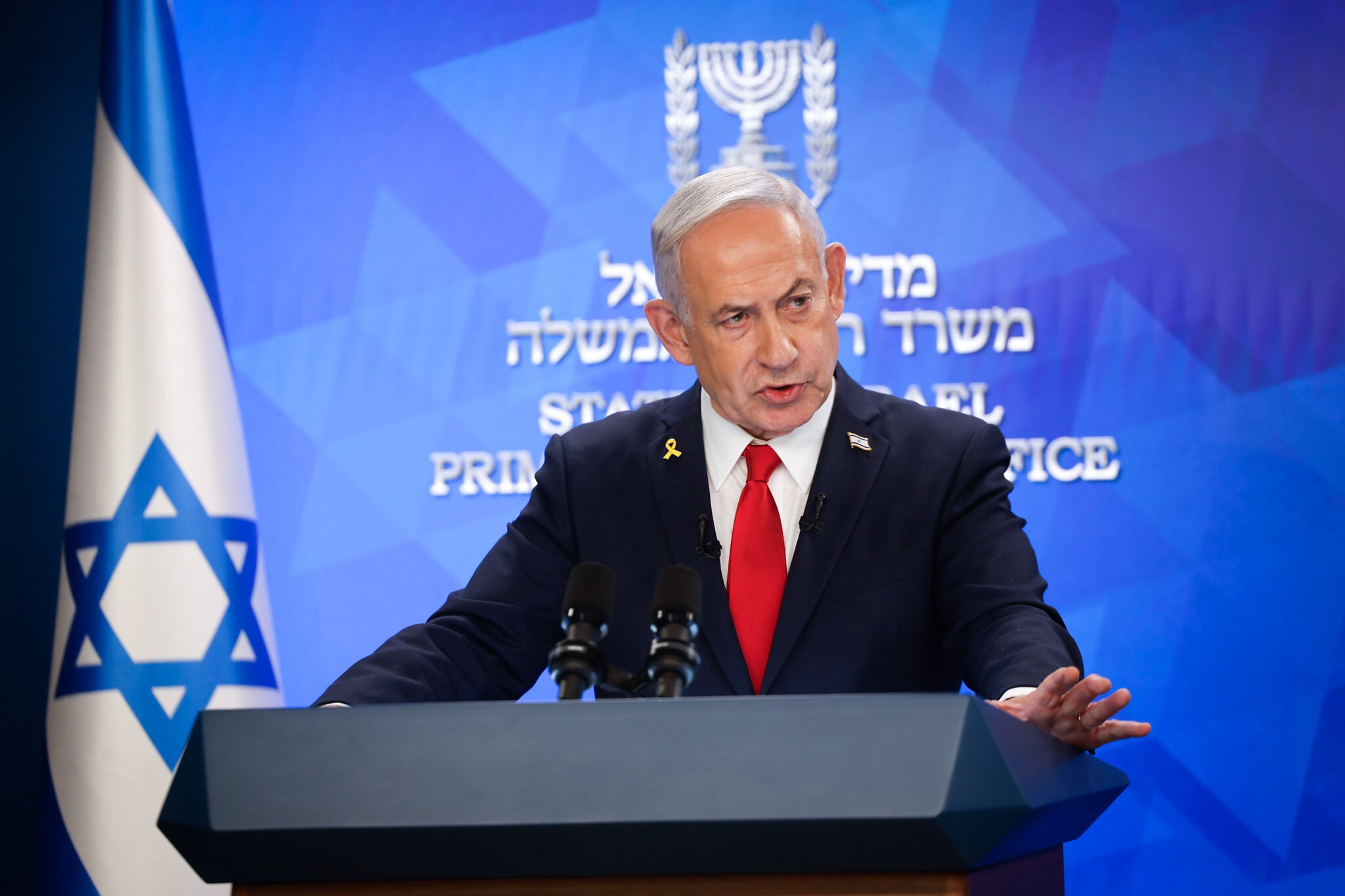
Prime Minister Benjamin Netanyahu holds a press conference at the Prime Minister's Office in Jerusalem, on August 10, 2025. (Yonatan Sindel/ Flash90)
Prime Minister Benjamin Netanyahu says that the security cabinet’s approval of a plan to take over Gaza City is a result of Hamas’s “continued refusal” to compromise in negotiations for a truce, and rejects claims that the plan will aimlessly prolong the war.
Speaking before live TV cameras and reporters during a Hebrew press conference for local media at his Jerusalem office, Netanyahu says that, “After months of fruitless negotiations, it has become clear beyond doubt that Hamas simply is not interested in a deal. Hamas has clung to this refusal.”
Hamas “has raised impossible conditions — not only in our view, but also in the view of the United States,” he charges, saying “They include, among other things, a complete withdrawal from the Gaza Strip — including from the Philadelphi Corridor — which would allow the free smuggling of weapons; the release of imprisoned terrorists, these monsters; and a demand for binding international guarantees that would prevent the IDF from resuming combat. These are terms of surrender that no responsible government would agree to accept — and certainly I will not accept them.”
“Hamas has deceived us. Therefore, I have become convinced that the only way to return all our hostages is to defeat Hamas,” says Netanyahu.
He adds that in the security cabinet’s discussions, “an alternative was also raised — to hold our position while encircling the remaining Hamas strongholds and carrying out raids.
After an in-depth discussion, an overwhelming majority of cabinet members concluded that by this method, we would achieve neither victory nor the return of our hostages.”
The decision for the expanded takeover was achieved “despite immense pressures from home and abroad — pressures to stop the war,” which Netanyahu says existed “even before we entered Rafah” last year.
The premier says that if he had yielded “to those pressures,” Hamas leaders Yahya Sinwar and Ismail Haniyeh “would still be ruling in Gaza, [former Hezbollah leader Hassan] Nasrallah would be in Lebanon, [former Syrian president Bashar] al-Assad in Syria, and Iran today would be racing toward a nuclear weapon.”
“I am determined to end the war with our victory, and precisely because I am aware of the great effort of our reservists, I want to end the war as quickly as possible. That is why I have instructed the IDF to shorten the timetable for taking control of Gaza City,” he says, adding, “I do not intend to perpetuate Hamas — I intend to defeat Hamas.”
PM says conquering Gaza City will free hostages, dodges question on support for partial deal
Prime Minister Benjamin Netanyahu says that he believes the plan to take over the Gaza Strip will bring about the release of the 20 remaining living hostages in Gaza.
In response to a question at a press conference for local media on whether he would agree to a partial hostage release deal if Hamas agrees to one after the operation begins, Netanyahu does not answer directly, replying instead that he is “committed to…the release of all 20 of our hostages, and the defeat of Hamas is the decisive operation that I believe will achieve that.”
There are 50 hostages still in Gaza, 20 of whom are believed to be alive. Several times during this Hebrew press conference, the prime minister refers to the imperative to secure the release of the “20” hostages, rather than all 50.
Addressing his commitment to returning the hostages, Netanyahu says: “People ask why the war has taken so long — first of all, because we paused for the release of hostages.”
He adds that the newly approved operation aims to bring down Gaza City — Hamas’s “center of gravity” — in a decisive strategic hit to the terror group that contrasts with previous operations.
“We didn’t do this in a systematic way before; we saw Gaza, we went here and we went there. But as a goal — to topple Hamas, to topple its last stronghold, to bring down its center of gravity — that we did not do before. We are doing that now, and I am certain this will also bring about the release of all the hostages.”
Merz: Germany’s support for Israel hasn’t changed, but we cannot support Gaza City takeover
Germany’s decision to curb arms exports to Israel comes in response to Israel’s plan to expand its operations in the Gaza Strip, Chancellor Friedrich Merz says an interview with public broadcaster ARD.
“We cannot deliver weapons into a conflict that is now being pursued exclusively by military means,” Merz says. “We want to help diplomatically, and we are doing so.”
The worsening humanitarian crisis in Gaza and Israel’s plans to expand military control over the enclave have pushed Germany to take this historically fraught step.
The chancellor says in the interview that the expansion of Israel’s operations in Gaza could claim hundreds of thousands of civilian lives and would require the evacuation of the entirety of Gaza City.
“Where are these people supposed to go?” Merz sats. “We can’t do that, we won’t do that, and I will not do that.”
Nevertheless, the principles of Germany’s Israel policy remain unchanged, the chancellor insists.
“Germany has stood firmly by Israel’s side for 80 years. That will not change,” Merz says.
PM denies delaying process of regulating Haredi conscription to appease ultra-Orthodox allies
Prime Minister Benjamin Netanyahu says Israel is working to recruit the ultra-Orthodox community into the IDF, and rejects claims that he is deliberately delaying this process to ensure political support from the Haredi parties.
Responding to questions about the Haredi draft exemption at a press conference for local media held at his Jerusalem office, Netanyahu says: “We are working to enlist many thousands from the ultra-Orthodox public, something that has not happened in the 77 years of the state’s existence.”
“This process takes time,” he continues, adding that “there were those who explicitly delayed the legislative process” and that it would have already been completed “if not for those delays, which were political in nature.”
Appearing to refer to the ousted chair of the Knesset Foreign Affairs and Defense Committee, Yuli Edelstein, Netanyahu says he tried “every way to prolong committee meetings again and again so that there would be no legislation.”
“Now we have moved to a process where there will be legislation, there will be a law, and there will be enlistment,” he says.
The premier addresses public discontent over the growing burden on IDF reservists as the war in Gaza drags on, saying he “greatly values” their service.
“But we must understand that we have to complete the [war’s] mission,” he adds.
No major incidents reported in Greek ‘Day of Action’ against Israel
No major incidents have been reported from the “Day of Action” organized today by Greek pro-Palestinian, anti-Israel groups.
Social media pages connected with BDS Greece and several other anti-Israel organizations in Greece posted photos of numerous small gatherings on different islands throughout the country. Most appear to have just a handful of participants, or several dozen at most.
Protest coordinators had threatened demonstrations at more than 100 locations around Greece to protest Israel’s war against Hamas in Gaza. The Foreign Ministry had urged Israelis in Greece to avoid protests, refrain from displaying visible Israeli symbols, and to stay alert in crowded places and keep family updated on their location.
✊???????????? Σήμερα η Ελλάδα είναι ένας απέραντος χάρτης αλληλεγγύης | Από τα σοκάκια της Σαντορίνης μέχρι τις πλατείες της…
Posted by March to Gaza Greece on Sunday, August 10, 2025
PM stands by choice to approve Gaza City takeover despite opposition from military officials

Prime Minister Benjamin Netanyahu holds a press conference at the Prime Minister's Office in Jerusalem, on August 10, 2025. (Yonatan Sindel/ Flash90)
Prime Minister Benjamin Netanyahu says that he approved last week’s security cabinet decision to take over Gaza City in an expanded military operation against Hamas despite opposition from military officials.
Throughout the war and in the case of this plan, he says, “the basic decisions — the fundamental decisions — were made at the political level, and made by me,” addressing disagreements between the premier and IDF Chief of Staff Lt. Gen. Eyal Zamir over the plan’s approval.
Netanyahu declines to answer whether the plan would see the IDF enter underground tunnels operated by Hamas, possibly leading to the harm of hostages, saying, “I do not intend to go into the tactics that have been discussed. I think that would be a mistake, as it would give Hamas information it does not need to receive.”
“We will surprise them in various ways. I have no doubt that we will defeat them, because we have demonstrated this remarkable capability — and the IDF has demonstrated this remarkable capability,” he continues.
“I have great respect for the IDF and its commanders, for our soldiers, both in regular service and in the reserves,” he adds, before adding that ultimately, “the decisions were mine, and at times I made them against the opinion of the IDF’s top command and even against the opinion of senior defense officials.”
He cites several examples of key operational decisions he says he made in opposition to military officials, including ordering a full mobilization of reserves on the first day of the war; rejecting advice to open a second front in Lebanon; refusing calls to notify the United States in advance of the Hezbollah “Beeper” operation last September; intervening to protect Druze minorities in Syria; and deciding to carry out the operation against Iranian nuclear facilities “with or without” a “green light” from the US.
The premier nevertheless offers backing to Zamir despite their disagreements, saying he supports him “in carrying out the actions decided upon by the cabinet. And I want to make that clear: the body that determines the major moves is the cabinet. I do not decide where exactly this company will go, or this brigade, or even this division. I set the mission, and then I give the army full backing to carry it out, and I expect it to do so.”
“That is the correct way in a democracy. This has been said a thousand times, and I will say it once more: we are a state with an army, not an army with a state,” he concludes.
Netanyahu briefly confuses Trump with his predecessor, expressing gratitude to ‘our great friend President Biden’
Prime Minister Benjamin Netanyahu speaks during a press conference at the Prime Minister's Office in Jerusalem, August 10, 2025. (Abir Sultan/ Pool Photo via AP)
Answering questions at the second of today’s lengthy press conferences, Prime Minister Benjamin Netanyahu briefly confuses President Donald Trump with former president Joe Biden. In the course of the two press events, he has already stressed the depth of his alliance with Trump while alleging that the Biden administration imposed an arms “embargo” on Israel at one point in the war against Hamas.
Netanyahu makes the naming slip when talking to Israeli reporters about how, although he seeks the support and sometimes the participation of Israel’s allies in military operations, he does not seek or await an American “green light” for actions critical to Israel’s defense.
Nonetheless, he stresses, “I am grateful and full of appreciation for our great friend, President Biden…”
Somebody in the audience immediately tries to correct him.
“Sorry?” Netanyahu says, surprised. “Yes, President…”
Then he realizes his error and, with a short laugh, corrects himself, acknowledging: “President Trump, in this case. That’s true.”
He then says dryly, “There is a certain difference.”
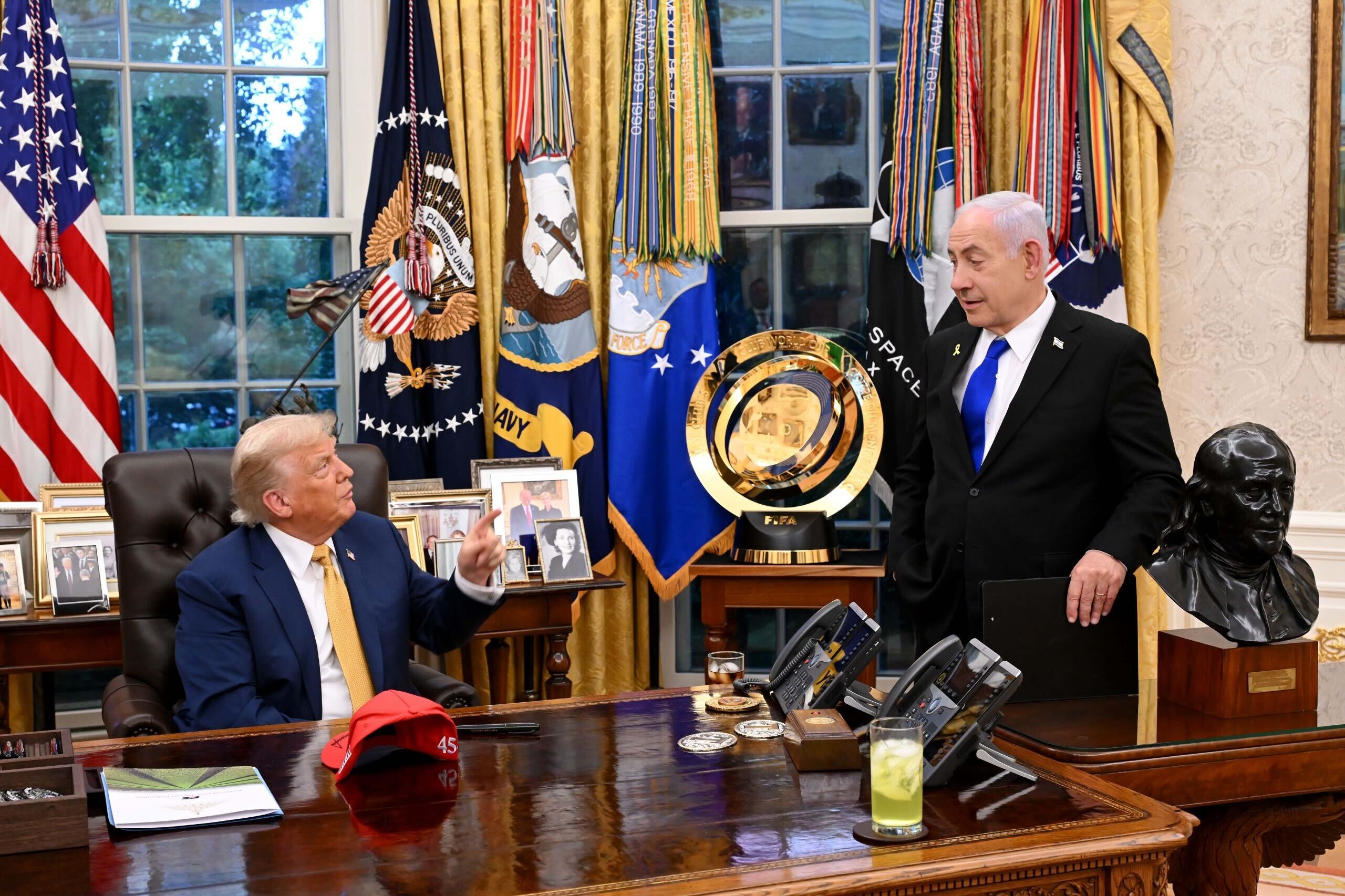
Netanyahu goes on to stress that Trump “acted in a wonderful manner” — apparently, though not definitively, referring to the US participation in June’s 12-day war against Iran.
“And I will continue to maintain a close connection with him,” Netanyahu says of Trump, “including in the very near future.”
PM’s office says Netanyahu spoke with Trump, discussed need to capture remaining Hamas strongholds to end Gaza war
Prime Minister Benjamin Netanyahu spoke with US President Donald Trump a short while ago, the Prime Minister’s Office says.
It says that the two discussed Israel’s plans to conquer the remaining Hamas strongholds in Gaza, in order to free the remaining 50 hostages and defeat Hamas.
Netanyahu “thanked President Trump for his steadfast support of Israel since the beginning of the war,” the PMO adds.
Hamas decries Netanyahu’s ‘series of lies’ during Gaza press conference
Hamas slams Prime Minister Benjamin Netanyahu for telling what it calls a “series of lies” at a press conference where he laid out his vision for victory in Gaza.
“Netanyahu continues to lie, deceive, and try to mislead the public. Everything Netanyahu said in the press conference is a series of lies, and he cannot face the truth; instead, he works on distortion and hiding it,” Taher al-Nunu, the media adviser to the head of Hamas’s political bureau, tells AFP.
Bennett spars with Deri after Shas chair tells yeshiva students to avoid military conscription
Former prime minister Naftali Bennett lambastes Shas chair Aryeh Deri over his recent statement urging yeshiva students not to even think about abandoning their studies to enlist in the army and contribute militarily to the current war in Gaza.
“He who calls for draft refusal cannot send soldiers to battle,” he tweets, attaching a video of Deri’s remarks, which he says “are like a knife in the heart.”
In remarks made late last month at the Shaar HaMelech yeshiva in Jerusalem and aired by the i24 news network, Deri could be heard discouraging the students from enlisting, stating “God forbid it should occur to anyone here in a moment of weakness that maybe at a time like this when the people of Israel are in a state of war…that anybody should, God forbid, perhaps think…maybe we really need to do something different, maybe we need to contribute. God forbid.”
The Shas party, in response, slams Bennett as a “swindler” who “stuck a knife in the heart” of the voters when he took “the votes of the right and transferred them to the left.”
Deri has sat for 30 years in the security cabinet “and works day and night for Israel’s security, and in doing so has saved thousands of fighters and civilians” while Bennett “formed a government with the Muslim Brotherhood and the left, a government that did not dare to act against terrorism and eliminate the leaders of Hamas, for fear that [the Islamist] Ra’am would topple the government.”
“How does this man even dare to show his face in public?” asks Shas.
Asked about Deri’s call to evade service during a rare press conference this evening, Prime Minister Benjamin Netanyahu told a reporter: “I didn’t hear it, but he told me he denied these words. I don’t know. I didn’t see it and they told me he didn’t say it.”
PM says conquering Gaza City is only way to free all 50 hostages, living and dead
Prime Minister Benjamin Netanyahu says that through the plan to occupy Gaza City, Israel aims to achieve a comprehensive deal with Hamas that will result in the release of all 50 remaining hostages in Gaza — both the living and the dead.
“As for our goal” in the plan, Netanyahu says at a press conference for local media, “we want to free all the hostages. When I say ‘all,’ I mean the living and the dead.”
Asked for the second time in the press conference whether Israel would agree to a partial hostage-release deal if Hamas offered one after the operation begins, Netanyahu again does not answer directly, saying: “We are going for a deal — not a partial deal — for the complete release of all 20 [remaining living hostages], with the aim of defeating Hamas.”
“We’ve talked about partial deals, we’ve waited for partial deals, and all the while we’ve been misled. [Hamas handed over] a little here, a little there, and would have kept many hostages in their hands — and it’s not at all clear that we would have ever seen them. I want to see them all, and I believe that a decisive victory is the way to achieve that,” he says.
Addressing whether he is concerned that Chief of Staff Lt. Gen. Eyal Zamir’s expressed disapproval of the plan could affect operational success, Netanyahu says: “I encourage the army, its leaders, and all the security branches: say what’s on your mind. I want to hear it, and many times I am convinced. Sometimes I am not convinced, and in the end, I decide.”
“What we decide is what is carried out. That’s the decision. This is how democracy works,” he says.
PM insists Israel never adopted policy of starvation in Gaza
Prime Minister Benjamin Netanyahu says that while there was a “shortage” of food in Gaza, Israel never adopted a starvation policy in Gaza or caused starvation in the Strip.
Asked during a press conference in Jerusalem why Israel has not implemented harsher measures in Gaza to pressure or defeat Hamas — such as the so-called “Generals’ Plan,” proposed by retired IDF general Giora Eiland, which called for emptying northern Gaza of civilians and imposing a siege on those who remained — Netanyahu says the proposal was intended to starve Gaza City and “was not our intention, and was not our action.”
He says that the “humanitarian city” idea, pushed by Defense Minister Israel Katz, is simply what Israel is already doing: “That there will be areas…in which we will allow the population to leave combat areas, and to receive humanitarian aid.”
Netanyahu says he regularly receives criticism from both the left and the right, and that it does not move him.
“I don’t intend to stop here. I don’t intend to leave those monsters in their place,” he says, referring to Hamas terrorists.
He says the cabinet decision to conquer Gaza City last week is the “first step” in the push for the battlefield defeat of Hamas.
“I don’t intend to lay out the rest of the steps,” he adds, saying that the subsequent moves were discussed in the security cabinet meeting.
“The minute you collapse the center of gravity, the last true fortress left to Hamas in Gaza, Hamas falls apart,” argues Netanyahu, adding, “I think Hamas thinks so too.”
High Court freezes AG’s dismissal until further notice, rebukes minister who called to defy court orders on matter

High Court Justice Noam Sohlberg presides over a court hearing on the state comptroller's investigation into the failings surrounding the October 7 Hamas invasion, July 17, 2024. (Chaim Goldberg/Flash90)
The High Court of Justice turns the temporary order it issued freezing the dismissal of Attorney General Gali Baharav Miara into an interim order, ruling that the government’s decision to fire her will be suspended until further notice from the court, and repeating that Baharav-Miara’s authorities as attorney general remain unchanged.
Judge Noam Sohlberg also issues strong criticism of Communications Minister Shlomo Karhi, who, in a letter, told all employees in his ministry to ignore any instructions from the Attorney General’s Office following the vote on Baharav-Miara’s dismissal last week.
“What was said in the letter is regrettable. Everyone is obligated to respect decisions and rulings of the court,” writes Sohlberg, and, quoting from a 2023 ruling, says that such respect is to be expected all the more so from state officials.
“Needless to say, the conduct of the communications minister in this case is severe; it contradicts fundamental concepts of the rule of law,” continues the judge, saying Karhi’s letter was even more egregious since he instructed his employees to defy the court.
As well as citing High Court rulings, Sohlberg also references a quotation from the works of the 14th-century Talmudic scholar Rabbeinu Nissim about the crucial importance of adhering to the rule of law.
Sohlberg nevertheless rejects requests for a contempt of court ruling against Karhi, saying the court has yet to decide if the state’s agencies are subject to contempt of court rulings and, regardless, such a measure would be a last resort.
The judge says he hopes that Karhi’s letter will be “clarified,” and therefore “prevent a continuation of said conduct.”
He reiterates that the attorney general’s legal position papers remain binding on the government, and that Karhi had no legal basis to tell ministry employees to ignore them.
However, Karhi doubles down on his rejection of the court order, saying the High Court was acting “in direct opposition to the law.”
Says Karhi: “The law explicitly states that the government has the sole authority to appoint and dismiss the attorney general, and that is how the government acted. The judge’s order that the government’s decision is not valid until judicial review deviates from the law and contradicts the express language of the law.”
Despite Karhi’s comments, the High Court has exercised the power of judicial review over administrative decisions by the government since the 1950s.
Palestinian media reports journalist accused by Israel of being Hamas member killed in strike
Prominent Al Jazeera journalist Anas Al Sharif, whom Israel has accused of being a member of Hamas’s military wing, was killed in an airstrike in Gaza City a short while ago, Palestinian media reports.
The reports say Sharif, along with a second journalist, Mohammed Qreiqeh, were killed when an Israeli strike hit a tent near Shifa Hospital.
There is no immediate comment from the IDF on the strike.
In October, the IDF revealed documents seized in Gaza, which it said showed that Sharif was the head of a rocket-launching squad and a member of a Nukhba Force company in Hamas’s East Jabalia Battalion.
استشهاد الصحفيين أنس الشريف ومحمد قريقع بعد قصف الاحتلال خيمة الجزيرة في مستشفى الشفاء pic.twitter.com/7b7t8cUeAv
— شبكة قدس الإخبارية (@qudsn) August 10, 2025
Gaza City op won’t interfere with flow of humanitarian aid to enclave, Netanyahu says
Prime Minister Benjamin Netanyahu says that, in coordination with the United States, Israel decided to ensure that the recently approved military campaign to capture Gaza City does not halt efforts surrounding the transfer of humanitarian aid.
“We did… make a decision together with our American friends to separate the military operation we decided on [so as not to disrupt] the transfer of humanitarian aid,” Netanyahu says at a press conference for Israeli media.
He says that throughout the war, he has argued that if Israel stops allowing humanitarian aid into Gaza, “we will not be able to continue the war. There will be massive international pressure on us, not only from our enemies, but also from our friends,” and that Israel “does not want to use hunger as a tool of war.”
Asked whether his March decision to halt humanitarian aid — a move he reversed 11 weeks later only after heavy pressure from international allies — was a failed strategy to defeat Hamas, Netanyahu insists the policy was never intended to coerce Hamas into surrender. Rather, he says, it was aimed solely at preventing Hamas from seizing the aid and using it to recruit and control Gaza’s population.
“Hamas used [stolen aid] as a recruitment tool for new terrorists, telling a Palestinian woman, ‘You want this flour? Give me your 15-year-old son.’ That’s how they sustain their war machine,” he says.
“We didn’t want to cause hunger; the opposite, we want to get around the looting and robbery of Hamas,” he continues, pointing to Israel’s support for the Gaza Humanitarian Foundation (GHF), though he presents the latter’s establishment as one that came “in parallel” to the halt of aid, ignoring the three-month period between the March 2 halt to all aid and the start of GHF’s operations on May 26.
“But it didn’t work as we wanted it to,” Netanyahu acknowledges. “It didn’t work because there weren’t enough distribution points, et cetera. We learned the lesson. We stopped it, and now we’re operating in a different way. Aid is going in. We are doing our best to ensure that most won’t reach the hands of Hamas. And in parallel, we are indeed increasing the number of distribution points, the secure roads, and the air drops, which usually don’t reach Hamas.”
“There wasn’t starvation,” Netanyahu says. “There was a shortage; there certainly wasn’t a policy of starvation.”
Netnayhu offers some criticism of the policy he and his government chose, saying: “We can argue about whether [changing the policy] was too late, but we certainly shouldn’t have let ourselves be caught in that situation.”
Netanyahu argues that a sign of leadership is the ability to change direction if a policy is proven wrong, adding that he decided not to let the “campaign of starvation” defeat Israel, and that “It will take time until we are out of this, I also know the international problems.”
The premier adds that Israel “won’t commit suicide” by failing to defeat Hamas due to pressure from European countries over the humanitarian situation, saying their leaders “lack the ability to stand up to hostile media and radical minorities, Islamists, that are pressuring [them] in [their] countries.”
“We will win the war, we will eliminate Hamas, and these things will sort themselves out,” he says.
PM pressed on why he framed 2024 Rafah op as last step needed to defeat Hamas
Prime Minister Benjamin Netanyahu is asked about comments he made in March 2024 in which he argued that “it won’t be possible to complete the victory without the IDF entering Rafah and eliminating the remaining Hamas battalions” and about an assertion he made in a CBS interview around the same time that “once we begin the Rafah operation, the intense phase of the fighting is weeks away from completion.”
Netanyahu is asked what went wrong, given that he is now once again framing another major military operation as part of the last step Israel must complete in order to finish off Hamas.
“What happened after the conquering of Rafah was that we achieved victories,” Netanyahu responds, highlighting the developments in Lebanon, Syria and Iran that took place in the months that followed Israel’s Rafah operation.
He doesn’t specify how the Rafah operation led to the developments in other arenas and why he framed the Rafah takeover as the final operation needed to defeat Hamas when Israel had not yet fully entered Gaza City or the refugee camps in central Gaza.
He later acknowledges that even after the Gaza City takeover, Israel will have to stage another operation to clear the central Gaza camps. However, he declines to elaborate in order, he says, to avoid tipping off Hamas.
PM acknowledges public diplomacy shortcomings over Gaza war, says efforts must be adapted to digital age
Asked during tonight’s press conference with local media about Israel’s performance in the battle for global public opinion, Prime Minister Benjamin Netanyahu acknowledges shortcomings in the Public Diplomacy Directorate of the Prime Minister’s Office, which has not had a director for over a year.
“There is a public diplomacy directorate — it simply doesn’t operate according to the absurd bureaucratic dictates of our system, which is stuck in the 1980s — it’s literally still in the 1980s,” Netanyahu says.
“We have serious public diplomacy challenges,” he continues, “and the most serious of them is, first of all, the continuation of the war.”
“This war has dragged on, but it has in fact achieved results that are truly game-changing… across the Middle East. So you pay a price. The best way not to pay the price is to shorten the war. That’s exactly what I want to do now, by eliminating Hamas’s last remaining strongholds” through the recently approved plan to occupy Gaza City, he says.
Netanyahu argues that public perception efforts, headed by the Foreign Ministry, were effective in supporting public relations during the June war against Iran, as it was a short and decisive conflict.
“The Foreign Ministry has a huge budget of hundreds of millions of shekels for propaganda tools — which I won’t detail here — and they’re important; they’re important in the digital age,” he continues, adding that the effort is headed by Foreign Ministry Director-General Eden Bar Tal, and includes a cross-agency team that works around the clock.
He adds that “it is completely clear that we will have to enter the digital era — to address the issue of algorithms, bots and other means,” which he claims also play a significant role in promoting anti-Israel narratives in the media.
PM says war with Iran set its nuke program back by years, claims there are efforts to downplay this
Concluding his second lengthy press conference this evening with a response to a question on the June war against Iran, Netanyahu assesses that Israel’s campaign set Tehran’s nuclear program “years” back.
“On Iran — we have inflicted very significant damage, setting them back by years. One can debate how many years, but they were just months away from a nuclear weapon — a nuclear facility or nuclear bombs — and this has been pushed back.”
“They will try to rebuild. I’ve said before, this is like a person who removes cancer from his body — but when you remove cancer from your body, there can be metastases, it can come back. Only we knew that if we did not remove this cancer, we would die. And so we removed it. This obligates us to remain fully vigilant. We are prepared for any scenario. The Iranians are also preparing for various scenarios — which I will not detail here,” he concludes.
Earlier in the press conference, Netanyahu claims that there are efforts to downplay the achievements in the war against Iran — a likely reference to reports citing alleged US intelligence pointing to Tehran’s nuclear program only having been set back by months.


read more: