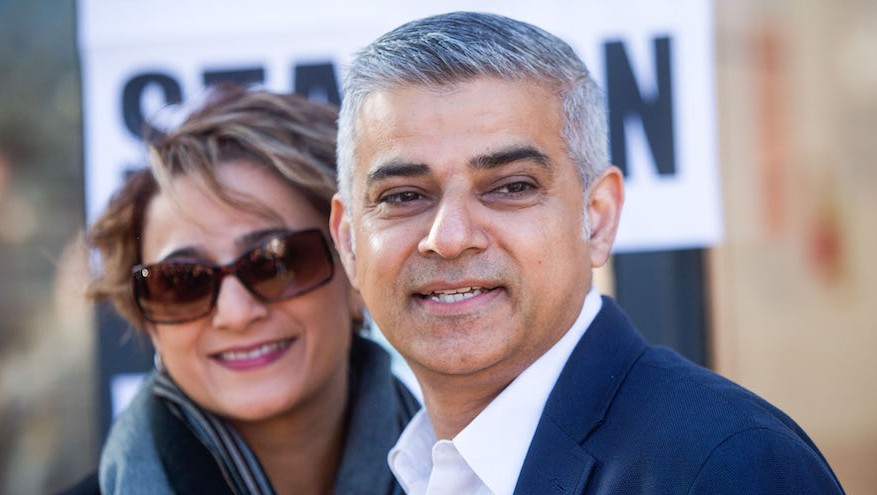
Sadiq Khan, the victorious Labour Party candidate for London mayor, and his wife Saadiya Khan, pose for photographers after voting in the elections on Thursday, May 5, 2016. (Simon Dawson/Bloomberg, via JTA)
London Mayor Sadiq Khan, the first Muslim mayor of a European capital city, has been bombarded with anti-Semitic messages since he said he would not support Jeremy Corbyn in the Labour Party leadership election.
Several of the messages suggested that he had been influenced by Jews, the London-based news website Jewishnews.uk reported.
The mayor “spends his time writing articles to help his masters in Tel Aviv,” read one tweet.
“Who owns you @sadiqkhan?” read another, which included a photo of Khan wearing a kippah while eating matzah at a Jewish community event.
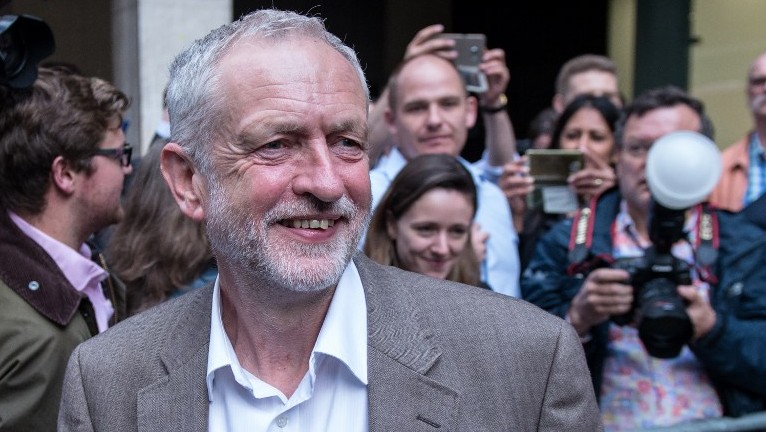
British Labour Party leader Jeremy Corbyn meets supporters and members of the media after attending a meeting of Labour’s National Executive Committee in London on July 12, 2016. (AFP/Chris Ratcliffe)
Last week, Khan threw his support behind Owen Smith, who has been a Parliament member since 2010 and is Corbyn’s only challenger for the party leadership. Smith previously worked as a radio and television producer for the BBC.
Get The Times of Israel's Daily Editionby email and never miss our top stories
Khan, a Labour member, wrote an op-ed published Saturday in The Guardian newspaper in support of Smith. He said in the London-based daily that if Corbyn remained party leader, Labour would be unlikely to win the next general election. Khan also said Corbyn “has already proved that he is unable to organize an effective team, and has failed to win the trust and respect of the British people.”
In a June op-ed in The Jerusalem Post, Kahn pledged to root out anti-Semitism in London and in the Labour Party.
Some 500,000 ballots for the leadership race were sent out to party members on Monday; the results will be announced next month.
Advertisement
We can't do this work alone.
The war with Iran has been draining for all of us in Israel. But when I heard about a high casualty incident – ballistic missile impacts in Arad and Dimona that left nearly 200 people wounded – I drank a cup of coffee, packed a bag, and headed south.
There, I spoke with Shilgit, the head of an after-school program for underprivileged youth. Standing outside her destroyed center, Shilgit said it was a miracle that no children were hurt and spoke about the community coming together in the hours since.
As a Times of Israel reporter, I’m committed to telling stories of resilience like Shilgit’s. But my colleagues and I can't do this alone. If you value work like this,please consider joining our reader support group, The Times of Israel Community. Your financial support is essential to keep real human reporting like this going.
We’re really pleased that you’ve read X Times of Israel articles in the past month.
That’s why we started the Times of Israel - to provide discerning readers like you with must-read coverage of Israel and the Jewish world.
So now we have a request. Unlike other news outlets, we haven’t put up a paywall. But as the journalism we do is costly, we invite readers for whom The Times of Israel has become important to help support our work by joining The Times of Israel Community.
For as little as $6 a month you can help support our quality journalism while enjoying The Times of Israel AD-FREE, as well as accessing exclusive content available only to Times of Israel Community members.
Thank you, David Horovitz, Founding Editor of The Times of Israel