

Mekorot report gives thumbs up to desalination
Tap water quality shows dramatic increase over the last 20 years
Stuart Winer is a breaking news editor at The Times of Israel.
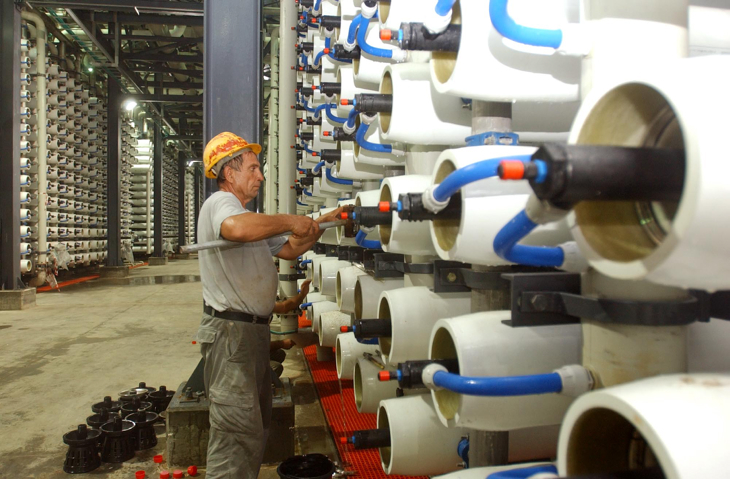
A report published this week by Mekorot, the national water company, shows that water quality has improved greatly over the past two decades, in part due to desalination.
Throughout 2010, Mekorot conducted over 17,000 tests of water quality to detect microorganisms and other impurities. Only 19 tests showed contamination above acceptable levels — about 0.07 percent — far below the five percent requirement for safe drinking water determined by the World Health Organization. This marks a dramatic improvement over the 6.5 percent of tests that showed an unacceptable level of impurities in 1991.
The report also recorded a shift in the balance of water sources from pumped water to desalination sites. Four years ago, Mekorot pumped an annual 276 million cubic meters of water from the Sea of Galilee, while only 153 million cu.m. came from desalination. Nowadays the figures have reversed, with 277 million cu.m. coming from desalination plants along the Mediterranean coast and 176 million cu.m. from Sea of Galilee.

The figures are bad news for mineral water companies that find it hard to show the advantages of their product over tap water. Haaretz reports that Environment Minister Gilad Erdan recently announced his intention to run a campaign encouraging the public to drink from the faucet rather than buy bottled mineral water that, the minister said, is a strain on natural springs.
Serious concerns remain over the persistent contamination of the coastal aquifers from invasive sea water and pollution. According to a Hydrological Service report, figures from 2009 showed that only 39% of the coastal aquifer’s water was of good quality and 11% was unusable. The remaining 60% was graded as “acceptable.”








The Times of Israel Community.