This file mosaic image composed of 12 PolyCam images collected on Dec. 2, 2018, and provided by NASA shows the asteroid Bennu. The Osiris-Rex spacecraft entered orbit Monday, Dec. 31, 2018, around the asteroid Bennu, 70 million miles (110 million kilometers) from Earth. It’s the smallest celestial body ever to be orbited by a spacecraft. Bennu is just 1,600 feet (500 meters) across. (NASA/Goddard/University of Arizona via AP, File)
LAUREL, Maryland— A NASA spacecraft has gone into orbit around an ancient asteroid, setting a pair of records.
The Osiris-Rex spacecraft entered orbit Monday around the asteroid Bennu, 70 million miles (110 million kilometers) from Earth. It’s the smallest celestial body ever to be orbited by a spacecraft. Bennu is just 1,600 feet (500 meters) across.
The spacecraft’s laps are barely a mile (1.6 kilometers) above the asteroid’s surface, another record.
Osiris-Rex arrived at Bennu in early December and flew in formation with it until the latest maneuver. The goal is to grab gravel samples in 2020 for return to Earth in 2023.
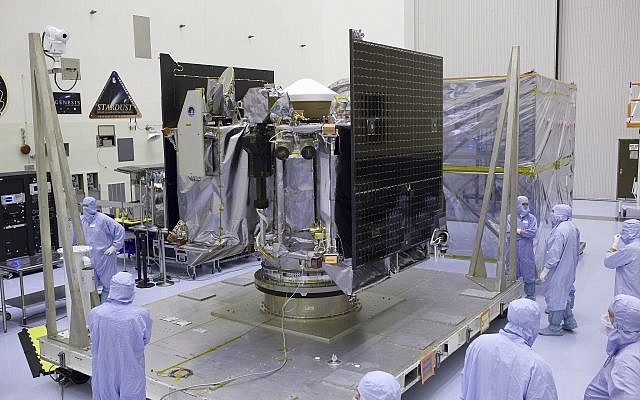
This May 21, 2016, file photo provided by NASA shows the Osiris-Rex spacecraft inside a servicing facility at Kennedy Space Center in Florida after arriving from Lockheed Martin’s facility near Denver. The Osiris-Rex spacecraft entered orbit Monday, Dec. 31, 2018, around the asteroid Bennu, 70 million miles (110 million kilometers) from Earth. (Dimitri Gerondidakis/NASA via AP)
The New Year’s Eve milestone occurred just hours before another NASA explorer, New Horizons, was set to fly past an icy space rock beyond Pluto.
Get The Times of Israel's Daily Editionby email and never miss our top stories
As a multimedia journalist, my job is to take the quality, fact-based journalism produced by The Times of Israel newsroom and make it accessible across every platform — from Instagram posts to podcasts to short-form videos.
This is how many, especially young people, consume news these days. But misinformation is rampant on social media. Our team at ToI produces accurate, responsible short-form reporting on Israel and the Jewish world.
If you believe in the importance of factual social media journalism, please consider joining our reader support group, The Times of Israel Community. Your financial support is essential to sustain responsible multimedia reporting.
We’re really pleased that you’ve read X Times of Israel articles in the past month.
That’s why we started the Times of Israel - to provide discerning readers like you with must-read coverage of Israel and the Jewish world.
So now we have a request. Unlike other news outlets, we haven’t put up a paywall. But as the journalism we do is costly, we invite readers for whom The Times of Israel has become important to help support our work by joining The Times of Israel Community.
For as little as $6 a month you can help support our quality journalism while enjoying The Times of Israel AD-FREE, as well as accessing exclusive content available only to Times of Israel Community members.
Thank you, David Horovitz, Founding Editor of The Times of Israel


 Add ToI as a Preferred Source on Google