

Netanyahu seeks new paths to a Palestinian state he’s not sure he wants
He called on Obama to help engage the Arab world in peace efforts, but would the PM ever actually sign off on a State of Palestine?
Raphael Ahren is a former diplomatic correspondent at The Times of Israel.
Does he or does he not believe in the two-state solution? Due to the conspicuous absence of the phrase in Prime Minister Benjamin Netanyahu’s speech at the United Nations on Monday, pundits were this week wondering once again whether he really means it when he says that, in principle, he is in favor of the establishment of a Palestinian state.
During his comprehensive address to the UN General Assembly, Netanyahu had said that any peace agreement “will obviously necessitate a territorial compromise.” In almost the same breath, however, he repeated a phrase settler leader and Economy Minister Naftali Bennett has popularized in recent months: “The people of Israel are not occupiers in the Land of Israel.”
In his 35-minute New York speech, he chose not to utter the words “Palestinian state” or in any other way explicitly endorse the two-state solution. Some observers saw the omission as a signal that the prime minister had abandoned the idea.
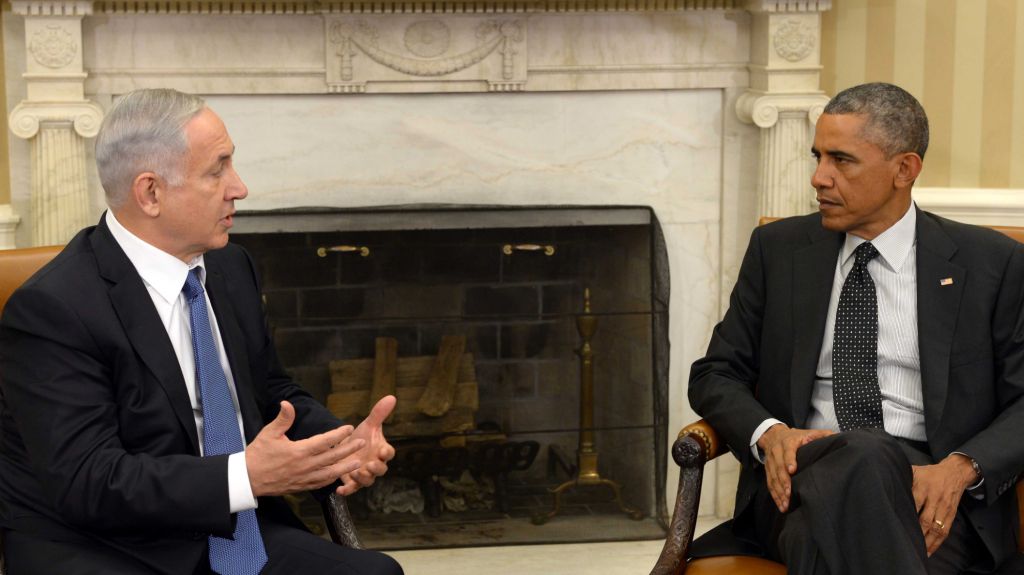
But during his meeting with US President Barack Obama Wednesday in the White House, he moved to silence the doubters: “I remain committed to a vision of peace of two states for two peoples based on mutual recognition and rock solid security arrangements on the ground” he declared.
Bennett and other right-wing politicians began attacking Netanyahu even before he had left the White House. “Someone who is committed to fighting Hamas and ISIS cannot give them a state,” Bennett said.
Some still believe Netanyahu was merely paying lip service to the idea of a Palestinian state. Veteran Israeli reporter Itamar Eichner, for instance, joked that Netanyahu said he’s committed to the two-state solution, but “surely he meant Israel and Judea” — the two biblical kingdoms.
There is no necessary contradiction between Netanyahu declaring that Israelis are not “occupiers” and at the same time accepting the idea of Palestinian statehood. He truly believes that the Land of Israel belongs to the Jewish people, but realpolitik may have convinced him that he needs to share it with another people living there.
Yet there is reason to argue that Netanyahu would never actually agree to the establishment of a Palestinian state. This summer, he indicated that Israel could never give up security control over the territory to its east, which means in practice that Palestinians can never receive full sovereignty over the West Bank, as was noted here at the time.
Still, the chief Israeli peace negotiator Tzipi Livni told The Times of Israel last week that it was always clear the Palestinians would not have full sovereignty, and that this did not necessarily rule out statehood. And Netanyahu sometimes seems quite ready to accept, in principle, the establishment of a Palestinian state in parts of the West Bank, as opposed to many of his colleagues in the Likud party.
Some people familiar with his thinking believe that, if the Palestinians were to recognize Israel as a Jewish state and acquiesce to his security requirements (which include a long-term Israeli military presence in the Jordan Valley, and perhaps elsewhere), Netanyahu would be willing to sign a peace treaty that would establish the State of Palestine.
Despite pressure from his political base, Netanyahu resolutely refuses to even discuss annexing the West Bank. He has indicated, in his repeated comments against a binational state, that he is cognizant of the problems that would arise — in terms of demography and democracy — if Israel failed to separate from the Palestinians.
Furthermore, as Livni also told The Times of Israel last week, Netanyahu does not abide by the ideology of Greater Israel. Livni was Israel’s chief negotiator during the recent peace talks with the Palestinians, and she spent countless hours debating with the prime minister the various aspects of a possible agreement.
Perhaps more than anyone else bar a tiny circle of close advisers, she should know how Netanyahu really feels about the two-state solution.
For now, much of the international community cares much less about what Netanyahu really thinks about a Palestinian state, and much more about his ostensible dooming of it through settlement expansion. And it will continue to press him on the imperative for a two-state solution.
On Wednesday, as they began their White House meeting, Obama said he wanted to “extensively” discuss with his Israeli guest “ways to change the status quo” vis-à-vis the Palestinians. But the president probably had in mind something entirely different than the prime minister.
After nine months of fruitless negotiations with the Palestinian Authority and nearly a week after Mahmoud Abbas’s notorious “genocide” speech to the UN, Netanyahu no longer believes the route to a possible peace goes through Ramallah.
Rather, he believes it needs involvement from the likes of Cairo, Amman, Riyadh and Abu Dhabi, he told the UN on Monday. With the rise of Islamist radicalism and Iran’s nuclear ambitions, “a commonality of interests” has emerged between Israel and moderate Arab states,” he elaborated in the White House on Wednesday. “And I think that we should work very hard together to seize on those common interests and build a positive program to advance a more secure, more prosperous and a more peaceful Middle East.”
We should “think outside the box” and see how we can “recruit” the Arab countries to advance this “very hopeful agenda,” Netanyahu told Obama in the Oval Office, with Vice President Biden and Secretary of State John Kerry present in the room.
Sitting next to the president of the United States of America, one presumably doesn’t just throw out such ideas, so perhaps there really is a genuine rapprochement in the offing. The Arab world is not rushing to embrace the Jewish state. But Netanyahu seems serious about his outreach efforts. Apparently he believes that the mutual enemies Israel and the Arab states face must eventually turn some Arabs and Israelis into friends.
The next days and weeks will give some indication of whether Netanyahu’s vision of Arab-Israeli collaboration will materialize. There is certainly room for skepticism. If it does not — with Abbas pushing his unilateral statehood bid at the UN, and Netanyahu again under fire for more building over the pre-1967 lines — Obama and the rest of the international community will likely increase pressure on Israel to resume the bilateral talks with the Palestinian Authority.








The Times of Israel Community.