

Netanyahu’s new settlement? ‘Abandoned’ Amona evictees aren’t holding out hope
Residents of the evacuated West Bank outpost are not taking pledge for granted: ‘This fight is not over,’ they say. ‘We’ve just moved to the next stage’
 Add ToI as a Preferred Source on Google
Raoul Wootliff is a former Times of Israel political correspondent and Daily Briefing podcast producer.
OFRA — A 35-minute walk up the hill, the final protesters were being forcibly removed by Border Police from the synagogue of the Amona outpost in grisly scenes that saw several officers injured and screaming teens cut free after chaining themselves to furniture.
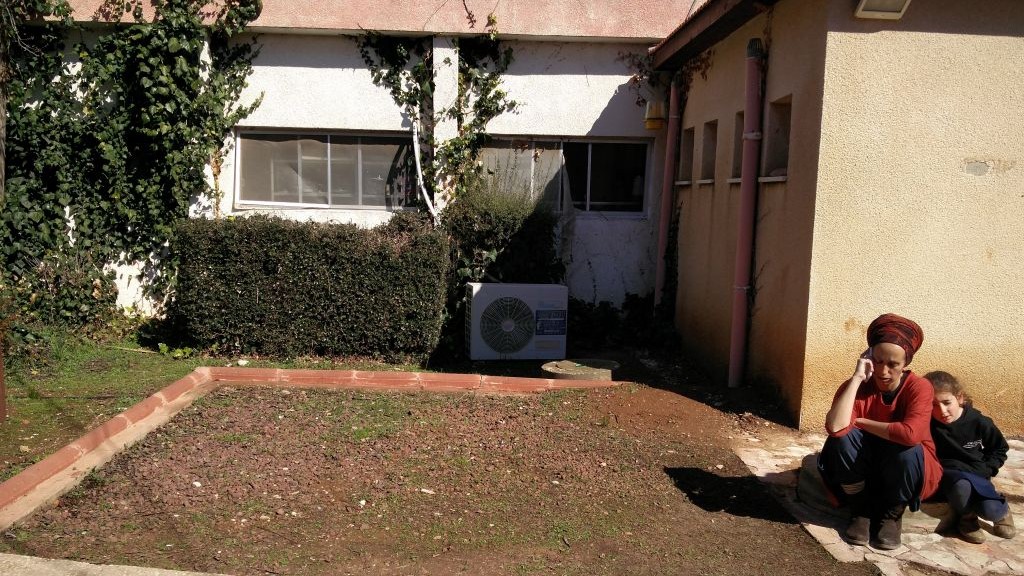
In the Ofra Seminary campus, however, among the majority of families who had themselves been evicted from the small settlement a day earlier, a more placid but no less strained atmosphere prevailed.
Mothers cradled their young babies protectively as side-lock laden young boys played on the grass in the sun. Separate groups of men and women huddled together in conversation. Some people walked around in an apparent daze, barefoot and still wearing the ripped clothes they had symbolically torn as a sign of mourning when they left their homes. Others sat on benches talking quietly in pairs while sipping dark Turkish coffee from paper cups.
Thirty-two of the 42 families evicted from Amona had stayed here the night before, sleeping in the guest house rooms usually used by youth groups and school programs visiting the settlement for the weekend, and most were expected to stay for at least the coming weeks. According to site manager Amichai Rubin, the approximately 300 people would be able to stay “as long as they needed with no limit whatsoever,” with the help of the Binyamin Regional Council which was paying for the accommodation and food.

A 2014 High Court of Justice order gave residents more than two years to prepare for the outpost’s evacuation. But due to both repeated promises by Israel’s political echelon that the eviction would not take place, and a deep ideological belief that they would not leave because they should not leave, many of the residents said they had no plans in place for where to go now.
“I can’t make any plans for new accommodation because I’m still fighting for my home,” Sarah Frank told The Times of Israel with tears in her eyes. Frank, 44, grew up in the Yamit settlement in the northern Sinai until she was 9, when it was evacuated in 1982 as part of the Egypt–Israel peace treaty. “This fight is not over; we’ve just moved to the next stage,” she said Thursday.
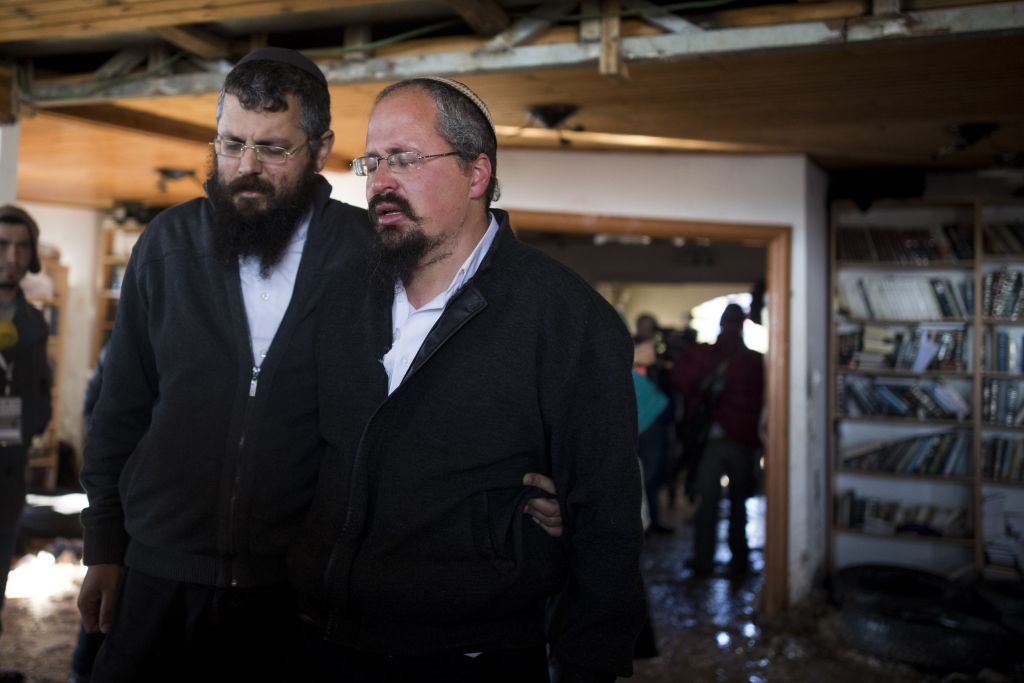
While her husband, the community’s spiritual leader Rabbi Yair Frank, had opted to remain in the settlement synagogue until police forces removed the final protesters, Sarah had stayed the night in one of the Ofra guest house rooms with six of her nine children. She said the youngest three, who were currently at relatives in a nearby settlement, would be joining them soon.
As the evacuation got underway on Wednesday, Jewish Home leader Education Minister Naftali Bennett said that even though the residents had been forced to leave, their campaign to stay in their homes would eventually lead to the annexation of the West Bank and avert future evacuations of settlements.
“We lost the battle, but we are winning the war for the Land of Israel,” Bennett said, referring to the so-called Regulation Bill, which the Knesset was set to vote into law next Monday. The controversial legislation, which would legalize some housing units built on privately owned Palestinian land, was advanced in response to the impending demolition of Amona, though pressure from some coalition lawmakers led to the adding of a clause that excluded the outpost from its protections.
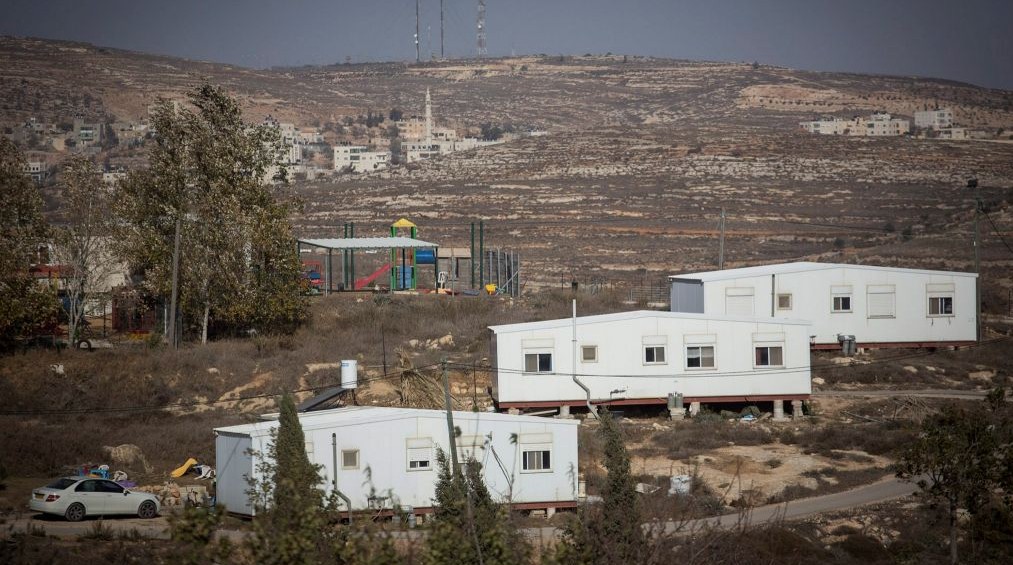
“From this legal defeat [in Amona] we will establish a new legal regime in Judea and Samaria that will regulate the entirety of settlements, and from the painful loss of this foothold in this mountain will emerge the State of Israel’s application of sovereignty over all of Judea and Samaria,” Bennett said, shortly after the government announced plans to build 3,000 new homes in existing settlements, including some that lie outside major settlement blocs.
But Frank said new building could not make up for what she and her family were going through. “Is that supposed to make it better? To give me hope?” she asked emphatically. “That’s not enough. That’s no deal. What will happen to my house?”
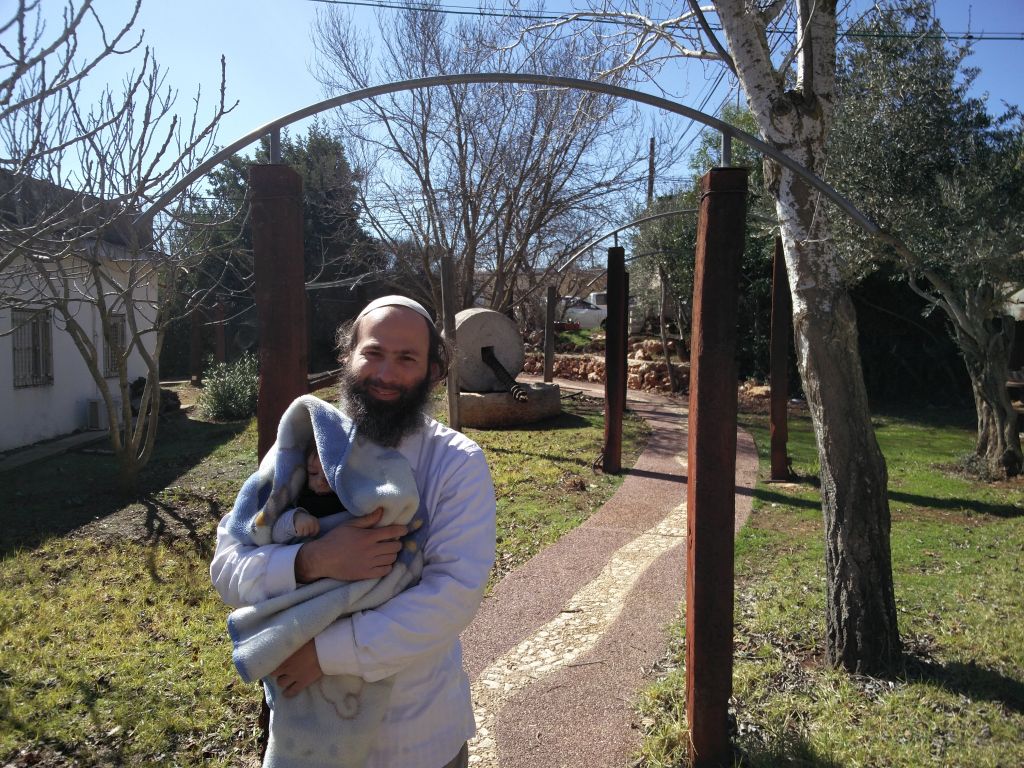
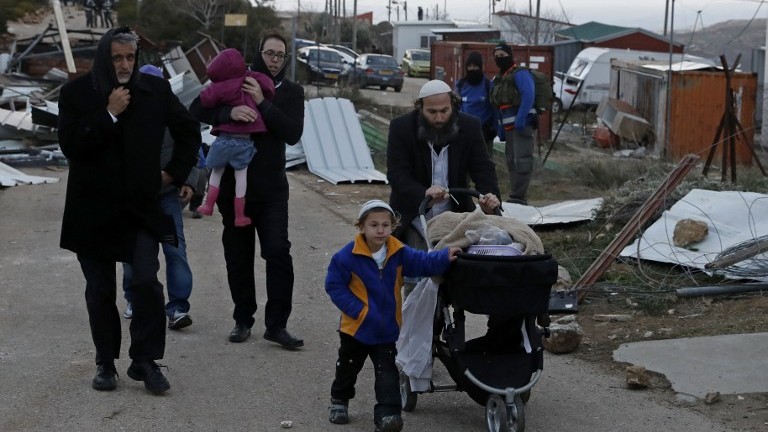
Holding his 3-month-old baby, who was born at home in Amona towards the end of last year, Avraham Rossano said he felt like a child who had been “thrown out and abandoned by his parents.” Towards nightfall on Wednesday, Rossano left his house voluntarily and walked the two kilometers from Amona to Ofra, pushing his baby in a stroller with his two other children by his side.
Now, he said, he plans to go with his family to Jerusalem to “set-up camp” in a place where Prime Minister Benjamin Netanyahu, who many within the settler movement blame for not preventing the evacuation, “can’t look away.” While insisting that ultimately he can only rely on God, Rossano said he wanted Netanyahu to see what they were going through in order to encourage him to take action. “How can a father not take back his children after kicking them out?” he said.
Netanyahu on Thursday said that the evacuation was unavoidable but the whole country shared the residents’ “great pain.” Speaking as security forces wrapped up the evacuation, he said he would fulfill a promise he had made to residents to establish a new West Bank settlement to replace Amona.
Under fierce pressure from settlers and their Knesset supporters, the government had initially sought to reach a compromise with residents for the outpost to be relocated to an adjacent plot of land on the same hilltop. But local Palestinians objected to the government plan, saying the adjacent plot was also privately owned, and the High Court earlier on Wednesday sided with the Palestinian complainants, overriding the deal.
With moving to the adjacent plot off the table, an Amona spokesperson told The Times of Israel that residents would agree to relocating the entire settlement. “In the absence of any other option, the residents will accept the offer to establish a new settlement,” Ofer Inbar said.

But Tamar Nizri, a veteran Amona resident who was one of the last to leave the outpost on Wednesday with her eight children, was skeptical of the prime minister’s pledge. “He’s made up promises before and he hasn’t been able to deliver,” she said.
“We can’t even trust Bennett and [Justice Minister Ayelet] Shaked,” she said of the religious-Zionist Jewish Home party’s leaders. “They promised us we could move to the new plot. Their words are empty.”
While admitting to feeling a sense of despair, Nizri said that of all the possible options, the one that at this moment seemed impossible may in fact the be easiest, and even most likely.
“I know they are right now destroying it… but we can’t go to the adjacent plot and who knows how hard it will be to set up a new settlement,” she insisted.
“The easiest option will be for us to go back, back to Amona,” she said, pointing to the hilltop where her house still stood, for now.










The Times of Israel Community.