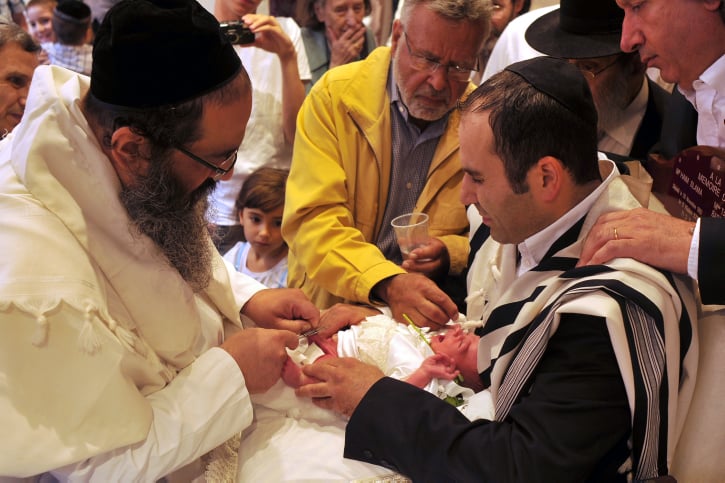
A newborn in New York contracted herpes from a controversial Jewish ritual circumcision rite.
The baby boy is undergoing treatment for neonatal genital herpes, according to the Forward, contracted through metzitzah b’peh, in which the ritual circumciser places his mouth directly on the child’s circumcision wound to draw blood away from the cut.
The New York City Department of Health and Mental Hygiene issued a health alert about the baby’s case on Jan. 28. The baby was treated for the genital rash five days after his circumcision.
At least 11 boys contracted herpes from the practice between 2004 and 2011, according to New York City health officials. Two died from the disease and two others suffered brain damage, the officials said.
In September 2013, the city’s Board of Health voted 9-0 to require mohels to obtain signed consent forms from parents; the haredi Orthodox Jewish community opposes the forms. Several months earlier, the city had struck an agreement with city hospitals to distribute pamphlets about the ritual’s dangers to the mothers of newborns.
Get The Times of Israel's Daily Edition
by email and never miss our top stories
By signing up, you agree to the
terms
New York Mayor Bill de Blasio said shortly after taking office on Jan. 1 that he would leave the signed consent forms in place while looking for a more effective solution, according to the Forward. The haredi Orthodox community had believed de Blasio would do away with the forms.
Metzitzah b’peh is not used in most Jewish circumcision ceremonies, but many in the haredi Orthodox community still adhere to the rite. Many haredi leaders have resisted calls to use alternative approaches.
We can't do this work alone.
The war with Iran has been draining for all of us in Israel. But when I heard about a high casualty incident – ballistic missile impacts in Arad and Dimona that left nearly 200 people wounded – I drank a cup of coffee, packed a bag, and headed south.
There, I spoke with Shilgit, the head of an after-school program for underprivileged youth. Standing outside her destroyed center, Shilgit said it was a miracle that no children were hurt and spoke about the community coming together in the hours since.
As a Times of Israel reporter, I’m committed to telling stories of resilience like Shilgit’s. But my colleagues and I can't do this alone. If you value work like this, please consider joining our reader support group, The Times of Israel Community. Your financial support is essential to keep real human reporting like this going.
— Stav Levaton, military reporter
Yes, I'll join
Yes, I'll join
Already a member? Sign in to stop seeing this
You're a dedicated reader

We’re really pleased that you’ve read X Times of Israel articles in the past month.
That’s why we started the Times of Israel - to provide discerning readers like you with must-read coverage of Israel and the Jewish world.
So now we have a request. Unlike other news outlets, we haven’t put up a paywall. But as the journalism we do is costly, we invite readers for whom The Times of Israel has become important to help support our work by joining The Times of Israel Community.
For as little as $6 a month you can help support our quality journalism while enjoying The Times of Israel AD-FREE, as well as accessing exclusive content available only to Times of Israel Community members.
Thank you,
David Horovitz, Founding Editor of The Times of Israel
Join Our Community
Join Our Community
Already a member? Sign in to stop seeing this