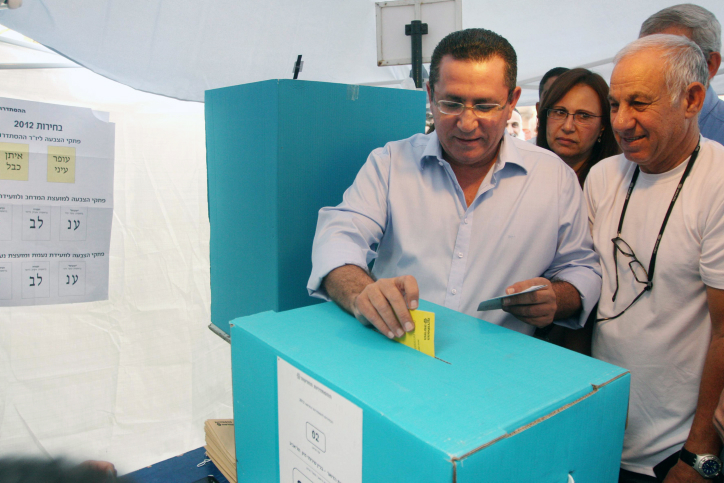
Histadrut chairman Ofer Eini casts his ballot for union leadership on Tuesday (photo credit: Roni Schutzer/Flash90)
Histadrut chairman Ofer Eini emerged as the early leader in the count-up of ballots cast in the labor federation’s leadership race, Tuesday night.
With 10 percent of ballots counted, incumbent Eini leads his challenger, Labor MK Eitan Cabel, with 63% of the votes. Roughly 200,000 people voted in the elections, making up 40 percent of all eligible voters.
Final results are expected to be announced on Thursday
The elections will also determine the delegates at the Histadrut Convention and leadership of the Naamat women’s organization.
The Histadrut labor union, founded in 1920, grew to be one of the most powerful institutions in both Mandate-era Palestine and Israel.
Get The Times of Israel's Daily Editionby email and never miss our top stories
Although the influence of organized labor has waned in recent years, the Histadrut’s huge membership insures its ability to call paralyzing strikes when it deems necessary.
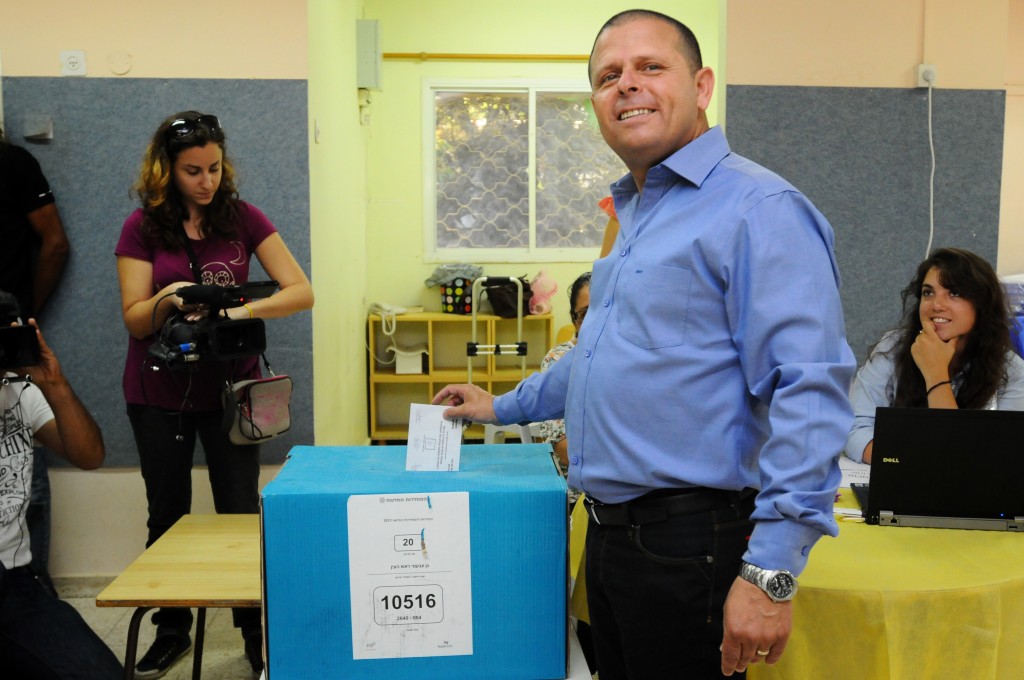
Cabel was hoping that Eini’s lukewarm support of last summer’s social justice protests, and relative reluctance to use the weapon of strikes, would cause voters to shift their allegiance. He campaigned as an energized alternative to the incumbent, who he tried to paint as a lackey of Israel’s business tycoons.
Eini meanwhile pointed to Cabel’s lack of experience. In media interviews Tuesday morning, Eini said he was confident of winning by a landslide.
Advertisement
Eitan Cabel votes in Tuesday's elections for the chairmanship of the Histadrut (photo credit: Yossi Zeliger/Flash90)
Help us report truthfully on social media
As a multimedia journalist, my job is to take the quality, fact-based journalism produced by The Times of Israel newsroom and make it accessible across every platform — from Instagram posts to podcasts to short-form videos.
This is how many, especially young people, consume news these days. But misinformation is rampant on social media. Our team at ToI produces accurate, responsible short-form reporting on Israel and the Jewish world.
If you believe in the importance of factual social media journalism, please consider joining our reader support group, The Times of Israel Community. Your financial support is essential to sustain responsible multimedia reporting.
We’re really pleased that you’ve read X Times of Israel articles in the past month.
That’s why we started the Times of Israel - to provide discerning readers like you with must-read coverage of Israel and the Jewish world.
So now we have a request. Unlike other news outlets, we haven’t put up a paywall. But as the journalism we do is costly, we invite readers for whom The Times of Israel has become important to help support our work by joining The Times of Israel Community.
For as little as $6 a month you can help support our quality journalism while enjoying The Times of Israel AD-FREE, as well as accessing exclusive content available only to Times of Israel Community members.
Thank you, David Horovitz, Founding Editor of The Times of Israel


 Add ToI as a Preferred Source on Google