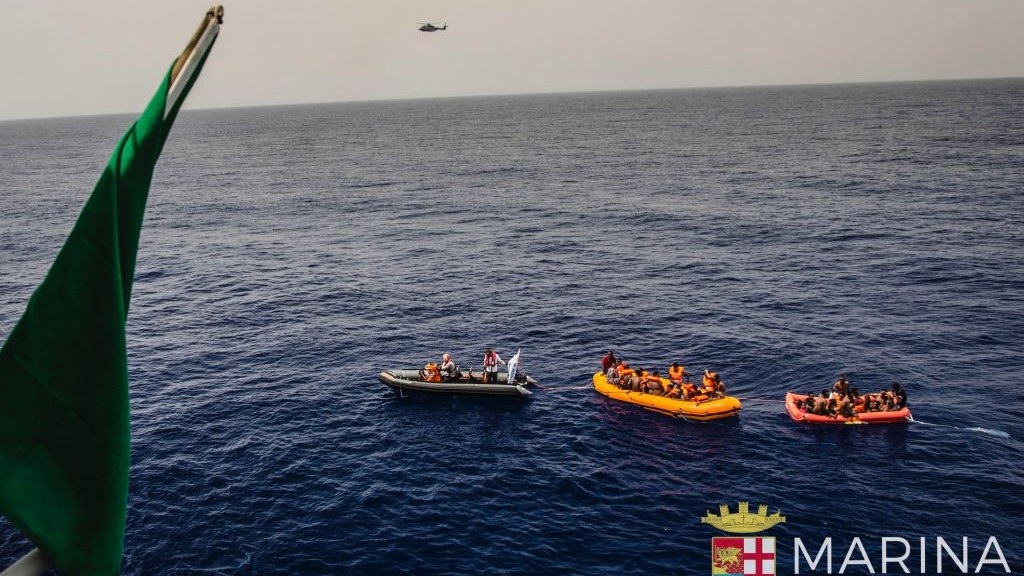
In this photo taken in the Mediterranean Sea, off the Libyan coast, Friday, May 27, 2016, rescuers tow migrants to the Italian Navy ship Vega, after the boat they were aboard sunk. (Raffaele Martino/Marina Militare via AP Photo)
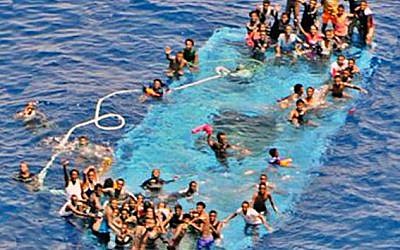
PARIS, France — More than 100 migrants, including at least 20 children, died when two boats sank off the coast of Libya early this month, according to Doctors without Borders, citing survivors.
The witnesses told Doctors without Borders, also known by its French acronym MSF, that two inflatable boats had left the Libyan coast on September 1, each with 160 people on board, the medical charity said in a statement.
The migrants were from Sudan, Mali, Niger, Cameroon, Ghana, Libya, Algeria and Egypt, MSF said.
According to a survivor, the motor broke down on one boat while the other continued until it “began to deflate… there were 165 adults and 20 children on board.”
As the boat began to sink, “few passengers had life jackets or knew how to swim, only those who held onto the hull of the boat managed to survive,” said the witness to the tragedy.
Get The Times of Israel's Daily Editionby email and never miss our top stories
On September 2, the Libyan coastguard brought 276 people to the port of Khoms, among whom were the survivors of this sinking.
In this photo taken in the Mediterranean Sea, off the Libyan coast, May 27, 2016, rescuers tow migrants to the Italian Navy ship Vega, after the boat they were aboard sunk. (Raffaele Martino/Marina Militare via AP)
The group was transferred to a detention center under the control of the Libyan authorities, MSF said.
Advertisement
MSF, which treated the survivors, said there were pregnant women, children and even babies. Some had suffered burns from escaped fuel, others had caught pneumonia from staying so long in the water.
Some had burns over 75 percent of their body, said Jan Defransciscis, an MSF nurse who works in Misrate, Libya.
We can't do this work alone.
The war with Iran has been draining for all of us in Israel. But when I heard about a high casualty incident – ballistic missile impacts in Arad and Dimona that left nearly 200 people wounded – I drank a cup of coffee, packed a bag, and headed south.
There, I spoke with Shilgit, the head of an after-school program for underprivileged youth. Standing outside her destroyed center, Shilgit said it was a miracle that no children were hurt and spoke about the community coming together in the hours since.
As a Times of Israel reporter, I’m committed to telling stories of resilience like Shilgit’s. But my colleagues and I can't do this alone. If you value work like this,please consider joining our reader support group, The Times of Israel Community. Your financial support is essential to keep real human reporting like this going.
We’re really pleased that you’ve read X Times of Israel articles in the past month.
That’s why we started the Times of Israel - to provide discerning readers like you with must-read coverage of Israel and the Jewish world.
So now we have a request. Unlike other news outlets, we haven’t put up a paywall. But as the journalism we do is costly, we invite readers for whom The Times of Israel has become important to help support our work by joining The Times of Israel Community.
For as little as $6 a month you can help support our quality journalism while enjoying The Times of Israel AD-FREE, as well as accessing exclusive content available only to Times of Israel Community members.
Thank you, David Horovitz, Founding Editor of The Times of Israel