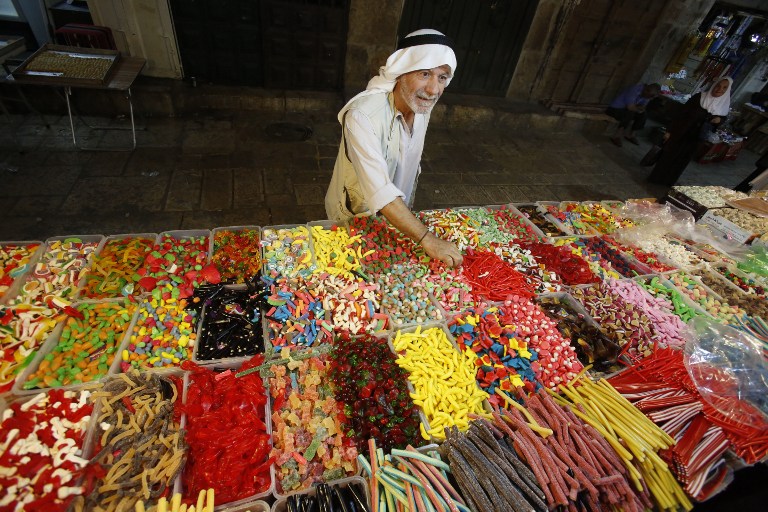
A Palestinian man buys sweets as Muslims shop in preparation for the holiday of Eid al-Adha at the market in the Old City of Jerusalem on September 11, 2016. (AFP PHOTO/HAZEM BADER)
Prime Minister Benjamin Netanyahu sent his best wishes to the Muslim and Druze citizens of Israel for the Eid al-Adha festival that began Sunday night.
“On the occasion of the Festival of the Sacrifice, Eid al-Adha, I am happy to offer my best wishes to our Muslim and Druze citizens with wishes for a happy festival,” Netanyahu said in a statement released to the media. He offered the traditional festive greeting, “May you be well every year.”
“This festival praises the values which the Jewish religion also values, fear of God, family values and helping others. This is another example of the many things which unite us in our shared life in the State of Israel,” Netanyahu said. “I wish you and all your families a great and happy festival.”
Eid al-Adha commemorates the willingness of the patriarch Abraham, or Ibrahim in the Muslim tradition, to sacrifice his son and God’s intervention that stopped the slaughter.
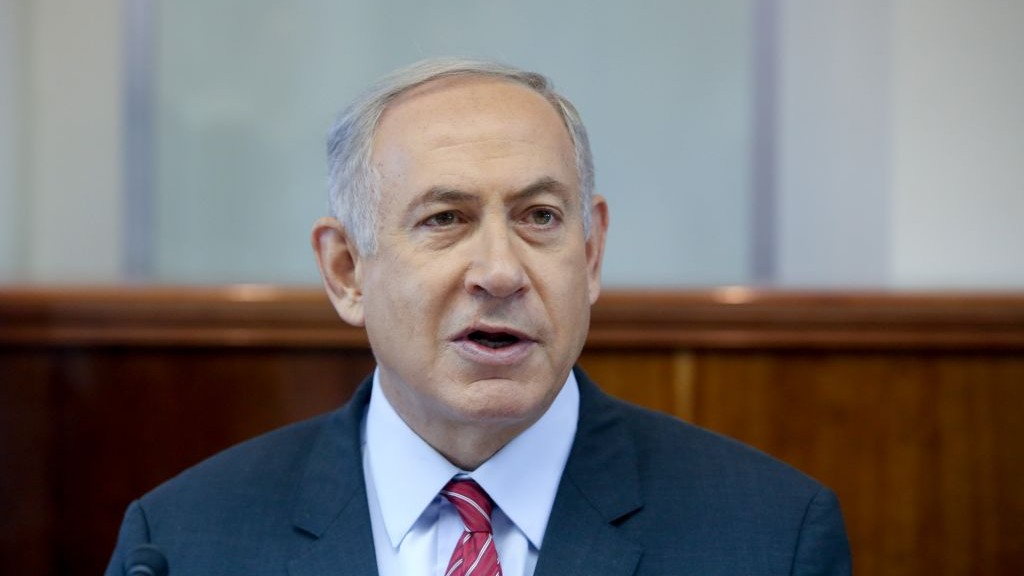
Prime Minister Benjamin Netanyahu leads the weekly cabinet meeting at the Prime Minister’s Office in Jerusalem on September 11, 2016. (Marc Israel Sellem/POOL)
According to the Muslim faith, Abraham’s almost-sacrificed son was Ishmael, while in Judaism, it is Isaac.
Get The Times of Israel's Daily Editionby email and never miss our top stories
The holiday continues for the next four days, and falls every year during the Muslim month of Dhu al-Hijjah, when Muslims perform the hajj pilgrimage to Mecca.
The Defense Ministry has announced that it will permit 100,000 West Bank Palestinians to visit family in Israel during Eid al-Adha, the Coordinator of Government Activities in the Territories, Major General Yoav Mordechai, announced on Facebook.
In addition, border checkpoints will operate for longer than usual to enable Palestinians, including Gazans, to travel abroad via Ben Gurion International Airport or Amman in Jordan. This will allow Muslims to make the hajj pilgrimage.
Advertisement
We can't do this work alone.
The war with Iran has been draining for all of us in Israel. But when I heard about a high casualty incident – ballistic missile impacts in Arad and Dimona that left nearly 200 people wounded – I drank a cup of coffee, packed a bag, and headed south.
There, I spoke with Shilgit, the head of an after-school program for underprivileged youth. Standing outside her destroyed center, Shilgit said it was a miracle that no children were hurt and spoke about the community coming together in the hours since.
As a Times of Israel reporter, I’m committed to telling stories of resilience like Shilgit’s. But my colleagues and I can't do this alone. If you value work like this,please consider joining our reader support group, The Times of Israel Community. Your financial support is essential to keep real human reporting like this going.
We’re really pleased that you’ve read X Times of Israel articles in the past month.
That’s why we started the Times of Israel - to provide discerning readers like you with must-read coverage of Israel and the Jewish world.
So now we have a request. Unlike other news outlets, we haven’t put up a paywall. But as the journalism we do is costly, we invite readers for whom The Times of Israel has become important to help support our work by joining The Times of Israel Community.
For as little as $6 a month you can help support our quality journalism while enjoying The Times of Israel AD-FREE, as well as accessing exclusive content available only to Times of Israel Community members.
Thank you, David Horovitz, Founding Editor of The Times of Israel