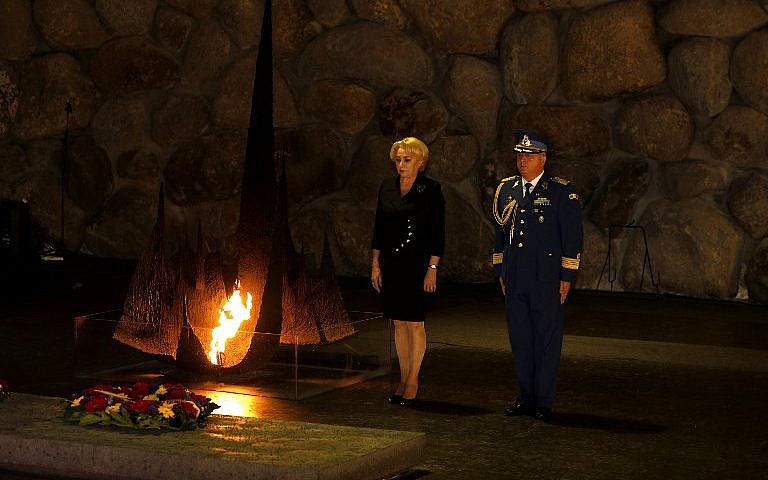
Romanian Prime Minister Viorica Dancila (L) lays a wreath at the Hall of Remembrance on April 25, 2018, during her visit to the Yad Vashem Holocaust Memorial museum in Jerusalem. (AFP Photo/Gali Tibbon)
BUCHAREST — Romania’s President Klaus Iohannis on Tuesday gave his green light to the creation of a Holocaust museum in Bucharest aimed at shedding light on the country’s controversial role during WWII.
The capital’s city council had initially rejected the plan in March, drawing accusations of anti-Semitism.
“The history of Jewish Romanians, their contribution to the country’s development and the tragedy experienced during the war… represent a legacy which was hidden from us for decades,” Iohannis said Tuesday at a ceremony attended by Shoa survivors.
“This museum will not so much bring answers as raise more questions,” he added.
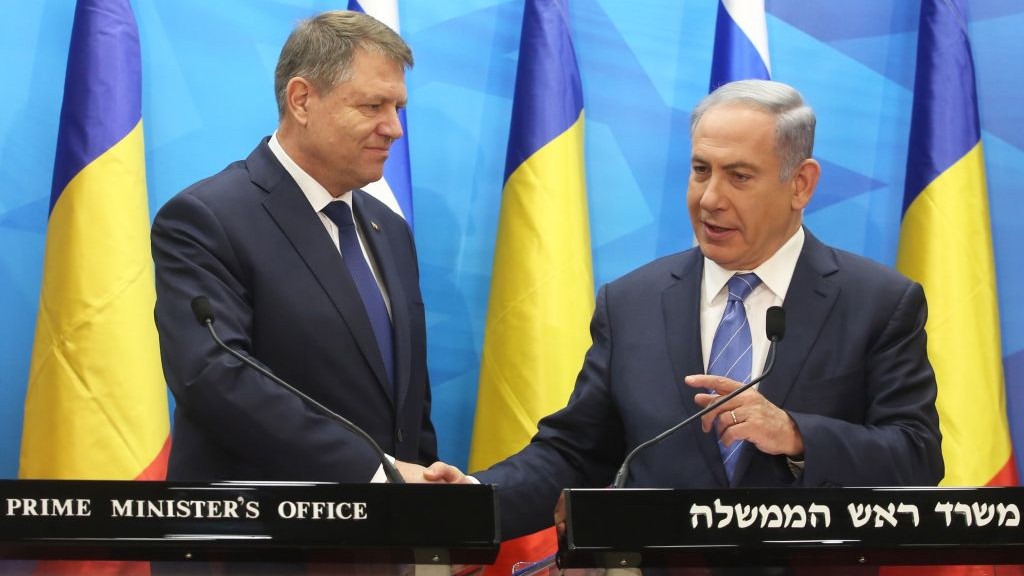
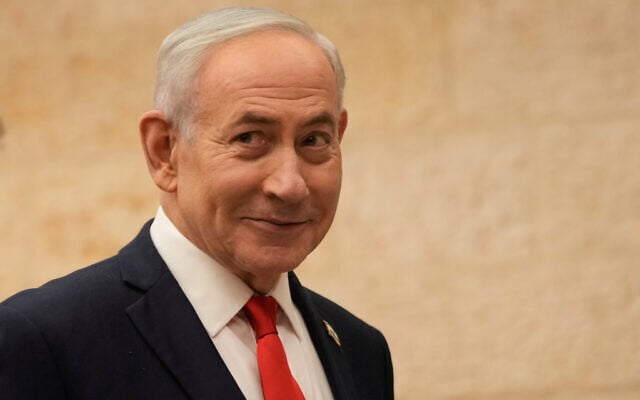
Benjamin Netanyahu (R) holds a joint press conference with Romanian President Klaus Iohannis in Jerusalem on March 7, 2016. Marc Israel Sellem/Pool)
The country had long denied in any responsibility in the Nazi atrocities, but in 2003 accepted to put in a place a panel of experts to investigate its role in the Holocaust.
Get The Times of Israel's Daily Editionby email and never miss our top stories
The panel, headed by Nobel Peace Prize winner Elie Wiesel, found that 280,000 Romanian Jews and 380,000 Ukrainian Jews died in Romania and territories under its control during the war, along with 11,000 Roma.
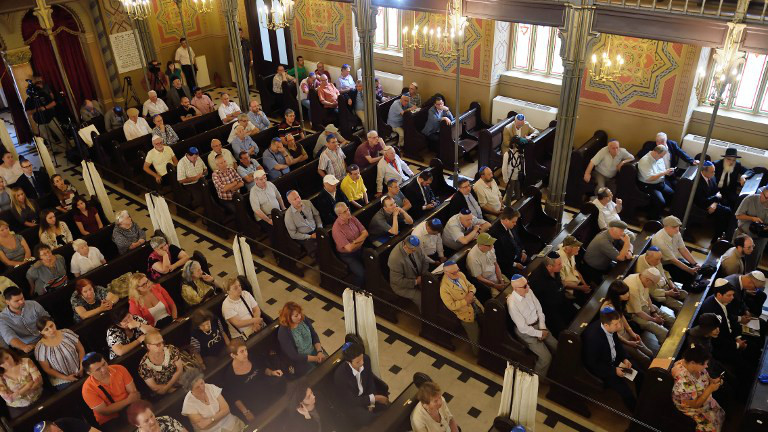
Romanian Jews attend a commemoration service for Holocaust survivor and Nobel Peace Prize winner Elie Wiesel, at Choral Temple in Bucharest on July 7, 2016. (AFP/Daniel Mihailescu)
Around 3,200 Jews still live in Romania, according to the last census in 2011.
The museum will be opened in central Bucharest and be managed by the Elie Wiesel National Institute for the Study of the Holocaust.
Advertisement
Help us report truthfully on social media
As a multimedia journalist, my job is to take the quality, fact-based journalism produced by The Times of Israel newsroom and make it accessible across every platform — from Instagram posts to podcasts to short-form videos.
This is how many, especially young people, consume news these days. But misinformation is rampant on social media. Our team at ToI produces accurate, responsible short-form reporting on Israel and the Jewish world.
If you believe in the importance of factual social media journalism, please consider joining our reader support group, The Times of Israel Community. Your financial support is essential to sustain responsible multimedia reporting.
We’re really pleased that you’ve read X Times of Israel articles in the past month.
That’s why we started the Times of Israel - to provide discerning readers like you with must-read coverage of Israel and the Jewish world.
So now we have a request. Unlike other news outlets, we haven’t put up a paywall. But as the journalism we do is costly, we invite readers for whom The Times of Israel has become important to help support our work by joining The Times of Israel Community.
For as little as $6 a month you can help support our quality journalism while enjoying The Times of Israel AD-FREE, as well as accessing exclusive content available only to Times of Israel Community members.
Thank you, David Horovitz, Founding Editor of The Times of Israel


 Add ToI as a Preferred Source on Google