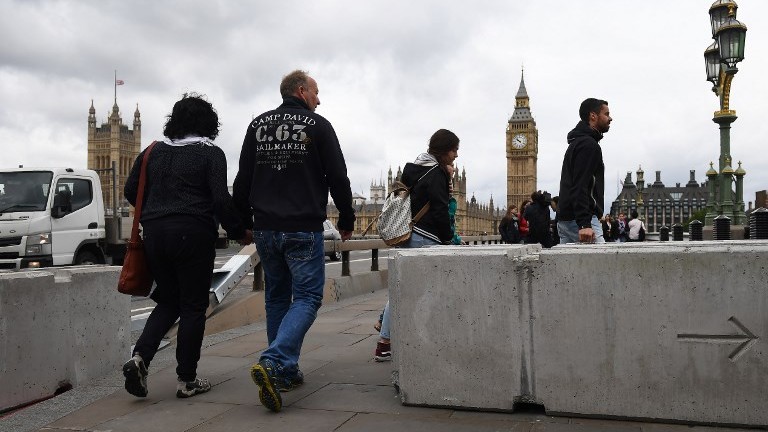
A concrete barrier between the road and the sidewalk is pictured after being installed on Westminster Bridge in London on June 5, 2017, in reaction to the recent terror attacks. (AFP Photo/Justin Tallis)
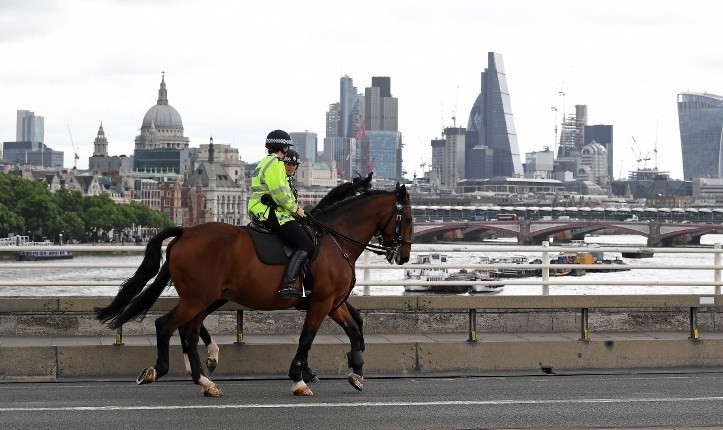
Metal barriers and concrete blocks have been installed on bridges in London following Saturday’s deadly London Bridge terror attack and a similar incident on Westminster Bridge close to the Houses of Parliament in March.
The commissioner of the Metropolitan Police, Cressida Dick, told the LBC Radio station, “This morning you will see some hostile vehicle blocking on some of our bridges…..We will have more armed policing on and near the bridges and people should be prepared for that.”
The barriers are on Westminster, Lambeth and Waterloo bridges in the capital.
Barriers were not installed on London Bridge, which was reopened to the public in time for the start of the working week on Monday.
Police on horses ride past a security barrier between the road and the sidewalk on Waterloo Bridge in London on June 5, 2017, installed in reaction to the recent terror attacks. (AFP Photo/Justin Tallis)
Islamic State claimed responsibility for Saturday’s attack in which seven people were killed and 48 people injured, 21 of them critically, when a van veered off the road and mowed down pedestrians on London Bridge before terrorists got out and stabbed passersby at nearby Borough Market.
Get The Times of Israel's Daily Editionby email and never miss our top stories
Just one day before Saturday’s attack, authorities had decided against installing barriers on London Bridge, according to British media reports.
In March, terrorist Khalid Masood murdered five people, running pedestrians over on Westminster Bridge before stabbing a police officer to death.
UK Prime Minister Theresa May on Monday said police have identified all the London Bridge attackers and that 11 people remain in custody for possible connections to the attack.
Advertisement
The threat level in the UK is to remain at “severe,” May said Monday, meaning an attack is highly likely.
Help us report truthfully on social media
As a multimedia journalist, my job is to take the quality, fact-based journalism produced by The Times of Israel newsroom and make it accessible across every platform — from Instagram posts to podcasts to short-form videos.
This is how many, especially young people, consume news these days. But misinformation is rampant on social media. Our team at ToI produces accurate, responsible short-form reporting on Israel and the Jewish world.
If you believe in the importance of factual social media journalism, please consider joining our reader support group, The Times of Israel Community. Your financial support is essential to sustain responsible multimedia reporting.
We’re really pleased that you’ve read X Times of Israel articles in the past month.
That’s why we started the Times of Israel - to provide discerning readers like you with must-read coverage of Israel and the Jewish world.
So now we have a request. Unlike other news outlets, we haven’t put up a paywall. But as the journalism we do is costly, we invite readers for whom The Times of Israel has become important to help support our work by joining The Times of Israel Community.
For as little as $6 a month you can help support our quality journalism while enjoying The Times of Israel AD-FREE, as well as accessing exclusive content available only to Times of Israel Community members.
Thank you, David Horovitz, Founding Editor of The Times of Israel


 Add ToI as a Preferred Source on Google