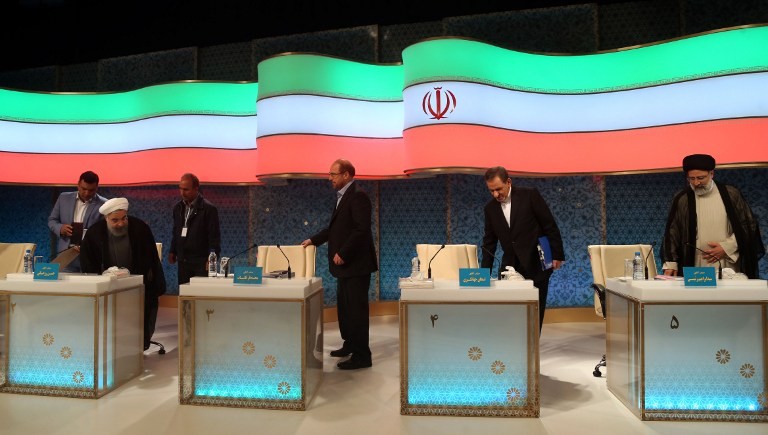
Iranian presidential candidates, left to right, Hassan Rouhani, Mohammad Baqer Qalibaf, Eshaq Jahangiri and Ebrahim Raisi attend a live debate on state TV in Tehran on April 28, 2017. (AFP/Jamejamonline/Mehdi Dehghan)
TEHRAN, Iran (AP) — Tehran’s mayor and presidential candidate Mohammad Bagher Qalibaf accused on Friday President Hassan Rouhani’s administration of dishonesty, mismanagement and supporting the rich at the expense of the poor in the first debate between the six presidential candidates.
During the first of three planned debates ahead of the May 19 elections, Qalibaf criticized the Rouhani administration, saying social and environmental problems remained unsolved because of “Your weak management. Your old and traditional management.”
Qalibaf’s other criticisms of Rouhani’s administration included that it does not believe in privatization and had failed to fulfil a promise to create four million jobs — a promise Rouhani, interrupting, denied making.
Rouhani’s senior vice-president and presidential candidate responded by saying that Qalibaf and other hard-liners did not voice concern for the “squandering of some $700 billion” during president Ahmadinejad’s administration.
Rouhani also accused Qalibaf of issuing false statements.
Get The Times of Israel's Daily Editionby email and never miss our top stories
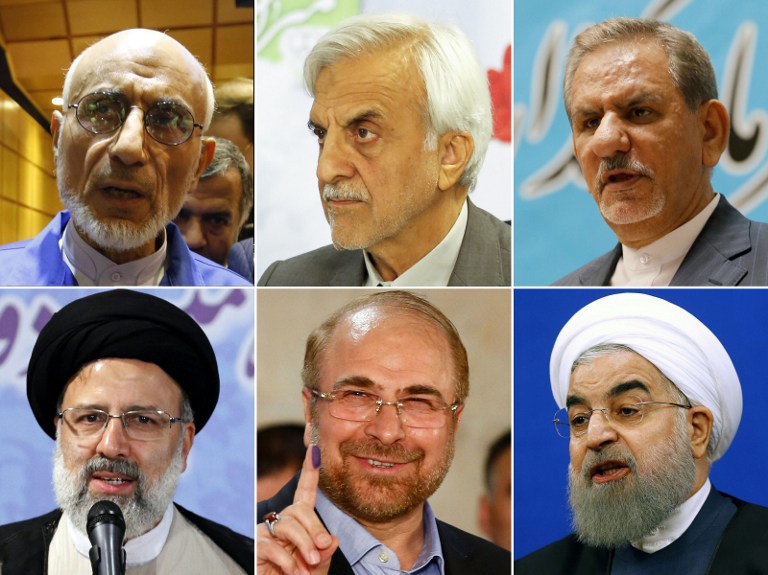
This combination of pictures created on April 21, 2017 shows the main contenders for Iran’s upcoming presidential elections: top, left to right, Head of the Islamic Coalition Party’s Central Council and former Minister of Culture, Mostafa Mirsalim on April 11, 2017, former Iranian minister Mostafa Hashemitaba registering his candidacy on April 13, 2017, Iran’s first Vice-President, Eshaq Jahangiri speaking during a conference on investment in Iran’s tourism sector at the International Conference Center in Tehran on October 2, 2016, (bottom L-R) Iranian cleric and head of the Imam Reza charitable foundation, Ebrahim Raisi, delivering a speech after registering his candidacy for the presidential elections in Tehran on April 14, 2017, Mohammad Bagher Ghalibaf, Mayor of Tehran, showing his ink-stained finger after registering his candidacy for the presidential elections at the ministry of interior in Tehran on April 14, 2017 and Iranian President Hassan Rouhani giving a press conference in Tehran on April 10, 2017. (AFP/ ATTA KENARE AND STR)
He went to added that Iran needed a $200 billion investment in its oil industry, and that there was a need for more investment to create more jobs.
Qalibaf, 55, a conservative veteran member of the elite Revolutionary Guard, is running for president for the third time after unsuccessful bids in 2005 and 2013.
His candidacy could, however, be marred by his support for hardliners who stormed the Saudi embassy in 2016, leading to a severing of diplomatic ties between Tehran and Riyadh. A January fire that engulfed Tehran’s Plasco building, killing dozens, is also a significant blemish on his term as mayor.
Advertisement
Other candidates Ebrahim Raisi, Mostafa Mirsalim and Mostafa Mirsalim did not raise any controversial issues, relaying simple messages that they will support the poor.
Both Qalibaf and Raisi promised to increase threefold the current monthly $13 “cash-for-poor” scheme.
Responses to the debate from the city’s residents varied. Zaha Mohammadi, a 39-year-old homemaker, said Qalibaf won the debate “because he spoke about the people’s problems.”
Akbar Souri, a 26-year-old taxi driver, said he wasn’t planning to vote, but “Qalibaf’s wrong comments made me crazy and want to vote for Rouhani or Jahangiri.”
Fatemeh Rahimi, a 44-year-old teacher, said it was “shameful of Qalibaf to offer money for votes.”
“Is it an auction?” she added.
We can't do this work alone.
The war with Iran has been draining for all of us in Israel. But when I heard about a high casualty incident – ballistic missile impacts in Arad and Dimona that left nearly 200 people wounded – I drank a cup of coffee, packed a bag, and headed south.
There, I spoke with Shilgit, the head of an after-school program for underprivileged youth. Standing outside her destroyed center, Shilgit said it was a miracle that no children were hurt and spoke about the community coming together in the hours since.
As a Times of Israel reporter, I’m committed to telling stories of resilience like Shilgit’s. But my colleagues and I can't do this alone. If you value work like this,please consider joining our reader support group, The Times of Israel Community. Your financial support is essential to keep real human reporting like this going.
We’re really pleased that you’ve read X Times of Israel articles in the past month.
That’s why we started the Times of Israel - to provide discerning readers like you with must-read coverage of Israel and the Jewish world.
So now we have a request. Unlike other news outlets, we haven’t put up a paywall. But as the journalism we do is costly, we invite readers for whom The Times of Israel has become important to help support our work by joining The Times of Israel Community.
For as little as $6 a month you can help support our quality journalism while enjoying The Times of Israel AD-FREE, as well as accessing exclusive content available only to Times of Israel Community members.
Thank you, David Horovitz, Founding Editor of The Times of Israel