

The wave that never was: Did Israelis’ ‘common sense’ help stop a new COVID spike?
In March, when case numbers rose again, people didn’t wait for rules, but rather started to take more care; experts say this combined with high immunity levels to reduce infection

 Add ToI as a Preferred Source on Google
Nathan Jeffay is The Times of Israel's health and science correspondent
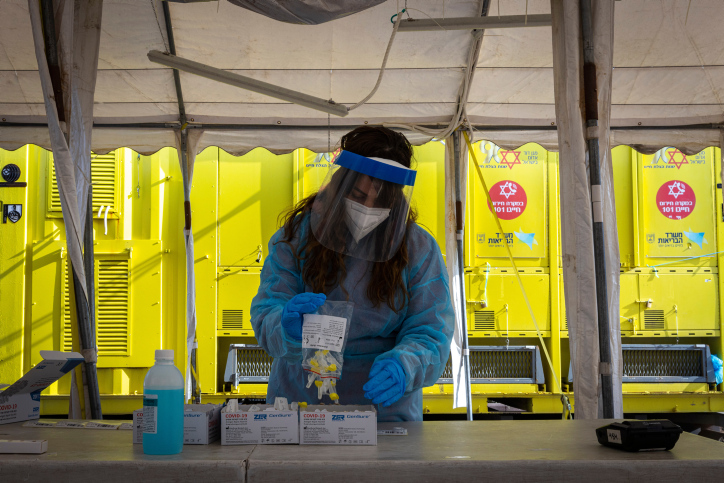
Fears of a new coronavirus wave are subsiding, with case numbers shrinking again after a bump, and the transmission rate back under 1. This good news points to the power of the Israeli people to respond to the virus based on common sense.
After Israel’s intense Omicron wave, which peaked in late January, case numbers dropped for some time. But in mid-March they began to rise, leading to concerns of a sixth wave.
Experts pointed to the highly transmissible BA.2 subvariant of Omicron, the impact of rolling back restrictions, and biological factors that aren’t understood. Politicians watched the statistics with concern.
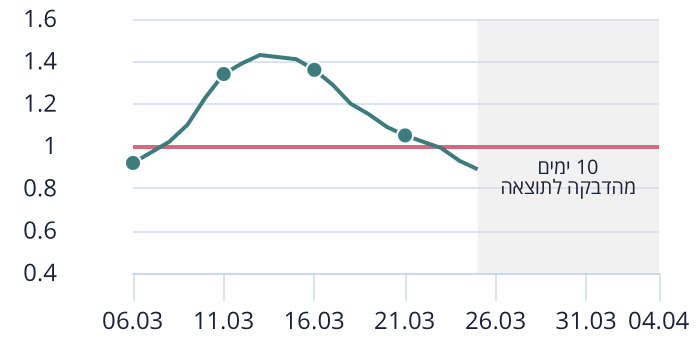
But on Sunday, the transmission rate fell to 0.98, reflecting its first drop below 1 in two weeks. The latest figure, released on Wednesday, is 0.89.
That was important, as the transmission rate is used to gauge the spread of the virus, with any reading above 1 indicating it is accelerating, and any below 1 that it’s slowing.
The statistic is calculated based on data from 10 days earlier, so it indicated that a decline in transmission was already well underway.
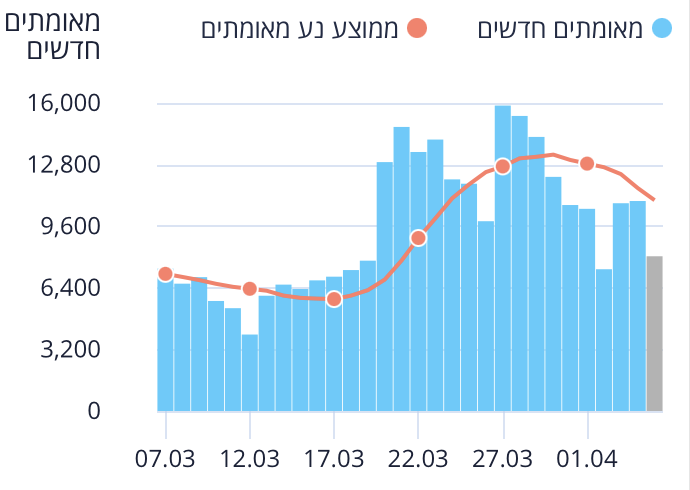
The number of new daily cases has also shown a decrease. Based on a moving average, the recent peak was on March 30, with 13,381 cases. The number has now fallen to 10,952.
Part of the explanation is that huge numbers of people caught Omicron and were left with immunity, which means that the virus has limited targets left to infect — at least for now while the protection of recovered people is high.
But there is also a behavioral explanation.
“What we saw was people responding to the news, acting more carefully, taking care to wear masks, and looking out for older people,” Prof. Nadav Katz told The Times of Israel, noting that the spike subsided without the imposition of any new rules, and soon after the softening of regulations.
“We saw that behavioral factors can be really powerful — as powerful if not more so than rules,” added Katz, a leading member of a Hebrew University team that monitors and models coronavirus statistics. “You can instruct people to be careful and may succeed, but if people are motivated to be careful based on the reality they see, it can really be very effective.”
The leading epidemiologist Prof. Nadav Davidovitch agreed. He said the rise in cases was limited due to the fact that immunity levels are high — a point that Katz also made. But he said that “common sense” had a major impact.
“People now aren’t waiting for rules before they respond,” Davidovitch, a Ben Gurion University academic and leader of Israel’s doctors’ union, told The Times of Israel.
“There are many commonsense reactions, and despite the pandemic fatigue, people have started to react based on these reactions. What we’re seeing is in a sense a normalization of COVID, and acceptance of the fact we’re living with it, which means that when cases start to rise people know how to react, and conduct themselves accordingly.”
Katz said that after the intense wave of December and January, and following the latest spike, he is optimistic. “If there are no significant variants on the horizon, it seems we’re in a good place,” he said.










The Times of Israel Community.