

Trump and the other wall
The US president’s visit to the region is all anyone’s talking about, but the Hebrew-language media wonders if the American leader still has any surprises up his sleeve
Adiv Sterman is a breaking news editor at The Times of Israel.
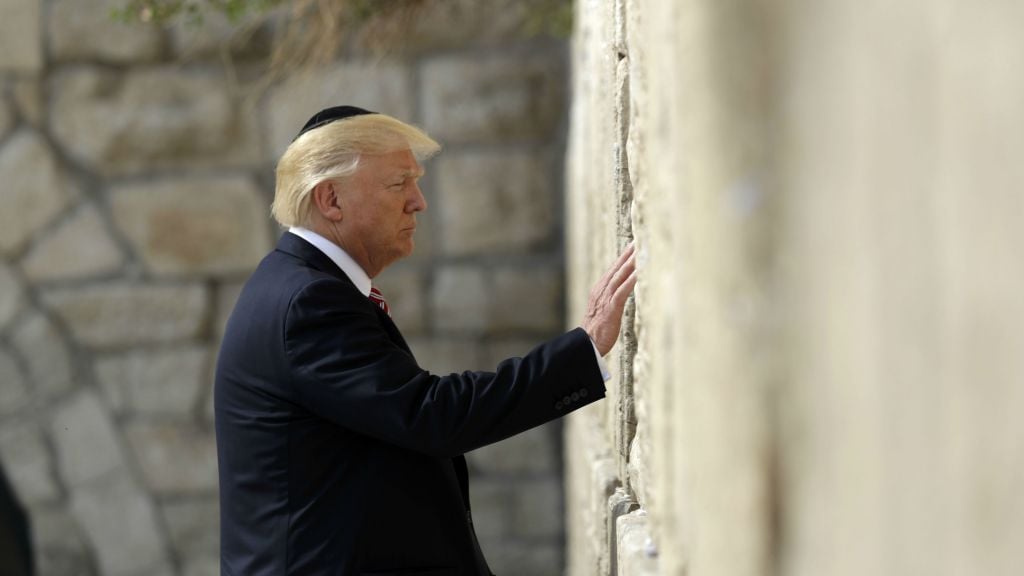
Regardless of one’s opinions about the current US administration, there is no denying that the widely circulated photograph of US President Donald Trump wearing a traditional black kippa atop his head as he stands alone at the Western Wall plaza, lightly touching the ancient stones with his hands, is a powerful image.
“We are allies,” reads Yedioth Ahronoth’s headline, shown alongside the photo of Trump, while Israel Hayom titles an almost identical version of the picture as “a friend at the Western Wall.” The photograph serves as a metaphor for the country’s two major Hebrew-language dailies’ interpretation of the president’s trip to the region as a sign of Trump’s respect and admiration for Benjamin Netanyahu and his government. At the same time though, following Trump’s much-noticed statements concerning a renewed US attempt to kickstart peace talks between Israel and the Palestinians as well as his warming up to the Saudi leadership, analysts and reporters try to decipher the president’s true intentions for the region, and wonder how cooperation between Netanyahu and the American leader will hold up given these plans.
“Last night, the streets around the [Jerusalem] neighborhoods of Talbiyeh and Katamon were empty [due to Trump’s security requirements]… The Waze app solved Jerusalemites’ traffic hardships, progress has affected even a city as old as Jerusalem,” writes Yedioth contributor Yoaz Hendel. “Unfortunately, no app has yet been found which can solve the hardships of [Trump’s] visit. The uncertainty that Trump brings behind the smiles. The question marks surrounding the Israeli-Palestinian conflict.”
Hendel, who formerly served as director of communications and public diplomacy for Netanyahu, further notes that Trump has just announced arms deals and investments worth hundreds of billions of dollars with Saudi Arabia, and voices concerns regarding the long-run implications of the move on Israel’s security. “The shared interests of the Sunni states and Israel against Iran must not hide the face that Saudi Arabia is a source of the spread of radical Islam in past decades,” Hendel writes. “The average age of the [Saudi] king and his heirs is a source of instability, and Israel can’t accept the Arab initiative.”
Shimon Shiffer, another leading columnist at Yedioth, asserts that Trump is serious about striking a peace deal between the Israelis and the Palestinians, and is preparing to pressure Netanyahu on the matter in the very near future. “According to trustworthy sources, Trump is expected to hand the bill [of demands] to Netanyahu soon,” Sheffer writes. “[The president] has been convinced that there is a partner [for peace] on the Arab side — and he is unsure if there is one on the Israeli side. During the two days Trump spent in Riyadh, he has become sold on the idea that if Israel seeks to reach an agreement with its Arab neighbor states and join the coalition against Iran, it must pay up in Palestinian coin.”
Israel Hayom focuses less on peace and more on the president’s actions since arriving in the holy land. “Especially in the Middle East, symbols have not only a spiritual, religious, or cultural significance, but also an existential, practical, and political significance,” writes Dror Eydar, one of the daily’s leading columnists. “For this reason, a visit to the Western Wall on behalf of a serving US president is significant in terms of [the Jewish] historical, religious and political affinity with the land of Israel in its entirety.”
In Haaretz, typically skeptical and critical of Trump and his administration, some of the analysts sound surprisingly optimistic about the president’s prospects of promoting peace between Israel and the Palestinians, as well as bringing stability to the region.
“Trump has already reintroduced the word peace to the Israeli dictionary,” Barak Ravid, Haaretz’s diplomatic correspondent, writes. Chemi Shalev, the paper’s US editor, interprets Trump visit to the Western Wall as a tactical choice aimed to ease the Israeli public’s nerves. “If a prerequisite to making peace is gaining Israeli citizens’ trust, so that they will have a hard time rejecting a hard-to-swallow proposal, then Trump has chosen the right path,” Shalev writes. “He can always wave the iconic photos of him and his pious daughter at the Western Wall.”
The second aspect of Trump’s visit to Israel that garnered the most attention is rabble-rousing and ever-controversial Likud MK Oren Hazan’s sneaky selfie with the US president. As Trump passed by him during the welcoming ceremony at Ben Gurion Airport, the never-shy Hazan whipped out his cellphone and suggested taking a photograph with Trump. A bewildered-looking Trump agreed and the MK took the snap, although, amusingly, Netanyahu tried to prevent it by gently pushing Hazan’s arm.
The Hebrew papers almost unanimously refer to Hazan’s selfie ploy as an “embarrassment,” echoing the sentiments of many Israelis across the country. Yedioth, however, goes slightly meta in its criticism, implying that the incident reveals the “face of the nation.” The daily even dedicates a special section to internet memes inspired by the Hazan-Trump selfie.
Hazan, on his part, was completely unfazed by the charges of the “disgrace” he brought upon the people of Israel. “I will continue to accept the love of the nation,” Hazan said, according to Yedioth. “I got 12,000 ‘likes’ for my selfie with Trump. It is time for all the elites and old-school politicians to understand that there is a new kind of politics. Protocols are important, but sometimes you have to think outside of the box. That’s what I did.”


The Times of Israel Community.