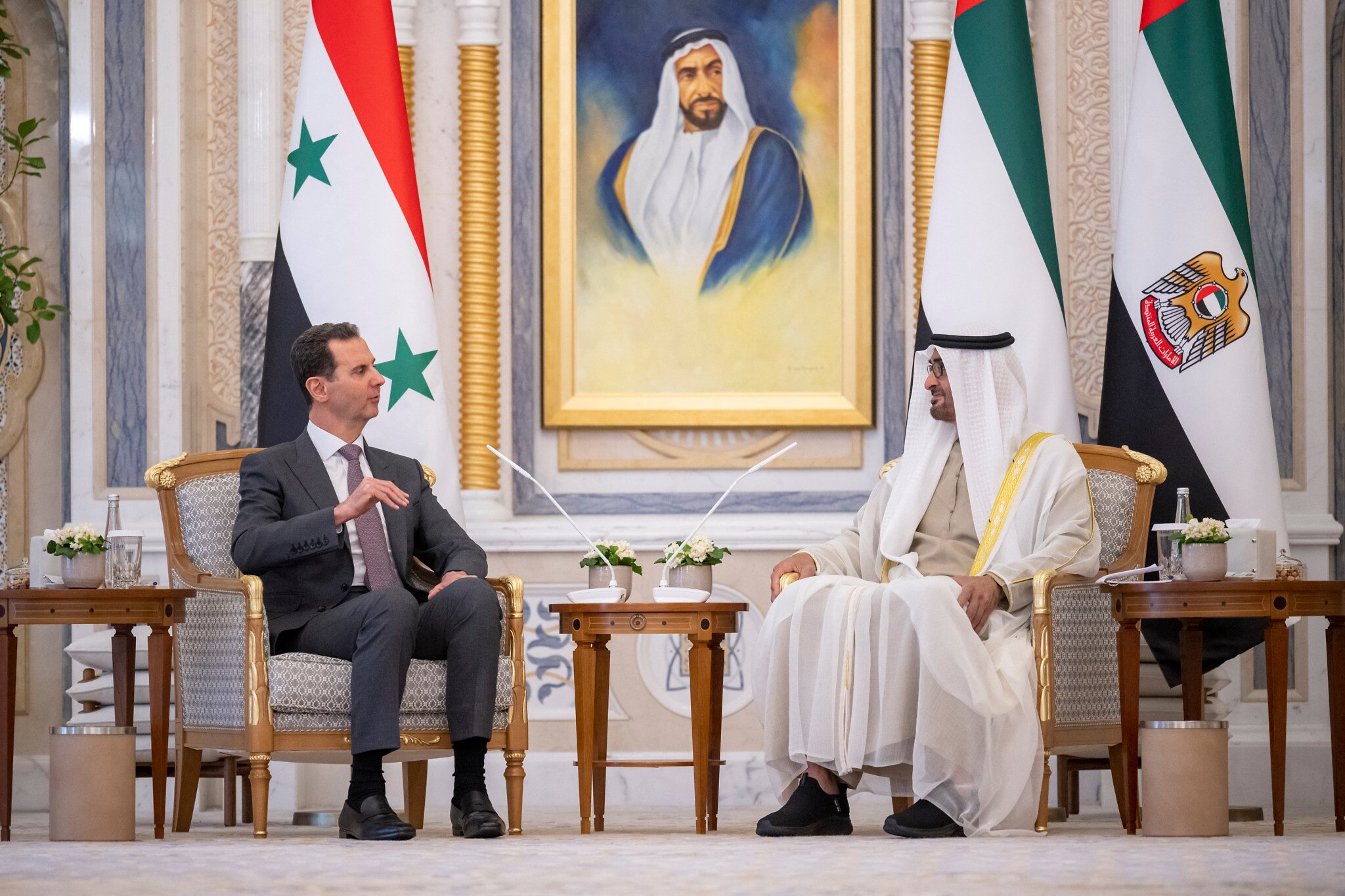
Emirati President Sheikh Mohamed bin Zayed al-Nahyan (R) meeting his Syrian counterpart Bashar al-Assad in Abu Dhabi, March 19, 2023. (Rashed Al-Mansoori/UAE Presidential Court/AFP)
The United Arab Emirates has dispatched an ambassador to Damascus for the first time since the Syrian civil war erupted in 2011, Syria’s state media reported on Tuesday, in a new signal of Syria’s warming ties with the Arab region.
Incoming Emirati envoy Hassan al-Shehi presented his credentials to Syria’s Foreign Affairs Minister Faysal al-Meqdad at the Foreign Ministry on Tuesday.
Syria has been slowly re-establishing diplomatic ties with the Arab region in recent years after many recalled their envoys and closed embassies in reaction to Syrian President Bashar al-Assad’s crackdown on protests against him in 2011.
Saudi Arabia, Qatar, and, to a lesser extent, the UAE, then backed rebels against Assad — but Abu Dhabi has rebuilt ties with Damascus in recent years.
Assad visited the UAE in 2022 — his first trip to an Arab state since the civil war erupted — and again in 2023 after a devastating earthquake killed thousands in Syria.
Get The Times of Israel's Daily Editionby email and never miss our top stories
The tragedy cleared the way for a thaw in Arab ties with Assad and months later, the Arab League reversed its more than decade-long suspension of Syria’s membership.
Syrian President Bashar Assad, left, speaks with UAE President Sheikh Mohammed bin Zayed Al-Nahyan, in Abu Dhabi, United Arab Emirates, Sunday, March 19, 2023. (Syrian Presidency via AP)
Regional powerhouse Saudi Arabia, which last year reached an agreement with rival Iran to restore bilateral ties, has opened the door for possible dialogue with Damascus, especially on humanitarian issues.
Syrian daily Al-Watan reported that Riyadh would be sending an ambassador to Damascus soon.
Advertisement
Hundreds of thousands of people have died in the Syria conflict, which spiraled out of an uprising against Assad, splintering the country and drawing in numerous foreign powers.
Help us report truthfully on social media
As a multimedia journalist, my job is to take the quality, fact-based journalism produced by The Times of Israel newsroom and make it accessible across every platform — from Instagram posts to podcasts to short-form videos.
This is how many, especially young people, consume news these days. But misinformation is rampant on social media. Our team at ToI produces accurate, responsible short-form reporting on Israel and the Jewish world.
If you believe in the importance of factual social media journalism, please consider joining our reader support group, The Times of Israel Community. Your financial support is essential to sustain responsible multimedia reporting.
We’re really pleased that you’ve read X Times of Israel articles in the past month.
That’s why we started the Times of Israel - to provide discerning readers like you with must-read coverage of Israel and the Jewish world.
So now we have a request. Unlike other news outlets, we haven’t put up a paywall. But as the journalism we do is costly, we invite readers for whom The Times of Israel has become important to help support our work by joining The Times of Israel Community.
For as little as $6 a month you can help support our quality journalism while enjoying The Times of Israel AD-FREE, as well as accessing exclusive content available only to Times of Israel Community members.
Thank you, David Horovitz, Founding Editor of The Times of Israel


 Add ToI as a Preferred Source on Google