UN envoy calls for ‘steps’ toward solution for war-torn Syria
Geir Pedersen, in Damascus with Foreign Minister Mekdad: ‘My message is that there is another possibility… to start to move forward,’ after a decade of civil war
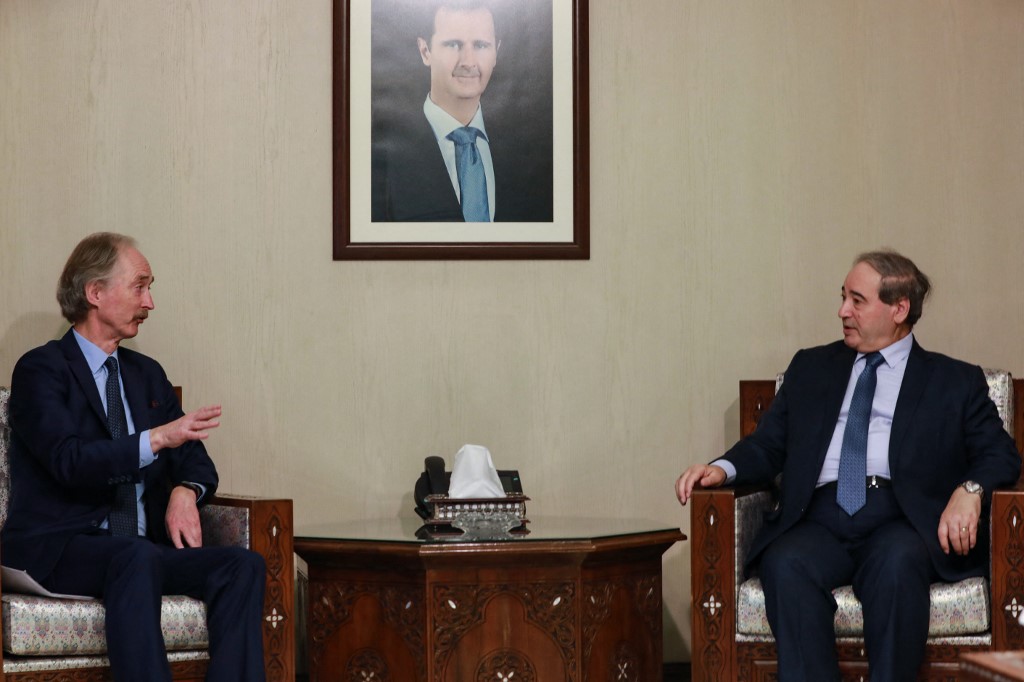
Syrian Foreign Minister Faisal Miqdad (R) receives the United Nations Special Envoy for Syria Geir Pedersen (L) in the capital Damascus, on December 12, 2021. (LOUAI BESHARA / AFP)
DAMASCUS, Syria — UN special envoy Geir Pedersen called Sunday for a “step for step” approach in finding a political solution to Syria’s conflict, following his tour of Europe, the US, and Arab states.
Several rounds of United Nations-brokered negotiations in Geneva since 2019 between the government and opposition aimed at forging a new constitution have so far failed.
“I think there is a possibility now to start to explore what I call ‘a step for step’ approach, where you put on the table steps that is defined with precisions, that is verifiable, that hopefully can start to build some trust,” he said after talks in Damascus with Foreign Minister Faisal Mekdad.
“My message is that there is another possibility to start to explore possible avenues, to start to move forward on this process,” he told journalists.
Pedersen has toured all the main foreign players with a stake in Syria’s conflict.
Get The Times of Israel's Daily Editionby email and never miss our top stories
With major fighting subsiding since 2020, Damascus had made inroads into easing its international isolation, especially with fellow Arab states.
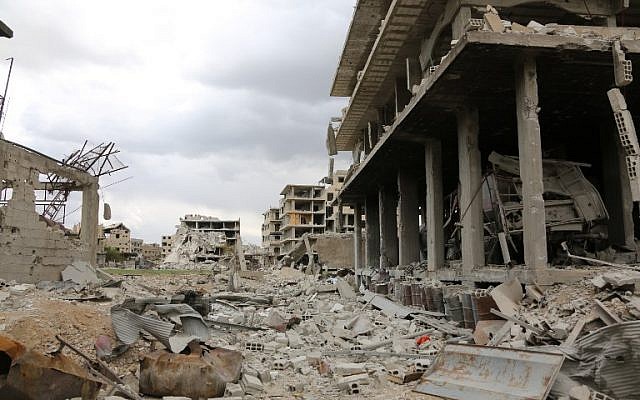
Illustrative: Destruction in the former rebel-held town of Saqba in the Eastern Ghouta region on the outskirts of the Syrian capital Damascus on April 10, 2018. (AFP Photo/Stringer)
“I think we should now analyze not only the Arabs, but also the American position, the Europeans, the Turkish, the Russians, the Iranians,” the UN envoy said.
The war in Syria is estimated to have killed nearly half a million people and displaced millions more, since it began with a brutal crackdown on anti-government protests in 2011.
Advertisement
It quickly spiraled into a complex conflict that pulled in numerous actors, including jihadist groups and foreign powers.
Throughout the civil war, the UN has been striving to nurture a political resolution.

We can't do this work alone.
The war with Iran has been draining for all of us in Israel. But when I heard about a high casualty incident – ballistic missile impacts in Arad and Dimona that left nearly 200 people wounded – I drank a cup of coffee, packed a bag, and headed south.
There, I spoke with Shilgit, the head of an after-school program for underprivileged youth. Standing outside her destroyed center, Shilgit said it was a miracle that no children were hurt and spoke about the community coming together in the hours since.
As a Times of Israel reporter, I’m committed to telling stories of resilience like Shilgit’s. But my colleagues and I can't do this alone. If you value work like this,please consider joining our reader support group, The Times of Israel Community. Your financial support is essential to keep real human reporting like this going.
We’re really pleased that you’ve read X Times of Israel articles in the past month.
That’s why we started the Times of Israel - to provide discerning readers like you with must-read coverage of Israel and the Jewish world.
So now we have a request. Unlike other news outlets, we haven’t put up a paywall. But as the journalism we do is costly, we invite readers for whom The Times of Israel has become important to help support our work by joining The Times of Israel Community.
For as little as $6 a month you can help support our quality journalism while enjoying The Times of Israel AD-FREE, as well as accessing exclusive content available only to Times of Israel Community members.
Thank you, David Horovitz, Founding Editor of The Times of Israel